
Virginia Beach, VA-NC · metro guide
Solar Panels in Virginia Beach: Wind Ratings, Salt, and a Changing Credit
The array has to be engineered like a coastal roof, because that is what it is.
Metro snapshot
Virginia Beach in numbers
Sources named below each block
- Population
- 1.8M
- Households
- 707K
- Housing units
- 764K
- People / household
- 2.53
- population ÷ households
Owner-occupied homes 63%
The rest are rented. Owners are the ones who commission most exterior work.
Single-family detached 61%
Detached houses carry their own roof, gutters and exterior walls.
Built before 1980 44%
Older housing stock shapes what fails first: gutters, flashing, pipe material.
Season
The year in Virginia Beach
- Precipitation
- 49.2 in
- Snowfall
- 6.2 in
Average temperature by month, °F — the shape of the year is what decides when exterior work gets done.
Precipitation by month, inches.
Snowfall by month, inches.
| Month | Average temperature (°F) | Precipitation (in) | Snowfall (in) |
|---|---|---|---|
| January | 42.2°F | 3.41 in | 3.2 in |
| February | 44.2°F | 2.90 in | 1.5 in |
| March | 50.7°F | 3.69 in | 0.4 in |
| April | 60.1°F | 3.37 in | 0.0 in |
| May | 68.3°F | 3.78 in | 0.0 in |
| June | 76.7°F | 4.43 in | 0.0 in |
| July | 81.1°F | 6.08 in | 0.0 in |
| August | 79.2°F | 5.88 in | 0.0 in |
| September | 74.0°F | 5.40 in | 0.0 in |
| October | 63.7°F | 3.86 in | 0.0 in |
| November | 53.3°F | 3.10 in | 0.0 in |
| December | 46.1°F | 3.28 in | 1.1 in |
NOAA 1991–2020 climate normals, station NORFOLK INTL AP, VA US (USW00013737). Station observations, not a metro-wide average — a metro that spans a mountain range can differ by more than this record shows.
Population, households and housing shares: U.S. Census Bureau, American Community Survey 2024 5-year estimates, metropolitan statistical area.
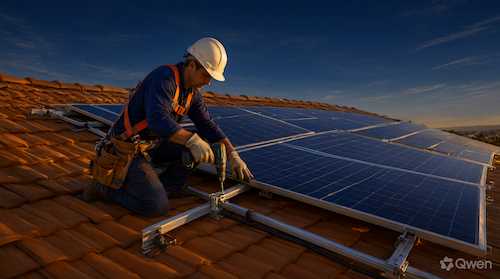
Solar on the Virginia coast is a wind and corrosion project before it is an energy project. An array is a permanent attachment to the most exposed surface of the building, in a metro that sees tropical systems and nor'easters, in air that corrodes every ferrous fitting it touches. None of that makes solar a bad idea here — the sun is adequate and 44.2% of the housing is old enough to have a roof that deserves assessment anyway — but it does mean the questions to ask are about engineering and about what happens in a storm.
Design wind speed and the attachment detail
Ask what wind speed the mounting is engineered for, how each penetration is flashed, and whether the array is set back from ridges and edges where wind pressure is highest. The failure that matters in practice is usually not the panel leaving the roof but a penetration leaking a season later. Ask for photographs of the finished flashing, keep them, and make sure the design accounts for the exposure of the specific lot — an oceanfront property and a sheltered inland one are not the same problem.
Salt and the hardware around the array
Racking, clamps, bolts and grounding components all live outdoors in salt air for decades. Ask whether the mounting system is specified for a coastal environment, whether the fasteners are corrosion-resistant, and what the warranty says about corrosion as distinct from mechanical failure. This is also worth raising with your insurer, since corrosion of a mounting system is a different conversation from wind damage.
Roof age, storms, and insurance
A covering near the end of its life is a bad host for an array, and in this market the roof may be replaced after a storm long before the panels reach the end of theirs. Ask how old the roof is, what its remaining service life is judged to be, and whether the installer will put that in writing. Ask also who pays for removal and reinstallation if the roof is replaced on a claim — the answer is usually the homeowner, which is a real cost to plan for.
Heat and humidity take their share
Module output falls as cell temperature rises, and coastal humidity reduces the clear-sky irradiance that generic models assume. Ask what cell temperature and weather data the estimate used, whether the mounting leaves an air gap behind the modules, and how the seasonal profile looks. A proposal showing flat output across the year is not modelling this climate.
The export credit has been reduced in Virginia
Virginia's rules for crediting exported solar have been revised, with the value of exported energy reduced relative to retail. The terms that apply depend on when the system is interconnected, which makes the application timeline a financial variable. Ask who files the interconnection request, what the current credit is worth, whether credits carry over or expire, and what fixed charges remain. When exports are worth less, the design should focus on what the household consumes while the array is producing.
What to ask a coastal installer
Where this page stops
No prices, incentives or production figures are published here, because none can be produced honestly without a site assessment. Roof condition and structural capacity require inspection, and insurance, financial and regulatory questions belong to a qualified adviser, the insurer and the utility.
Virginia Beach metro context
The 2024 ACS 5-year estimates count about 1.79 million residents in 707,408 households across 763,678 housing units, with 63.4% owner-occupied and 60.5% single-family detached. About 44.2% of units were built before 1980, so roof condition varies considerably across the stock being quoted. A climate station is not reported for this metro in the site dataset, so no temperature or wind normals appear on this page.
Virginia Beach housing and ownership indicators
| Indicator | Value | Source |
|---|---|---|
| Owner-occupied share | 63.4% | U.S. Census Bureau |
| Single-family detached share | 60.5% | U.S. Census Bureau |
| Housing units built before 1980 | 44.2% | U.S. Census Bureau |
| Housing units | 763,678 | U.S. Census Bureau |
| Metro households | 707,408 | U.S. Census Bureau |
| Metro population | 1,787,235 | U.S. Census Bureau |
No climate normals are shown because no station record is held for this metro in the site dataset. Wind exposure and salt effects depend on the location of the property relative to the ocean and the bay.
Frequently Asked Questions
Can solar survive a coastal storm here?
Properly engineered mounting is designed for the applicable wind loads, and the quality of the attachments and flashing decides the outcome. Ask for the design wind speed and the corrosion specification, and confirm the array is covered by your insurance.
Does salt damage solar panels?
The glass and frame are designed for outdoor exposure, but the racking, bolts and grounding components are where corrosion matters. Ask whether the system is specified for coastal conditions and what the warranty says about corrosion.
What if my roof is replaced after a storm?
The array has to come off and go back on, and that cost usually falls to the homeowner rather than the roofing claim. It is one more reason to replace a roof that is near the end of its life before installing solar.
Is solar still worth it after the export credit was cut?
It can be, but the value shifts toward the electricity the household uses while the array is producing. Ask for a monthly comparison of production against consumption, and for the exported portion to be valued separately rather than blended into one savings figure.
How much does heat reduce output?
Predictably, and the amount depends on the module's temperature coefficient and on how hot the cells run. Coastal humidity adds to the effect by reducing the clear-sky conditions that generic estimates assume.
Do I need permission or a review to install?
Permits are required, and some localities or districts add review for visible installations. Ask the installer which approvals apply to the address, and confirm with the local authority rather than relying on the contractor's summary.
Sources and review date
- American Community Survey 2024 5-year estimates (CBSA tables) — U.S. Census Bureau, 2024 ACS 5-year estimates.
Reviewed on 2026-11-18.
Other Home Services in Virginia Beach-Norfolk-Newport News
All guides for the Virginia Beach-Norfolk-Newport News metro area