
Cincinnati, OH-KY-IN · metro guide
Electrical in Cincinnati: Old Services in Older Homes
In a metro where most houses predate 1980, the panel is often the newest thing in a very old electrical system.
Metro snapshot
Cincinnati in numbers
Sources named below each block
- Population
- 2.3M
- Households
- 907K
- Housing units
- 967K
- People / household
- 2.50
- population ÷ households
Owner-occupied homes 68%
The rest are rented. Owners are the ones who commission most exterior work.
Single-family detached 66%
Detached houses carry their own roof, gutters and exterior walls.
Built before 1980 56%
Older housing stock shapes what fails first: gutters, flashing, pipe material.
Season
The year in Cincinnati
- Precipitation
- 45.3 in
- Snowfall
- 23.3 in
Average temperature by month, °F — the shape of the year is what decides when exterior work gets done.
Precipitation by month, inches.
Snowfall by month, inches.
| Month | Average temperature (°F) | Precipitation (in) | Snowfall (in) |
|---|---|---|---|
| January | 31.4°F | 3.30 in | 7.7 in |
| February | 34.7°F | 3.17 in | 6.7 in |
| March | 43.6°F | 4.16 in | 3.4 in |
| April | 54.6°F | 4.53 in | 0.4 in |
| May | 64.1°F | 4.67 in | 0.0 in |
| June | 72.3°F | 4.75 in | 0.0 in |
| July | 75.9°F | 3.83 in | 0.0 in |
| August | 74.9°F | 3.43 in | 0.0 in |
| September | 68.1°F | 3.11 in | 0.0 in |
| October | 56.2°F | 3.35 in | 0.2 in |
| November | 44.4°F | 3.23 in | 0.8 in |
| December | 35.6°F | 3.73 in | 4.1 in |
NOAA 1991–2020 climate normals, station CINCINNATI NORTHERN KY AP, KY US (USW00093814). Station observations, not a metro-wide average — a metro that spans a mountain range can differ by more than this record shows.
Population, households and housing shares: U.S. Census Bureau, American Community Survey 2024 5-year estimates, metropolitan statistical area.
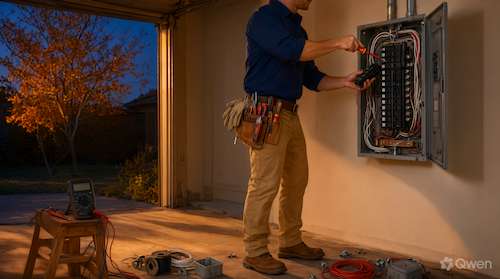
About 55.7% of Cincinnati metro housing units were built before 1980, according to ACS estimates, and many are considerably older. Those houses have often had several rounds of electrical work, each connecting new loads to whatever was already in the wall. The result is a system where the panel, the wiring method, and the actual demand can all date from different decades.
Capacity before equipment
Ask what the existing service rating is and whether a load calculation was done for the proposed change. Central air, a heat pump, an EV charger, or a finished basement can each push an older service past its practical limit. The answer may be a dedicated circuit, a panel change, a service upgrade, or a different equipment choice.
Mixed wiring and hidden junctions
Ask what wiring type serves the affected circuit, how the new work will connect, and whether the connection is appropriate for both. Past remodels can leave junctions inside walls that nobody documented. If a finding is unexpected, ask for a written change order rather than a verbal adjustment.
Panel condition, not just age
Ask what was inspected inside the panel: breaker condition, bus connections, grounding and bonding, and any signs of heat or moisture. Age alone does not condemn a panel, and a new panel does not fix an overloaded circuit. Get the finding in writing.
Plaster, permits, and restoration
Ask who files the permit, who schedules the inspection, and what restoration is included after walls are opened. Plaster and lath repair is slower than drywall patching and is often excluded. Put the restoration scope and the permit responsibility in writing before work begins.
Questions to ask before approving work
Where this page stops
This page does not assess electrical safety remotely and does not publish local prices. Electrical hazards should be handled by a qualified professional, and permit and inspection requirements must be confirmed with the authority responsible for the address.
Cincinnati metro context
The 2024 ACS 5-year estimates put the metro at about 2.3 million residents and 907,000 households. About 68.3% of occupied homes are owner-occupied, and about 66.3% of housing units are single-family detached. About 55.7% of housing units were built before 1980. This page reports Census indicators only; a NOAA station is not included for this metro in the site dataset.
Cincinnati metro housing indicators
| Indicator | Value | Source |
|---|---|---|
| Metro population | 2,270,706 | U.S. Census Bureau |
| Households | 906,675 | U.S. Census Bureau |
| Owner-occupied share | 68.3% | U.S. Census Bureau |
| Single-family detached share | 66.3% | U.S. Census Bureau |
| Housing units built before 1980 | 55.7% | U.S. Census Bureau |
Census values describe the metro area, not an individual property. A climate station is not reported for this metro in the site dataset.
Frequently Asked Questions
How do I know if my Cincinnati home needs a panel upgrade?
The decision should follow an assessment of the service rating, panel condition, and the proposed load. Ask whether a load calculation was performed and which findings support the upgrade.
What if the electrician finds unexpected wiring?
Ask for a written change order describing the finding, the proposed fix, and the cost before the work continues. Verbal adjustments are hard to compare and hard to dispute later.
Can I add an EV charger without upgrading the service?
Sometimes, depending on existing capacity and the charger's requirements. Ask for a load calculation and a written scope covering the circuit, the breaker, and any permit or inspection step.
Is plaster repair included after electrical work?
Often it is excluded or limited to patching. Ask what finish level is included and whether painting is part of the scope.
What should an electrical estimate include?
The tested condition, work area, materials, labor, permit assumptions, inspection responsibilities, restoration, exclusions, and warranty. Ask for the test results that support the recommendation.
What is the population of the Cincinnati metro area?
The U.S. Census Bureau's 2024 ACS 5-year estimates report about 2.3 million residents in the metro area. The figure describes regional scale, not the number of homes or providers.
Sources and review date
- American Community Survey 2024 5-year estimates (CBSA tables) — U.S. Census Bureau, 2024 ACS 5-year estimates.
Reviewed on 2026-11-18.