
New York, NY-NJ · metro guide
Electrical in New York: Panels, Wiring, and What to Compare
In a metro where most housing predates 1980, electrical work is often about capacity, access, and who approves the scope — not just the failed outlet.
Metro snapshot
New York in numbers
Sources named below each block
- Population
- 19.8M
- Households
- 7.4M
- Housing units
- 8.0M
- People / household
- 2.67
- population ÷ households
Owner-occupied homes 52%
The rest are rented. Owners are the ones who commission most exterior work.
Single-family detached 35%
Detached houses carry their own roof, gutters and exterior walls.
Built before 1980 73%
Older housing stock shapes what fails first: gutters, flashing, pipe material.
Season
The year in New York
- Precipitation
- 49.5 in
- Snowfall
- 29.8 in
Average temperature by month, °F — the shape of the year is what decides when exterior work gets done.
Precipitation by month, inches.
Snowfall by month, inches.
| Month | Average temperature (°F) | Precipitation (in) | Snowfall (in) |
|---|---|---|---|
| January | 33.7°F | 3.64 in | 8.8 in |
| February | 35.9°F | 3.19 in | 10.1 in |
| March | 42.8°F | 4.29 in | 5.0 in |
| April | 53.7°F | 4.09 in | 0.4 in |
| May | 63.2°F | 3.96 in | 0.0 in |
| June | 72.0°F | 4.54 in | 0.0 in |
| July | 77.5°F | 4.60 in | 0.0 in |
| August | 76.1°F | 4.56 in | 0.0 in |
| September | 69.2°F | 4.31 in | 0.0 in |
| October | 57.9°F | 4.38 in | 0.1 in |
| November | 48.0°F | 3.58 in | 0.5 in |
| December | 39.1°F | 4.38 in | 4.9 in |
NOAA 1991–2020 climate normals, station NEW YORK CNTRL PK TWR, NY US (USW00094728). Station observations, not a metro-wide average — a metro that spans a mountain range can differ by more than this record shows.
Population, households and housing shares: U.S. Census Bureau, American Community Survey 2024 5-year estimates, metropolitan statistical area.
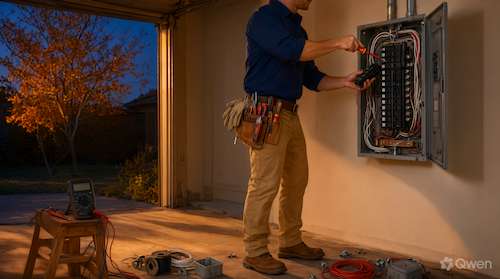
Electrical work in New York is rarely just an outlet. About 73% of metro housing units were built before 1980, according to ACS estimates, and only about 34.9% are single-family detached. That means a lot of work happens in apartment buildings, co-ops, and older houses where the question is not only what failed, but what the service and wiring can safely support.
Capacity comes before the appliance
Before adding a dryer, an EV charger, or a heat pump, ask what the service and panel can support. A useful proposal states the existing service rating, the panel condition, the proposed load, and whether a load calculation was performed. Adding a large load to an already full panel is a planning problem, not an installation problem, and it should be solved before equipment is purchased.
Testing, not guessing
Ask which tests support the diagnosis: voltage readings, circuit tracing, insulation testing, thermal imaging, or a panel inspection. Flickering lights and tripping breakers can come from loose connections, overloaded circuits, failing equipment, or supply issues. The finding should be written down so the repair addresses the cause rather than a symptom.
Older wiring and mixed updates
Buildings of this age often contain more than one generation of wiring, especially after renovations. Ask what type of wiring serves the affected circuit, how the new work connects to it, and whether the connection is appropriate for both. In multi-unit buildings, ask whether the work touches common areas, risers, or another unit's service.
Co-ops, condos, and access
Only about half of occupied homes in the metro are owner-occupied. If you rent, ask who authorizes the work. In a co-op or condo, ask whether board approval, an alteration agreement, or building access rules apply before work is scheduled. For a panel or service change, confirm how power will be interrupted and who coordinates with neighbors.
Questions to ask before approving work
Where this page stops
This page does not assess electrical safety remotely and does not publish local prices. Electrical hazards should be handled by a qualified professional, and permit and inspection requirements must be confirmed with the authority responsible for the address.
New York metro context
The 2024 ACS 5-year estimates put the metro at about 19.8 million residents and 7.4 million households. About 51.5% of occupied homes are owner-occupied, and about 34.9% of housing units are single-family detached — so a large share of electrical decisions involve a building, a management company, or a board. About 73% of housing units were built before 1980, which makes the age of service equipment a standard question. These figures describe the metro, not a specific building.
New York metro housing indicators
| Indicator | Value |
|---|---|
| Population | 19,798,537 |
| Households | 7,409,947 |
| Owner-occupied share | 51.5% |
| Housing units built before 1980 | 73.0% |
| Single-family detached share | 34.9% |
Metro-level estimates. Building age does not establish the condition of a specific electrical system.
Frequently Asked Questions
How do I know if my electrical panel needs to be replaced?
The decision should follow testing and observation: available capacity, the condition of the panel and breakers, parts availability, signs of overheating, double-tapped breakers, or missing grounding. Ask which findings support replacement and what alternatives were considered.
What is involved in a service upgrade in New York?
A service upgrade usually involves assessing existing capacity, the panel and breakers, grounding and bonding, circuit routing, permit and inspection steps, and restoration of the surrounding wall. In multi-unit buildings it may also involve common areas or utility coordination.
Do I need board approval for electrical work in a co-op or condo?
Often yes. Boards may require an alteration agreement, proof of insurance, and approved contractors, and building access rules can affect scheduling. Ask the managing agent before signing a contract.
Why do my lights flicker or dim?
Possible causes include loose connections, overloaded circuits, failing equipment, or supply issues. The cause should be identified with testing rather than by replacing parts.
Does electrical work require a permit?
Requirements vary by jurisdiction and by the type of work. Confirm with the authority responsible for the address and ask whether permit handling and inspection are included in the scope.
What is the population of the New York metro area?
The U.S. Census Bureau's 2024 ACS 5-year estimates report about 19.8 million residents in the metro area. The figure describes regional scale, not the number of homes or providers.
Sources and review date
- American Community Survey 2024 5-year estimates (CBSA tables) — U.S. Census Bureau, 2024 ACS 5-year estimates.
Reviewed on 2026-11-17.