
Cleveland, OH · metro guide
Landscaping in Cleveland: Clay, Road Salt, and a Canopy Worth Protecting
The soil holds water, the roads get salted hard, and the trees are the best asset most lots have.
Metro snapshot
Cleveland in numbers
Sources named below each block
- Population
- 2.2M
- Households
- 931K
- Housing units
- 1.0M
- People / household
- 2.33
- population ÷ households
Owner-occupied homes 67%
The rest are rented. Owners are the ones who commission most exterior work.
Single-family detached 66%
Detached houses carry their own roof, gutters and exterior walls.
Built before 1980 72%
Older housing stock shapes what fails first: gutters, flashing, pipe material.
Season
The year in Cleveland
- Precipitation
- 41 in
- Snowfall
- 63.8 in
Average temperature by month, °F — the shape of the year is what decides when exterior work gets done.
Precipitation by month, inches.
Snowfall by month, inches.
| Month | Average temperature (°F) | Precipitation (in) | Snowfall (in) |
|---|---|---|---|
| January | 29.1°F | 2.99 in | 18.4 in |
| February | 31.1°F | 2.49 in | 15.1 in |
| March | 38.9°F | 3.06 in | 10.8 in |
| April | 50.4°F | 3.75 in | 2.7 in |
| May | 61.2°F | 3.79 in | 0.0 in |
| June | 70.4°F | 3.83 in | 0.0 in |
| July | 74.5°F | 3.67 in | 0.0 in |
| August | 73.0°F | 3.56 in | 0.0 in |
| September | 66.4°F | 3.93 in | 0.0 in |
| October | 55.1°F | 3.60 in | 0.1 in |
| November | 44.0°F | 3.37 in | 4.5 in |
| December | 34.3°F | 2.99 in | 12.2 in |
NOAA 1991–2020 climate normals, station CLEVELAND, OH US (USW00014820). Station observations, not a metro-wide average — a metro that spans a mountain range can differ by more than this record shows.
Population, households and housing shares: U.S. Census Bureau, American Community Survey 2024 5-year estimates, metropolitan statistical area.
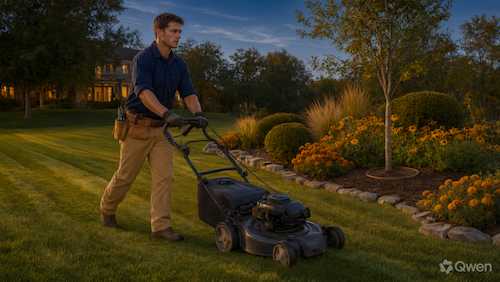
Landscaping in northeast Ohio begins with the soil, which is heavy clay across much of the region and drains slowly once saturated. It continues with the salt: road salt is applied generously through a long winter, and the first few feet of every boulevard strip take the consequences. What the region has in its favor is a mature tree canopy — the reason Cleveland is still called the Forest City — and that canopy is both the best asset on most lots and a real constraint on what can be planted underneath it.
Clay decides whether a plant survives
A planting hole dug into clay becomes a container: water fills it in spring and cannot drain, and plants drown while the same bed dries hard in August. The practical answers are to plant on a mound above grade, to amend the soil widely rather than in a narrow hole, and to grade so water leaves the property rather than sitting against the house. Ask how the contractor handles clay on the site, whether beds will be raised, and where water goes after a heavy rain — including whether the downspouts discharge beside the foundation.
Road salt is a design constraint
The strip between the sidewalk and the kerb takes salt spray, plow damage and reflected heat, and the damage shows up in spring as a brown margin along the road and delayed leaf-out on the exposed side of a tree. Salt-tolerant turf and perennials in that strip are a better bet than replacement sod every year. Ask whether a mulch or gravel border is proposed at the kerb, and whether the downspout discharges into the planting strip, which concentrates the problem.
The canopy is worth protecting
Mature trees shade the house in summer, hold the soil and define the street, and they are expensive to replace and slow to grow. Ask how existing trees will be protected during any excavation, whether irrigation will avoid cutting major roots, and whether pruning is part of the scope. Removing a public street tree normally requires local approval with a replacement requirement, and a contractor who proposes removal casually is not thinking about the long term.
Test before growing food
Soil in older industrial cities carries a history — lead from decades of exterior paint and leaded fuel, and sometimes other metals — and that history is not visible. Testing is inexpensive and it changes the design: raised beds with imported soil and a barrier beneath are the standard answer where results are elevated. Ask whether the contractor plans to test, and if vegetables or children are part of the brief, ask how the beds will be constructed rather than assuming the existing soil is fine.
A short season with a wet start
Spring soils here are often waterlogged well into the season, and autumn closes early enough that a late planting has no time to establish before the ground freezes. Ask what planting window is proposed and why, whether the contractor warranties plants through the first winter, and who waters in the first two summers. A design that assumes daily watering for two years is a design with an expiry date.
What to put in a landscaping brief
Where this page stops
This page does not evaluate a property and publishes no prices. Soil, drainage and utility locations must be confirmed on site, and work on public trees or boulevards is subject to local rules.
Cleveland metro context
The 2024 ACS 5-year estimates count about 2.17 million residents in 931,377 households across 1,018,605 housing units, with 66.5% owner-occupied and 66.2% single-family detached. About 72.0% of units predate 1980, one of the oldest stocks on this site, which means most lots were graded and planted long before modern stormwater practice. A climate station is not reported for this metro in the site dataset, so no temperature or precipitation figures are published here.
Cleveland housing indicators
| Indicator | Value | Source |
|---|---|---|
| Single-family detached share | 66.2% | U.S. Census Bureau |
| Owner-occupied share | 66.5% | U.S. Census Bureau |
| Housing units built before 1980 | 72.0% | U.S. Census Bureau |
| Metro households | 931,377 | U.S. Census Bureau |
| Housing units | 1,018,605 | U.S. Census Bureau |
| Metro population | 2,171,526 | U.S. Census Bureau |
No climate normals are shown because no station record is held for this metro in the site dataset. Soil conditions and tree cover vary block by block rather than across the metro.
Frequently Asked Questions
Why do plants die in my clay soil?
Often because the planting hole holds water rather than draining it, so roots drown in spring. Planting on a mound, amending widely rather than in a narrow hole, and correcting grade are more effective than choosing tougher plants.
Why does the grass by the road die every spring?
Road salt accumulates in that strip and shows up as a brown margin after the thaw, along with plow damage and reflected heat. Salt-tolerant turf and perennials, plus a mulch or gravel border, handle it better than replacing sod each year.
Should I test my soil before planting vegetables?
It is worth doing in older neighborhoods, where lead and other metals can persist. Raised beds with imported soil and a barrier beneath are the usual answer where results are elevated.
Can I remove a tree from the boulevard?
Usually only with local approval, and often with a replacement requirement. Ask the city before planning around removal, and consider a design that works with the tree instead.
When is the best time to plant here?
Spring after the soil drains and early autumn while there is still establishment time. The window is narrower than in milder regions, and late-autumn planting leaves a plant with no time before the ground freezes.
Does mulch attract termites?
Termite pressure in this region is lower than in the South, but keeping mulch away from the siding and avoiding wood in direct contact with soil remains sensible practice.
Sources and review date
- American Community Survey 2024 5-year estimates (CBSA tables) — U.S. Census Bureau, 2024 ACS 5-year estimates.
Reviewed on 2026-11-18.