
Cleveland, OH · metro guide
Roofing in Cleveland: Lake-Effect Snow on Old Decks
The snow comes off the lake in bands, and the roof underneath is often the original deck.
Metro snapshot
Cleveland in numbers
Sources named below each block
- Population
- 2.2M
- Households
- 931K
- Housing units
- 1.0M
- People / household
- 2.33
- population ÷ households
Owner-occupied homes 67%
The rest are rented. Owners are the ones who commission most exterior work.
Single-family detached 66%
Detached houses carry their own roof, gutters and exterior walls.
Built before 1980 72%
Older housing stock shapes what fails first: gutters, flashing, pipe material.
Season
The year in Cleveland
- Precipitation
- 41 in
- Snowfall
- 63.8 in
Average temperature by month, °F — the shape of the year is what decides when exterior work gets done.
Precipitation by month, inches.
Snowfall by month, inches.
| Month | Average temperature (°F) | Precipitation (in) | Snowfall (in) |
|---|---|---|---|
| January | 29.1°F | 2.99 in | 18.4 in |
| February | 31.1°F | 2.49 in | 15.1 in |
| March | 38.9°F | 3.06 in | 10.8 in |
| April | 50.4°F | 3.75 in | 2.7 in |
| May | 61.2°F | 3.79 in | 0.0 in |
| June | 70.4°F | 3.83 in | 0.0 in |
| July | 74.5°F | 3.67 in | 0.0 in |
| August | 73.0°F | 3.56 in | 0.0 in |
| September | 66.4°F | 3.93 in | 0.0 in |
| October | 55.1°F | 3.60 in | 0.1 in |
| November | 44.0°F | 3.37 in | 4.5 in |
| December | 34.3°F | 2.99 in | 12.2 in |
NOAA 1991–2020 climate normals, station CLEVELAND, OH US (USW00014820). Station observations, not a metro-wide average — a metro that spans a mountain range can differ by more than this record shows.
Population, households and housing shares: U.S. Census Bureau, American Community Survey 2024 5-year estimates, metropolitan statistical area.
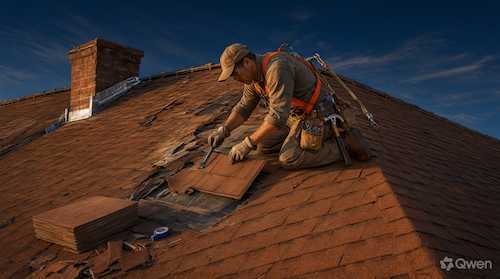
A roof in northeast Ohio is tested by snow that arrives in lake-effect bands and sits for weeks, and by the melt that refreezes at the cold eave. Because 72.0% of the housing here predates 1980, the deck under many of the roofs being replaced is original, the attic was built before ventilation was a design requirement, and there is often a second layer of shingles from a previous replacement. All three facts shape what a good job looks like, and none of them are visible from the ground.
Ice dams and the membrane under the covering
Snow melts on a warm deck, runs to the cold eave and refreezes, and the resulting dam pushes water back under the shingles into the wall or ceiling. The backstop is a waterproof membrane under the covering at the eave. Ask how far up the slope it runs, whether valleys and penetrations are covered too, and how junctions with walls and dormers are detailed. On a house with a history of ice dams that answer matters more than the shingle brand.
Ventilation is what actually prevents it
Intake at the soffit and exhaust at the ridge have to be balanced and unobstructed. Insulation blown over the soffit vents defeats the system, and a bath fan discharging into the attic adds moisture directly to the deck. Both are common in a stock this old. Ask what the ventilation calculation is, whether baffles will protect the intake, and whether an attic fan will be corrected while the roof is open — that is the cheapest moment it will ever be fixed.
The deck is the part that surprises people
On a house built in 1925 the sheathing may be board rather than plywood, and it may have soft spots at the eave where snow sat longest. Ask how many layers are present, whether a full tear-off is proposed, what the deck condition is likely to be, and what is priced if it turns out to be soft. A bid that assumes a layover and a sound deck has not answered the most expensive question in the job.
Wind and the edges
Winter storms bring wind as well as snow, and shingles lift from the rake and ridge inward. Ask what the wind rating of the covering is, what nailing pattern will be used, whether starter strip and ridge cap are being replaced, and whether the existing roof has already lost shingles in past events. Those details determine whether the roof survives the next big blow.
Gutter ice and where the melt goes
Ice in a gutter is normal here; a gutter pulled away from the fascia is a fastening and pitch problem. Downspouts that discharge beside the foundation send melt back to a basement wall that is already dealing with spring water and, in parts of the region, a combined sewer. Ask whether new hangers are included, whether downspout extensions carry water away, and where the discharge lands.
Questions to ask before signing
Where this page stops
This page does not inspect roofs and publishes no prices. Deck condition, structural capacity and snow loading require on-site assessment, and insurance questions belong to the carrier and the policy.
Cleveland metro context
ACS 2024 5-year estimates put the metro at about 2.17 million residents in 931,377 households and 1,018,605 housing units, with 66.5% owner-occupied and 66.2% single-family detached. About 72.0% of units were built before 1980, one of the oldest shares on this site, which is why original decking and attic construction are live topics here. A climate station is not reported for this metro in the site dataset, so no snowfall normals are published on this page.
Cleveland housing indicators
| Indicator | Value | Source |
|---|---|---|
| Housing units built before 1980 | 72.0% | U.S. Census Bureau |
| Single-family detached share | 66.2% | U.S. Census Bureau |
| Owner-occupied share | 66.5% | U.S. Census Bureau |
| Housing units | 1,018,605 | U.S. Census Bureau |
| Metro households | 931,377 | U.S. Census Bureau |
| Metro population | 2,171,526 | U.S. Census Bureau |
No NOAA climate normals are shown for this metro because no station record is held in the site dataset. Lake-effect snowfall varies greatly between the snowbelt and areas south of the metro.
Frequently Asked Questions
How do I stop ice dams?
Keep the deck cold: seal air leaks at the ceiling plane, insulate to current standards, and make sure the soffit intake and ridge exhaust are clear. Heat cable and raking manage symptoms; the membrane under the covering is the backstop.
Can I put a second layer of shingles on an old roof?
It may be permitted depending on how many layers exist, but on a deck this old it hides exactly what needs inspecting and adds weight. Ask for a tear-off price as well and compare honestly.
Why does my attic grow frost in winter?
Warm moist air is reaching a cold surface, usually from leaks at the ceiling plane or a bath fan discharging into the attic. Air sealing and ventilation fix it; more insulation alone often does not.
What is the risk with original board sheathing?
It may be soft where snow sat at the eave, and it may not accept new fasteners as reliably. That is why deck repair should be priced per unit up front rather than discovered mid-job.
Why do my gutters pull away in winter?
Ice loading plus a fastening or pitch problem. Gutters full of ice are normal; gutters separating from the fascia mean the hangers or the slope are not adequate.
Does the bath fan matter that much?
It does. A fan discharging into the attic adds moisture directly to the deck and works against every other measure taken to prevent ice dams.
Sources and review date
- American Community Survey 2024 5-year estimates (CBSA tables) — U.S. Census Bureau, 2024 ACS 5-year estimates.
Reviewed on 2026-11-18.