
Cleveland, OH · metro guide
Window Cleaning in Cleveland: Lake-Effect Snow, Salt and Steel-Era Soot
The oldest housing stock of any metro here, under the heaviest snow load, on masonry that has absorbed a century of smoke.
Metro snapshot
Cleveland in numbers
Sources named below each block
- Population
- 2.2M
- Households
- 931K
- Housing units
- 1.0M
- People / household
- 2.33
- population ÷ households
Owner-occupied homes 67%
The rest are rented. Owners are the ones who commission most exterior work.
Single-family detached 66%
Detached houses carry their own roof, gutters and exterior walls.
Built before 1980 72%
Older housing stock shapes what fails first: gutters, flashing, pipe material.
Season
The year in Cleveland
- Precipitation
- 41 in
- Snowfall
- 63.8 in
Average temperature by month, °F — the shape of the year is what decides when exterior work gets done.
Precipitation by month, inches.
Snowfall by month, inches.
| Month | Average temperature (°F) | Precipitation (in) | Snowfall (in) |
|---|---|---|---|
| January | 29.1°F | 2.99 in | 18.4 in |
| February | 31.1°F | 2.49 in | 15.1 in |
| March | 38.9°F | 3.06 in | 10.8 in |
| April | 50.4°F | 3.75 in | 2.7 in |
| May | 61.2°F | 3.79 in | 0.0 in |
| June | 70.4°F | 3.83 in | 0.0 in |
| July | 74.5°F | 3.67 in | 0.0 in |
| August | 73.0°F | 3.56 in | 0.0 in |
| September | 66.4°F | 3.93 in | 0.0 in |
| October | 55.1°F | 3.60 in | 0.1 in |
| November | 44.0°F | 3.37 in | 4.5 in |
| December | 34.3°F | 2.99 in | 12.2 in |
NOAA 1991–2020 climate normals, station CLEVELAND, OH US (USW00014820). Station observations, not a metro-wide average — a metro that spans a mountain range can differ by more than this record shows.
Population, households and housing shares: U.S. Census Bureau, American Community Survey 2024 5-year estimates, metropolitan statistical area.
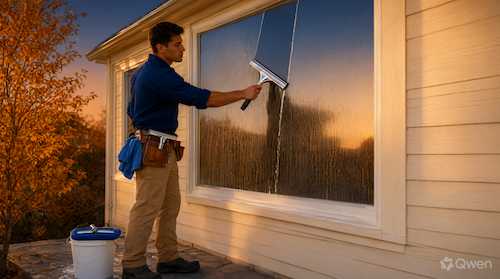
Cleveland has the oldest stock in this set: 72.0% of housing units predate 1980, and 66.2% are detached, so most glass sits in individually owned older houses with original or once-replaced sashes. Lake-effect snow and heavy road salt define the winter, and the region's industrial history is still in the brick — soot that rain carries down onto sills and glass long after the smokestacks stopped.
Lake-effect snow and what it leaves
Snow itself is harmless to glass, but the ploughed and salted roads beside it are not, and lake-effect bands can deliver repeated accumulations that keep the street wet with brine for weeks. The street elevation collects that continuously. Ask whether the street side is treated differently from the others.
Salt, frames and hardware
Road salt holds moisture against metal, so aluminum storms dull, hinges stiffen and fixings corrode while the glass looks merely hazy. On a house with 1970s storm windows that is the expensive part of the problem. Ask whether frames and hardware are rinsed as part of the scope.
A century of soot in the masonry
Industrial smoke darkened the brick across the region, and rain still carries that material out of the mortar and down over sills and glass. A clean window under a dirty wall does not stay clean. Ask whether the contractor accounts for run-off rather than treating the glass in isolation.
Original sashes and failing putty
With 72.0% of the stock predating 1980, wood sashes with failing putty, checked wood and many coats of paint are the norm, and many houses still carry storm panels. These frames do not tolerate being soaked. Ask how older wood is treated and whether soft spots are reported rather than cleaned over.
A narrow season between freezes
Exterior work is limited to the months when water does not freeze on glass or on equipment, which concentrates the whole year into a short window and makes spring booking decisive. Ask how the schedule handles a late cold snap.
What to pin down in the estimate
Where this page stops
No prices are quoted and no property is assessed here. Rot, failed putty, lead paint and corrosion are findings that need inspection, and masonry work belongs to another trade.
Cleveland metro context
The 2024 ACS 5-year estimates describe about 2.17 million residents in 931,377 households and 1,018,605 housing units, with 66.5% owner-occupied and 66.2% single-family detached. About 72.0% of units predate 1980. No climate station is reported for this metro in the site dataset, so no temperature or precipitation normals appear on this page.
Cleveland housing indicators
| Indicator | Value | Source |
|---|---|---|
| Housing units built before 1980 | 72.0% | U.S. Census Bureau |
| Single-family detached share | 66.2% | U.S. Census Bureau |
| Owner-occupied share | 66.5% | U.S. Census Bureau |
| Metro households | 931,377 | U.S. Census Bureau |
| Housing units | 1,018,605 | U.S. Census Bureau |
| Metro population | 2,171,526 | U.S. Census Bureau |
Station normals are historical averages for one location, not a forecast. Glass condition depends on how often the surface is wetted and what the water carries.
Frequently Asked Questions
Why does one elevation look permanently hazy?
The street side collects salt and grit all winter and holds it in repeated freeze-thaw. It needs rinsing rather than a wipe.
Why do sills below brick walls stain?
Rain carries soot and mortar dust out of the masonry onto the sill. The window is clean; the wall above it is not.
Can old wooden windows be cleaned safely?
Only with a method that does not soak or scrape the frame. Failing putty and checked wood are the vulnerable parts.
Do storm windows need to come off?
For the inner pane, yes. Confirm that removal and refitting are part of the job.
How long is the cleaning season?
Exterior work runs from spring to the first hard freeze. That makes early booking matter more than in a milder metro.
Is lead paint a concern here?
On pre-1978 windows, yes. Cleaning that disturbs old paint needs the right lead-safe practice.
Sources and review date
- American Community Survey 2024 5-year estimates (CBSA tables) — U.S. Census Bureau, 2024 ACS 5-year estimates.
Reviewed on 2026-11-18.