
Milwaukee, WI · metro guide
Gutter Cleaning in Milwaukee: Snow Load, Ice at the Eave and Brick Flats
Two-thirds of the housing predates 1980, and the gutter has to survive a lake winter as well as carry rain.
Metro snapshot
Milwaukee in numbers
Sources named below each block
- Population
- 1.6M
- Households
- 656K
- Housing units
- 702K
- People / household
- 2.39
- population ÷ households
Owner-occupied homes 60%
The rest are rented. Owners are the ones who commission most exterior work.
Single-family detached 54%
Detached houses carry their own roof, gutters and exterior walls.
Built before 1980 67%
Older housing stock shapes what fails first: gutters, flashing, pipe material.
Season
The year in Milwaukee
- Precipitation
- 34.6 in
- Snowfall
- 48.7 in
Average temperature by month, °F — the shape of the year is what decides when exterior work gets done.
Precipitation by month, inches.
Snowfall by month, inches.
| Month | Average temperature (°F) | Precipitation (in) | Snowfall (in) |
|---|---|---|---|
| January | 24.0°F | 1.79 in | 14.9 in |
| February | 27.1°F | 1.69 in | 11.8 in |
| March | 36.4°F | 2.20 in | 6.7 in |
| April | 46.3°F | 3.86 in | 2.1 in |
| May | 57.1°F | 3.54 in | 0.0 in |
| June | 67.6°F | 4.38 in | 0.0 in |
| July | 73.3°F | 3.40 in | 0.0 in |
| August | 72.3°F | 3.65 in | 0.0 in |
| September | 65.0°F | 3.16 in | 0.0 in |
| October | 53.0°F | 2.78 in | 0.3 in |
| November | 40.4°F | 2.24 in | 2.5 in |
| December | 29.5°F | 1.88 in | 10.4 in |
NOAA 1991–2020 climate normals, station MILWAUKEE MITCHELL AP, WI US (USW00014839). Station observations, not a metro-wide average — a metro that spans a mountain range can differ by more than this record shows.
Population, households and housing shares: U.S. Census Bureau, American Community Survey 2024 5-year estimates, metropolitan statistical area.
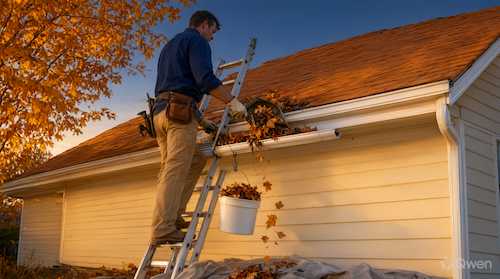
Milwaukee gets 38 inches of snow in a lake winter and 66.9% of its housing predates 1980, much of it brick duplexes and flats. In this climate the gutter is a structural item as much as a drainage one: snow that slides off a steep roof takes the gutter with it, ice at the eave loads the hangers, and a run left full of leaves in November freezes into a solid plug that stays until March.
Ice at the eave and in the channel
Water held in a blocked run freezes, and once the channel is a solid block the meltwater has nowhere to go but back under the roof edge. On a brick building that water then works into the wall. The clean that prevents this has to happen before the first sustained freeze.
Snow sliding off the roof
A steep roof shedding a winter's accumulation can tear hangers out and bend the run, and the damage is often only visible in spring. Ask whether hangers and the run's alignment are checked, not only the debris.
Narrow runs on old flats
Nearly seven in ten units predate 1980, and four-inch runs with a single downspout per elevation are common on brick flats, sized for the roof as originally built. They overflow at the low point long before a modern run would, and the overflow goes into the masonry.
Shared buildings and who is responsible
In a duplex or flat the gutter belongs to the building, and the damage from a blockage appears in whichever unit is below it. Ask who authorizes roofline work and whether the whole building is covered rather than one unit.
Frozen and buried outlets
A downspout that holds water or debris at the mouth freezes solid, and a buried line that has silted up does the same. Either way the run has no outlet and behaves as if it were blocked. Ask whether the outlet is checked as well as the channel.
What to pin down in the estimate
Where this page stops
No prices are quoted and no property is assessed here. Ice-dam causes, attic ventilation, masonry damage and hanger repair are findings that need inspection by the right trade.
Milwaukee metro context
The 2024 ACS 5-year estimates describe about 1.57 million residents in 656,436 households and 701,558 housing units, with 60.4% owner-occupied and 54.3% single-family detached. About 66.9% of units predate 1980. No climate station is reported for this metro in the site dataset, so no temperature or precipitation normals appear on this page.
Milwaukee housing indicators
| Indicator | Value | Source |
|---|---|---|
| Housing units built before 1980 | 66.9% | U.S. Census Bureau |
| Single-family detached share | 54.3% | U.S. Census Bureau |
| Owner-occupied share | 60.4% | U.S. Census Bureau |
| Metro households | 656,436 | U.S. Census Bureau |
| Housing units | 701,558 | U.S. Census Bureau |
| Metro population | 1,568,938 | U.S. Census Bureau |
Station normals are historical averages for one location, not a forecast. What a gutter has to carry depends on roof area, pitch, the debris the surrounding trees drop and whether downspouts discharge where the water can leave.
Frequently Asked Questions
Why does the gutter fill with ice?
Water held by debris freezes in the channel. A run that drains freely freezes far less often than one that holds water.
Can snow damage a gutter?
Sliding snow from a steep roof can pull hangers out and bend the run. The damage is usually noticed in spring.
When should gutters be cleared here?
Late autumn, before the first sustained freeze. A spring clean does nothing for the winter.
Is a four-inch run adequate on an old flat?
It was sized for the roof as built and holds less than a modern run, so it overflows sooner and needs clearing more often.
Who is responsible in a duplex?
Usually the building rather than a single unit. Confirm before booking, since the damage from a blockage lands in one unit.
What if my downspout is buried?
It still has to be checked. A silted buried line behaves exactly like a blocked gutter.
Sources and review date
- American Community Survey 2024 5-year estimates (CBSA tables) — U.S. Census Bureau, 2024 ACS 5-year estimates.
Reviewed on 2026-11-18.