
Nashville, TN · metro guide
Gutter Cleaning in Nashville: Karst Drainage, Summer Storms and Fast Growth
Limestone underfoot changes what a downspout can safely discharge into.
Metro snapshot
Nashville in numbers
Sources named below each block
- Population
- 2.1M
- Households
- 829K
- Housing units
- 897K
- People / household
- 2.51
- population ÷ households
Owner-occupied homes 65%
The rest are rented. Owners are the ones who commission most exterior work.
Single-family detached 64%
Detached houses carry their own roof, gutters and exterior walls.
Built before 1980 32%
Older housing stock shapes what fails first: gutters, flashing, pipe material.
Season
The year in Nashville
- Precipitation
- 50.5 in
- Snowfall
- 4.7 in
Average temperature by month, °F — the shape of the year is what decides when exterior work gets done.
Precipitation by month, inches.
Snowfall by month, inches.
| Month | Average temperature (°F) | Precipitation (in) | Snowfall (in) |
|---|---|---|---|
| January | 39.6°F | 4.02 in | 2.0 in |
| February | 43.4°F | 4.47 in | 1.5 in |
| March | 51.5°F | 4.52 in | 0.7 in |
| April | 60.8°F | 4.72 in | 0.0 in |
| May | 69.3°F | 5.02 in | 0.0 in |
| June | 77.1°F | 4.36 in | 0.0 in |
| July | 80.7°F | 4.16 in | 0.0 in |
| August | 79.7°F | 3.79 in | 0.0 in |
| September | 73.1°F | 3.80 in | 0.0 in |
| October | 61.7°F | 3.36 in | 0.0 in |
| November | 50.3°F | 3.86 in | 0.1 in |
| December | 42.7°F | 4.43 in | 0.4 in |
NOAA 1991–2020 climate normals, station NASHVILLE INTL AP, TN US (USW00013897). Station observations, not a metro-wide average — a metro that spans a mountain range can differ by more than this record shows.
Population, households and housing shares: U.S. Census Bureau, American Community Survey 2024 5-year estimates, metropolitan statistical area.
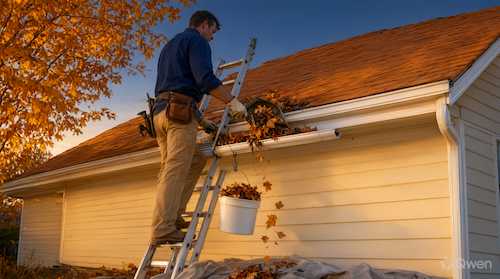
Nashville gets 50.5 inches of rain and sits on limestone karst, which is a pairing that matters for drainage: the ground can swallow water quickly through solution features, and it can also carry it somewhere unexpected. On top of that, only 31.7% of the housing predates 1980, so much of the stock is recent, and the gutter problems are less about corrosion than about capacity and where the discharge goes.
Karst ground and discharge
Limestone with solution features drains fast in places and can route water along unexpected paths. That is not something to solve by pointing a downspout at a hole in the ground, and it is a question for someone who knows the site. Ask where the water goes and whether the discharge is being directed into a defined system.
Heavy summer bursts
Rain arrives in intense storms, and a run with any restriction overflows visibly at the fascia. Streaks on fascia and soffit after a storm are the usual evidence. Ask whether the runs are checked for capacity as well as cleared.
New subdivisions and downspout counts
On a house built in the last decade the run is often continuous around several roof planes with only a few downspouts, and any partial blockage sends water over the edge. Ask how many downspouts serve each run relative to the roof area.
Limestone and construction dust
The region keeps grading limestone ground, and pale dust settles on roofs and washes into the runs, where it sets into a fine silt at the low points and in the outlets. That silt is easy to overlook and hard to flush. Ask whether the outlets are cleared.
Clay soil at the foundation
Where the soil does not drain, a downspout ending at the wall sends the roof's water along it. Ask whether the discharge has a path away from the house rather than onto the first available ground.
What to pin down in the estimate
Where this page stops
No prices are quoted and no property is assessed here. Karst drainage, sinkholes, grading and structural movement are matters for an engineer or a geotechnical specializt, not for this page.
Nashville metro context
The 2024 ACS 5-year estimates describe about 2.08 million residents in 829,134 households and 897,206 housing units, with 65.2% owner-occupied and 64.0% single-family detached. About 31.7% of units predate 1980. At the Nashville Intl Ap reference station January averages 39.6°F and July 80.7°F, on 50.5 inches of annual precipitation.
Nashville reference station and housing indicators
| Indicator | Value | Source |
|---|---|---|
| January mean temperature | 39.6°F | NOAA NCEI |
| July mean temperature | 80.7°F | NOAA NCEI |
| Annual precipitation | 50.5 in. | NOAA NCEI |
| Metro population | 2,079,596 | U.S. Census Bureau |
| Owner-occupied share | 65.2% | U.S. Census Bureau |
| Housing units built before 1980 | 31.7% | U.S. Census Bureau |
Station normals are historical averages for one location, not a forecast. What a gutter has to carry depends on roof area, pitch, the debris the surrounding trees drop and whether downspouts discharge where the water can leave.
Frequently Asked Questions
Can I discharge a downspout into a hole in the ground?
Not as a solution. Karst ground routes water unpredictably, and where it goes is a question for someone who knows the site.
Why do my gutters overflow in summer storms?
The rain arrives faster than a restricted run can carry. Capacity and blockage both produce the same visible result.
What is the fine silt in my gutters?
Limestone and construction dust washed off the roof. It settles at low points and blocks outlets.
How often do gutters need clearing here?
Usually twice a year, and more where the roof sits under trees or beside active building work.
Where should the downspout end?
Somewhere the water has a defined path away from the foundation rather than onto the first available ground.
Does a new house need this?
Yes. New runs are often undersized relative to the roof area, and the first few storms show it.
Sources and review date
- American Community Survey 2024 5-year estimates (CBSA tables) — U.S. Census Bureau, 2024 ACS 5-year estimates.
- 1991–2020 station normals — NASHVILLE INTL AP, TN US (USW00013897) — NOAA National Centers for Environmental Information, 1991–2020 climate normals.
Reviewed on 2026-11-18.
Other Home Services in Nashville-Davidson–Murfreesboro–Franklin
All guides for the Nashville-Davidson–Murfreesboro–Franklin metro area