
Raleigh, NC · metro guide
Electrical in Raleigh: A Young Housing Stock and a Long Cooling Season
Only 18.6% of the housing predates 1980 — the wiring is recent, and the loads have grown anyway.
Metro snapshot
Raleigh in numbers
Sources named below each block
- Population
- 1.5M
- Households
- 574K
- Housing units
- 619K
- People / household
- 2.59
- population ÷ households
Owner-occupied homes 67%
The rest are rented. Owners are the ones who commission most exterior work.
Single-family detached 62%
Detached houses carry their own roof, gutters and exterior walls.
Built before 1980 19%
Older housing stock shapes what fails first: gutters, flashing, pipe material.
Season
The year in Raleigh
- Precipitation
- 46.1 in
- Snowfall
- 5.2 in
Average temperature by month, °F — the shape of the year is what decides when exterior work gets done.
Precipitation by month, inches.
Snowfall by month, inches.
| Month | Average temperature (°F) | Precipitation (in) | Snowfall (in) |
|---|---|---|---|
| January | 41.9°F | 3.43 in | 2.6 in |
| February | 45.0°F | 2.78 in | 1.4 in |
| March | 51.8°F | 4.10 in | 0.3 in |
| April | 60.8°F | 3.53 in | 0.0 in |
| May | 68.8°F | 3.38 in | 0.0 in |
| June | 76.7°F | 3.89 in | 0.0 in |
| July | 80.5°F | 5.02 in | 0.0 in |
| August | 78.8°F | 4.71 in | 0.0 in |
| September | 72.6°F | 5.15 in | 0.0 in |
| October | 61.7°F | 3.37 in | 0.0 in |
| November | 51.5°F | 3.32 in | 0.1 in |
| December | 44.6°F | 3.39 in | 0.8 in |
NOAA 1991–2020 climate normals, station RALEIGH DURHAM INTL AP, NC US (USW00013722). Station observations, not a metro-wide average — a metro that spans a mountain range can differ by more than this record shows.
Population, households and housing shares: U.S. Census Bureau, American Community Survey 2024 5-year estimates, metropolitan statistical area.
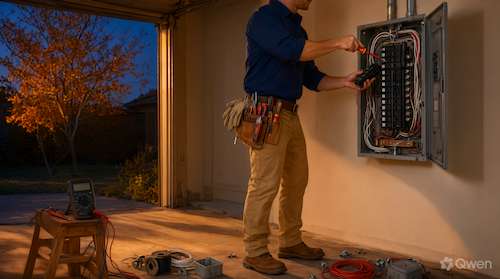
Raleigh is one of the youngest housing stocks this site covers: ACS estimates put just 18.6% of metro units before 1980, which means the electrical conversation here is rarely about knob-and-tube and almost always about capacity and new equipment. Houses built in the 1990s and 2000s were wired for a heat pump, an electric range and a dryer, and they have since acquired a second refrigerator, a workshop, an EV charger, a hot tub and, in many cases, a finished bonus room over the garage with its own conditioning. The panel is usually modern; the question is what has been added to it.
Cooling and heating both run on the same equipment
July averages 80.5°F at the Raleigh–Durham station and January 41.9°F, which is a climate where a heat pump does most of the work in both directions. That matters for sizing: the same compressor carries the summer load and, with auxiliary heat, the handful of cold nights in January and February. Ask what the calculation assumes for auxiliary heat, how many hours a year it is expected to run, and what the panel does when the strips, the dryer and the water heater run at once. In a house with a 200-amp service that is rarely a problem; in an older or smaller one it can be.
The loads that were added later
Because the housing is young, most of the electrical work here is cumulative rather than remedial: a hot tub added to a deck, a subpanel run to a detached garage, an EV charger in a carport, a generator inlet, landscape lighting, an outdoor kitchen. Each of those is a legitimate addition and each one consumes capacity. Ask for a panel schedule that reflects what is actually installed rather than what was installed at construction, and ask whether the proposed work leaves room for anything else, because the next addition is the one that usually breaks the budget.
Ice storms and generators
Winter ice and summer thunderstorms both interrupt power here often enough that generator connections are a normal request. The electrical detail that matters is the transfer equipment: a transfer switch or a listed interlock kit that prevents the main and the generator from being energized at the same time. A cord to a dryer outlet or a backfed breaker without an interlock is not an acceptable installation. Ask what is proposed, whether the panel accepts an interlock for that model, what the generator is expected to carry, and where the inlet is mounted.
Humidity and outdoor equipment
Long humid summers are hard on exterior devices: receptacles on a deck, a condenser disconnect, a pool or hot tub panel, lighting connections at grade. Corrosion at terminations and moisture inside enclosures are typical findings. Ask whether devices are rated for wet locations, whether covers and gaskets are intact, and whether ground-fault protection exists where it is required. These are inexpensive to make right and expensive to diagnose later.
Permits and the inspection
Electrical work is permitted and inspected locally, and in a fast-growing metro there is also a great deal of recent construction and renovation to check. For new equipment such as a charger, a hot tub or a subpanel, ask who pulls the permit, what the inspection covers, and whether the outdoor work is included in the same permit. Get the answer in writing; a permit that covers only part of the job is a common source of trouble at resale.
What to settle before approving work
Where this page stops
No specific property is assessed here and no prices are published. Electrical hazards, service capacity and code compliance require on-site evaluation by a licensed electrician, and permit requirements belong to the local authority.
Raleigh metro context
The 2024 ACS 5-year estimates count about 1.49 million residents in 574,295 households across 619,032 housing units. Owner occupancy is 66.6%, about 61.5% of units are single-family detached, and only 18.6% were built before 1980 — a young stock where capacity for new loads, not replacement of old wiring, is the usual question. NOAA's station at Raleigh–Durham records January at 41.9°F, July at 80.5°F, 46.1 inches of precipitation and 5.2 inches of snow in a typical year.
Raleigh reference station and housing indicators
| Indicator | Value | Source |
|---|---|---|
| July mean temperature | 80.5°F | NOAA NCEI |
| January mean temperature | 41.9°F | NOAA NCEI |
| Annual precipitation | 46.1 in. | NOAA NCEI |
| Housing units built before 1980 | 18.6% | U.S. Census Bureau |
| Single-family detached share | 61.5% | U.S. Census Bureau |
| Owner-occupied share | 66.6% | U.S. Census Bureau |
Station normals are 30-year averages for one location, not a forecast. Census values describe the metro area, not an individual property.
Frequently Asked Questions
Is a 200-amp service normal in Raleigh?
It is common in houses built in the last few decades, though 150-amp and smaller services exist on older and smaller homes. What matters is what is connected, not the number alone. Ask for a load calculation if anything substantial is being added.
Can I add an EV charger and a hot tub to an existing panel?
Often yes, sometimes with load management that prevents both from drawing at once. Ask for a calculation that includes the heat pump with auxiliary heat, since that is the load that coincides with winter evenings when the car is also charging.
How should a generator be connected?
Through a transfer switch or a listed interlock kit, so the main and the generator cannot be energized simultaneously. Backfeeding without one endangers utility workers and the household. Ask what equipment is proposed and where the inlet is mounted.
Do I need a permit for a subpanel in a detached garage?
In most jurisdictions, yes, and the inspection will look at the feeder, the grounding and the bonding. Confirm the requirements locally and ask the electrician whether the permit covers both the subpanel and the circuits it feeds.
Why do my outdoor outlets fail?
Humidity, rain and irrigation spray attack unprotected terminations. Devices rated for wet locations with intact covers and ground-fault protection last far longer, and replacing them is cheap compared with tracing a fault later.
Does a finished bonus room need its own circuit?
It usually needs dedicated circuits for whatever is installed there, and if it is conditioned, its load belongs in the calculation. Rooms converted after construction are a common place to find wiring that was stretched to serve more than intended.
Sources and review date
- American Community Survey 2024 5-year estimates (CBSA tables) — U.S. Census Bureau, 2024 ACS 5-year estimates.
- 1991–2020 station normals — RALEIGH DURHAM INTL AP, NC US (USW00013722) — NOAA National Centers for Environmental Information, 1991–2020 climate normals.
Reviewed on 2026-11-18.