
Raleigh, NC · metro guide
Window Cleaning in Raleigh: Pine Pollen, Red Clay and Constant Building
The newest housing in the state's fastest-growing metro, under the heaviest pollen load of the year.
Metro snapshot
Raleigh in numbers
Sources named below each block
- Population
- 1.5M
- Households
- 574K
- Housing units
- 619K
- People / household
- 2.59
- population ÷ households
Owner-occupied homes 67%
The rest are rented. Owners are the ones who commission most exterior work.
Single-family detached 62%
Detached houses carry their own roof, gutters and exterior walls.
Built before 1980 19%
Older housing stock shapes what fails first: gutters, flashing, pipe material.
Season
The year in Raleigh
- Precipitation
- 46.1 in
- Snowfall
- 5.2 in
Average temperature by month, °F — the shape of the year is what decides when exterior work gets done.
Precipitation by month, inches.
Snowfall by month, inches.
| Month | Average temperature (°F) | Precipitation (in) | Snowfall (in) |
|---|---|---|---|
| January | 41.9°F | 3.43 in | 2.6 in |
| February | 45.0°F | 2.78 in | 1.4 in |
| March | 51.8°F | 4.10 in | 0.3 in |
| April | 60.8°F | 3.53 in | 0.0 in |
| May | 68.8°F | 3.38 in | 0.0 in |
| June | 76.7°F | 3.89 in | 0.0 in |
| July | 80.5°F | 5.02 in | 0.0 in |
| August | 78.8°F | 4.71 in | 0.0 in |
| September | 72.6°F | 5.15 in | 0.0 in |
| October | 61.7°F | 3.37 in | 0.0 in |
| November | 51.5°F | 3.32 in | 0.1 in |
| December | 44.6°F | 3.39 in | 0.8 in |
NOAA 1991–2020 climate normals, station RALEIGH DURHAM INTL AP, NC US (USW00013722). Station observations, not a metro-wide average — a metro that spans a mountain range can differ by more than this record shows.
Population, households and housing shares: U.S. Census Bureau, American Community Survey 2024 5-year estimates, metropolitan statistical area.
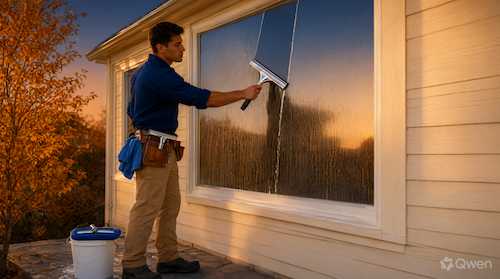
Only 18.6% of Raleigh's housing predates 1980, which makes it the newest stock in this set and the clearest example of what that means: coated glass, sealed units, tight frames and subdivisions built on graded red clay. The pollen season is the dominant event — the pines release a yellow-green dust that coats everything — and the clay dust from continuous construction fills the rest of the year. With 46.1 inches of rain and 5.02 of it in July, storms then set whatever has settled.
Pine pollen is the event of the year
For a few weeks the pines coat everything in a fine yellow-green pollen that is sticky enough that rain sets it rather than washing it off. Cleaning during the peak is wasted; the useful visit lands just after it, before the heat bakes the residue on. Ask how the contractor schedules around it.
Red clay construction dust
The metro keeps building on red clay, and graded ground produces a fine dust that lifts and settles as a reddish film. It is not pollen and does not respond to the same method, and in a new subdivision it is continuous for a season or two. Ask where the nearest active site is.
Storms that set the film
July alone brings 5.02 inches, and each storm wets the film and the sun dries it in place. Windows often look worse after a wet week than before it. Ask how the contractor removes the film rather than relying on weather.
Coated glass and what it rules out
With almost all the housing postdating 1980, low-emissivity coatings are the norm, and they are softer than glass and sensitive to ammonia, abrasives and dry scraping. A standard quick clean can permanently haze a new unit. Ask whether the glass is coated before any chemistry is chosen.
Wooded lots and shaded elevations
Subdivisions were built into existing pine and hardwood stands, so many elevations are shaded most of the day and stay damp after rain. That is where growth establishes on frames and in tracks. Ask whether frames and tracks are included.
What to pin down in the estimate
Where this page stops
No prices are quoted and no property is assessed here. Coating damage, failed seals and etched glass are findings that need inspection at the window.
Raleigh metro context
The 2024 ACS 5-year estimates describe about 1.49 million residents in 574,295 households and 619,032 housing units, with 66.6% owner-occupied and 61.5% single-family detached. About 18.6% of units predate 1980. At the Raleigh Durham Intl Ap reference station January averages 41.9°F and July 80.5°F, on 46.1 inches of annual precipitation.
Raleigh reference station and housing indicators
| Indicator | Value | Source |
|---|---|---|
| January mean temperature | 41.9°F | NOAA NCEI |
| July mean temperature | 80.5°F | NOAA NCEI |
| Annual precipitation | 46.1 in. | NOAA NCEI |
| Metro population | 1,487,302 | U.S. Census Bureau |
| Owner-occupied share | 66.6% | U.S. Census Bureau |
| Housing units built before 1980 | 18.6% | U.S. Census Bureau |
Station normals are historical averages for one location, not a forecast. Glass condition depends on how often the surface is wetted and what the water carries.
Frequently Asked Questions
What is the yellow dust in spring?
Pine pollen. It is sticky enough that rain sets it, which is why cleaning after the season is more useful than during it.
Why does red dust keep coming back?
Clay ground being graded nearby. It lifts and settles as a film until the site is finished and landscaped.
Is cleaning safe for new windows?
With the coating in mind. Ammonia and abrasives can damage low-emissivity glass permanently.
Why do windows look worse after rain?
The rain wets the film and the sun bakes it on. Storms redistribute dirt rather than removing it.
Do shaded sides need more work?
They stay damp longer, so growth establishes on frames and in tracks. Including them in the scope is what prevents it.
Do I need to be home?
Exterior work can usually be done unattended with agreed access. Interior work needs someone present.
Sources and review date
- American Community Survey 2024 5-year estimates (CBSA tables) — U.S. Census Bureau, 2024 ACS 5-year estimates.
- 1991–2020 station normals — RALEIGH DURHAM INTL AP, NC US (USW00013722) — NOAA National Centers for Environmental Information, 1991–2020 climate normals.
Reviewed on 2026-11-18.