
Washington, DC-VA-MD-WV · metro guide
Electrical Work in Washington DC: Rowhouse Panels and Old Wiring
A metro where most houses share a wall with the next one and were wired for far less load than a modern house now draws.
Metro snapshot
Washington in numbers
Sources named below each block
- Population
- 6.3M
- Households
- 2.4M
- Housing units
- 2.5M
- People / household
- 2.66
- population ÷ households
Owner-occupied homes 64%
The rest are rented. Owners are the ones who commission most exterior work.
Single-family detached 44%
Detached houses carry their own roof, gutters and exterior walls.
Built before 1980 46%
Older housing stock shapes what fails first: gutters, flashing, pipe material.
Season
The year in Washington
- Precipitation
- 41.8 in
- Snowfall
- 13.7 in
Average temperature by month, °F — the shape of the year is what decides when exterior work gets done.
Precipitation by month, inches.
Snowfall by month, inches.
| Month | Average temperature (°F) | Precipitation (in) | Snowfall (in) |
|---|---|---|---|
| January | 37.5°F | 2.86 in | 4.9 in |
| February | 40.0°F | 2.62 in | 5.0 in |
| March | 47.6°F | 3.50 in | 2.0 in |
| April | 58.2°F | 3.21 in | 0.0 in |
| May | 67.2°F | 3.94 in | 0.0 in |
| June | 76.3°F | 4.20 in | 0.0 in |
| July | 81.0°F | 4.33 in | 0.0 in |
| August | 79.4°F | 3.25 in | 0.0 in |
| September | 72.4°F | 3.93 in | 0.0 in |
| October | 60.8°F | 3.66 in | 0.0 in |
| November | 49.9°F | 2.91 in | 0.1 in |
| December | 41.7°F | 3.41 in | 1.7 in |
NOAA 1991–2020 climate normals, station WASHINGTON REAGAN AP, VA US (USW00013743). Station observations, not a metro-wide average — a metro that spans a mountain range can differ by more than this record shows.
Population, households and housing shares: U.S. Census Bureau, American Community Survey 2024 5-year estimates, metropolitan statistical area.
Only 44.2% of the housing units in this metro are single-family detached. That single figure explains most of the electrical work here: the stock is dominated by rowhouses, garden apartments and mid-century condominiums, and a large share of it was wired when the expected load was lighting, a refrigerator and a radio. Nearly half the units predate 1980. A rowhouse on a 100-amp service with fuses, three window air conditioners, an electric dryer and a car charger is not an unusual request — and it is usually the moment the service becomes the project rather than the appliance.
Fuse boxes, 100-amp panels and the modern load list
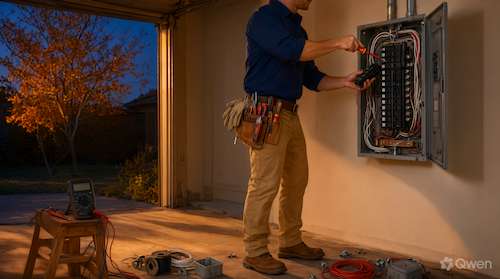
The first calculation in most of these houses is a load calculation, not a repair. A panel that was adequate for a gas range and a window unit runs out of capacity once a heat pump, an induction range, a dryer and EV charging all arrive on the same bus. Replacing the panel without checking the service drop, the meter socket and the grounding electrode is only part of the work. Ask for the calculated load, whether the service entrance conductors are being replaced, how grounding is being brought up to current requirements, and whether the utility needs to disconnect and reconnect.
Knob-and-tube, aluminum and plaster
Older neighborhoods in the District commonly have knob-and-tube wiring in the walls, sometimes still live behind plaster and lath; 1960s and 1970s buildings often have aluminum branch-circuit conductors at the receptacles. Both need a specific approach rather than a blanket answer: knob-and-tube can sometimes be left in place where it is intact and undisturbed, but not where it has been buried in insulation, and aluminum connections need proper connectors or pigtailing rather than repeated tightening. Ask what was actually found, how much of it is reachable, and — critically — what the making-good will look like, because in a plastered rowhouse every new circuit means patching.
Permits, inspections and historic review
Electrical work here is inspected, and the inspection is the thing that protects the owner when the house is sold. The complication is that the District, Arlington, Alexandria and the Maryland and West Virginia counties each run their own permit process, and locally designated historic districts add review for anything visible from the street — a relocated meter, a new exterior disconnect, conduit run on a front facade. Ask which jurisdiction is issuing the permit, whether it is included in the price, who meets the inspector, and whether any exterior change needs historic review before the work is scheduled.
Rewiring a house you cannot easily open
A brick rowhouse with plaster walls and a finished basement offers very few easy paths. Fishing a new circuit from the panel to a third-floor bedroom can mean going up the rear wall, through a closet, or in a chase that has to be built. That is why the estimate varies so much between contractors for what sounds like the same job, and why a low number sometimes means surface-mounted conduit in places the owner did not expect. Ask how the runs will be made, where the patching stops, and whether the quote assumes finished surfaces will be restored.
Condominiums, meter stacks and the association's scope
In a condominium or a converted rowhouse the electrical system is divided in a way that is not obvious from inside the unit. The meter stack, the house panel and the common-area circuits usually belong to the association, while the panel inside the unit belongs to the owner, and work that crosses that line needs the association's involvement as well as a permit. Ask where the meter stack is, which panel serves the unit, and who authorizes work in the common areas before a contractor opens anything.
What to pin down in the estimate
Where this page stops
No prices are quoted and no property is assessed here. Anything involving the service entrance, grounding or aluminum connections should be judged on site by a licensed electrician, and code questions belong to the authority having jurisdiction, not to a web page.
Washington metro context
The 2024 ACS 5-year estimates describe about 6.32 million residents in 2,373,022 households and 2,506,631 housing units, with 63.7% owner-occupied and only 44.2% single-family detached — the lowest detached share of any large metro in this dataset, reflecting the rowhouse, townhouse and condominium stock. About 45.5% of units predate 1980. No climate station is reported for this metro in the site dataset, so no temperature or precipitation normals appear on this page.
Washington housing indicators
| Indicator | Value | Source |
|---|---|---|
| Housing units built before 1980 | 45.5% | U.S. Census Bureau |
| Single-family detached share | 44.2% | U.S. Census Bureau |
| Owner-occupied share | 63.7% | U.S. Census Bureau |
| Metro households | 2,373,022 | U.S. Census Bureau |
| Housing units | 2,506,631 | U.S. Census Bureau |
| Metro population | 6,318,377 | U.S. Census Bureau |
No climate normals are shown because no station record is held for this metro in the site dataset. A low detached share means much of the electrical work here happens in shared-wall buildings, where service equipment location and access affect the scope.
Frequently Asked Questions
My rowhouse has a fuse box — does it have to be replaced?
Not automatically, but it usually becomes the question the moment load is added. Fuses are not inherently unsafe, yet the capacity and the number of circuits are fixed, and there is no room for a heat pump or a car charger. The real decision is whether the service itself can carry the new load.
Is knob-and-tube wiring always a problem?
It is a problem where it has been covered by insulation, spliced badly or overloaded — conditions common in houses that have been renovated over decades. Intact, accessible, undisturbed runs are a different case from wiring buried in a hot attic. An electrician has to look at what is actually there.
Why is the estimate so different between contractors for the same job?
Usually the routing and the patching. In a plastered brick rowhouse, getting a circuit from the basement to the third floor is the work, and one bid may assume surface conduit while another assumes opening walls. Compare what each one says about the path and who repairs the finishes.
Do I need historic approval to move my meter?
Possibly. Locally designated districts review visible changes, and a relocated meter or new exterior disconnect on a front facade falls in that category. Confirm with the jurisdiction before scheduling, because rework after the fact is expensive.
Can aluminum wiring be made safe without rewiring the house?
Often the connections can be addressed with proper connectors or by pigtailing copper at the devices, which is a recognized remediation. It does not change the fact that the circuit is old, and the right scope depends on what the inspection finds.
Will the utility need to disconnect power?
For a service replacement, yes — the utility disconnects, the electrician replaces the service and meter socket, the inspector approves, and the utility reconnects. That sequence drives the schedule, so ask who books it.
Sources and review date
- American Community Survey 2024 5-year estimates (CBSA tables) — U.S. Census Bureau, 2024 ACS 5-year estimates.
Reviewed on 2026-11-18.
Other Home Services in Washington–Arlington–Alexandria
All guides for the Washington–Arlington–Alexandria metro area