
Boston, MA-NH · metro guide
Painting in Boston: Brick, Porches, and a Historic Palette
The biggest decision on a Boston exterior is often which surfaces should never be painted at all.
Metro snapshot
Boston in numbers
Sources named below each block
- Population
- 5.0M
- Households
- 1.9M
- Housing units
- 2.1M
- People / household
- 2.55
- population ÷ households
Owner-occupied homes 62%
The rest are rented. Owners are the ones who commission most exterior work.
Single-family detached 47%
Detached houses carry their own roof, gutters and exterior walls.
Built before 1980 66%
Older housing stock shapes what fails first: gutters, flashing, pipe material.
Season
The year in Boston
- Precipitation
- 43.6 in
- Snowfall
- 49.2 in
Average temperature by month, °F — the shape of the year is what decides when exterior work gets done.
Precipitation by month, inches.
Snowfall by month, inches.
| Month | Average temperature (°F) | Precipitation (in) | Snowfall (in) |
|---|---|---|---|
| January | 29.9°F | 3.39 in | 14.3 in |
| February | 31.8°F | 3.21 in | 14.4 in |
| March | 38.3°F | 4.17 in | 9.0 in |
| April | 48.6°F | 3.63 in | 1.6 in |
| May | 58.4°F | 3.25 in | 0.0 in |
| June | 68.0°F | 3.89 in | 0.0 in |
| July | 74.1°F | 3.27 in | 0.0 in |
| August | 72.7°F | 3.23 in | 0.0 in |
| September | 65.6°F | 3.56 in | 0.0 in |
| October | 54.8°F | 4.03 in | 0.2 in |
| November | 44.7°F | 3.66 in | 0.7 in |
| December | 35.7°F | 4.30 in | 9.0 in |
NOAA 1991–2020 climate normals, station BOSTON LOGAN INTL AP, MA US (USW00014739). Station observations, not a metro-wide average — a metro that spans a mountain range can differ by more than this record shows.
Population, households and housing shares: U.S. Census Bureau, American Community Survey 2024 5-year estimates, metropolitan statistical area.
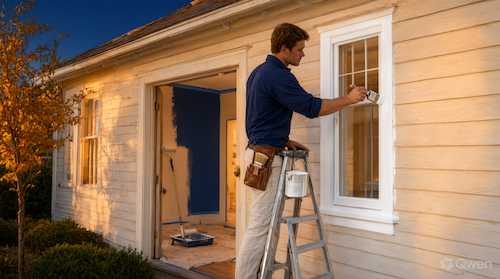
Two thirds of the housing in this metro, 66.2%, predates 1980, and much of the inner core is masonry with wood trim rather than a wood-sided house. That produces a painting conversation that is different from most of the country: the wall may be brick that should be left alone, the woodwork may be a triple-decker porch with a dozen turned balusters, and the color may be reviewed by someone other than the owner. Getting the sequence right matters, because the wrong coating on masonry causes damage that no amount of repainting repairs.
Brick was not designed to be painted
Unpainted brick and stucco are meant to dry through the wall, and a film-forming coating on the surface blocks that path. Trapped moisture then spalls the face of the brick, which is irreversible. If the masonry has already been painted, the practical goal changes to keeping water out without sealing it in: a breathable masonry coating, careful preparation of the failed areas, and attention to where the water is actually entering — often a parapet cap, a window head or a failed joint rather than the wall itself. Repointing with the wrong mortar hardness does its own damage, so it belongs to a mason, not a painter.
Triple-decker porches are the big wood job
A three-storey porch with columns, turned balusters, a beadboard ceiling and a stair rail is a lot of surface area in a small footprint, and it takes weather on every side. The failures are predictable: the bottom of the posts where splash hits, the tread nosings, the horizontal rails, and the joints where water sits. Preparation is the whole job here — scraping and sanding back to sound wood, priming bare spots with the right primer, and treating open joints with sealant that can move. A proposal that prices the porch by square footage without describing the prep is a proposal that will look good for two seasons.
In some neighborhoods the color is a reviewed decision
Parts of Boston, Cambridge and Brookline sit inside historic districts where exterior changes, including color in some cases, are subject to review. Even where color is not regulated, the wrong sheen or an inappropriate coating on a masonry building can be a problem at the review stage for other work. Ask before the paint is ordered, not after, and get the answer from the local historical commission for the specific address. It also helps to keep a record of the colors used, since matching an existing palette in five years is easier with a code than with a photograph.
Lead paint carries specific legal weight in Massachusetts
With two thirds of the housing stock built before 1978, lead paint is a live issue on most exterior and interior jobs, and Massachusetts has its own requirements that go beyond the federal ones — particularly for rental property and for homes where young children live. The practical questions for any contractor are how surfaces will be tested, how dust and chips will be contained, how debris leaves the site, and what documentation is provided at the end. A vague answer is a reason to look further, and owner-occupancy does not exempt the work from safe practices.
Salt air, wind, and the north side
On the eastern edge of the metro, salt spray and wind-driven rain attack the seaward elevations, and metal fittings corrode faster than inland. North-facing walls stay damp longer and grow mildew, which needs a coating that resists it rather than a thicker coat of the same paint. Ask whether the product specification differs by elevation, and whether the fasteners, flashing and rail caps that trap water are being addressed. On a coastal building, hardware and preparation usually decide the outcome more than the topcoat.
What to pin down in a Boston painting estimate
Where this page stops
No prices are published and no assessment of a specific building is made here. Masonry deterioration, rot and flashing failures should be evaluated by someone qualified to inspect the assembly, and lead and historic-district requirements belong to the state and the local authority.
Boston metro context
ACS 2024 5-year estimates report about 5.0 million residents, 1.94 million households and 2.06 million housing units, with 61.6% owner-occupied. About 66.2% of units were built before 1980 and only 46.6% are single-family detached, which is why so much of the exterior painting work here happens on shared and attached buildings. NOAA's Logan station records January at 29.9°F, July at 74.1°F, 43.6 inches of precipitation and 49.2 inches of snow, with frequent winter freeze-thaw cycles.
Boston housing age and reference station
| Indicator | Value | Source |
|---|---|---|
| Housing units built before 1980 | 66.2% | U.S. Census Bureau |
| Single-family detached share | 46.6% | U.S. Census Bureau |
| Owner-occupied share | 61.6% | U.S. Census Bureau |
| January mean temperature | 29.9°F | NOAA NCEI |
| July mean temperature | 74.1°F | NOAA NCEI |
| Annual precipitation | 43.6 in. | NOAA NCEI |
Housing age is a proxy for the likelihood of lead paint and for the number of existing coatings. It does not establish the condition of any particular building.
Frequently Asked Questions
Should painted brick be stripped?
Usually not. Stripping masonry is difficult, can damage the surface, and often leaves a worse substrate. Where brick is already painted, the practical approach is a breathable coating and proper preparation, plus fixing the water source that caused the paint to fail.
How often does a triple-decker exterior need work?
There is no fixed interval, and porches usually need attention before the siding does because they take water on every face. Inspect the post bases, tread nosings and rail joints each spring; those are the places that fail first.
Do I need approval to change my exterior color?
Possibly, if the building is in a historic district or subject to an architectural review. Ask the local historical commission for the address before ordering paint. Even where color is not reviewed, changing the coating type on masonry can require approval for other work later.
What does lead-safe painting involve in Massachusetts?
Testing or presuming lead on pre-1978 surfaces, containing dust and chips during preparation, controlling debris removal, and documenting the work. The state's requirements differ from the federal rule in some situations, particularly rentals, so confirm the applicable standard for the property.
Why does the paint on my seaward wall fail first?
Salt spray, wind-driven rain and more intense sun exposure on that elevation. The fix is a specification that recognizes the exposure rather than one product for the whole building, plus attention to metal fittings and any joint where water sits.
Is it worth painting a masonry building at all?
Only for a specific reason: it was already painted and needs maintenance, or there is a color or composition issue to address. On sound unpainted brick or stucco, the usual recommendation is to leave it alone and repair the joints and flashings instead.
Sources and review date
- American Community Survey 2024 5-year estimates (CBSA tables) — U.S. Census Bureau, 2024 ACS 5-year estimates.
- 1991–2020 station normals — BOSTON LOGAN INTL AP, MA US (USW00014739) — NOAA National Centers for Environmental Information, 1991–2020 climate normals.
Reviewed on 2026-11-18.