
Boston, MA-NH · metro guide
Solar Panels in Boston: Old Roofs, Shade, and Shared Buildings
The panels are the easy part. The roof, the neighbors and the utility are where these projects are decided.
Metro snapshot
Boston in numbers
Sources named below each block
- Population
- 5.0M
- Households
- 1.9M
- Housing units
- 2.1M
- People / household
- 2.55
- population ÷ households
Owner-occupied homes 62%
The rest are rented. Owners are the ones who commission most exterior work.
Single-family detached 47%
Detached houses carry their own roof, gutters and exterior walls.
Built before 1980 66%
Older housing stock shapes what fails first: gutters, flashing, pipe material.
Season
The year in Boston
- Precipitation
- 43.6 in
- Snowfall
- 49.2 in
Average temperature by month, °F — the shape of the year is what decides when exterior work gets done.
Precipitation by month, inches.
Snowfall by month, inches.
| Month | Average temperature (°F) | Precipitation (in) | Snowfall (in) |
|---|---|---|---|
| January | 29.9°F | 3.39 in | 14.3 in |
| February | 31.8°F | 3.21 in | 14.4 in |
| March | 38.3°F | 4.17 in | 9.0 in |
| April | 48.6°F | 3.63 in | 1.6 in |
| May | 58.4°F | 3.25 in | 0.0 in |
| June | 68.0°F | 3.89 in | 0.0 in |
| July | 74.1°F | 3.27 in | 0.0 in |
| August | 72.7°F | 3.23 in | 0.0 in |
| September | 65.6°F | 3.56 in | 0.0 in |
| October | 54.8°F | 4.03 in | 0.2 in |
| November | 44.7°F | 3.66 in | 0.7 in |
| December | 35.7°F | 4.30 in | 9.0 in |
NOAA 1991–2020 climate normals, station BOSTON LOGAN INTL AP, MA US (USW00014739). Station observations, not a metro-wide average — a metro that spans a mountain range can differ by more than this record shows.
Population, households and housing shares: U.S. Census Bureau, American Community Survey 2024 5-year estimates, metropolitan statistical area.
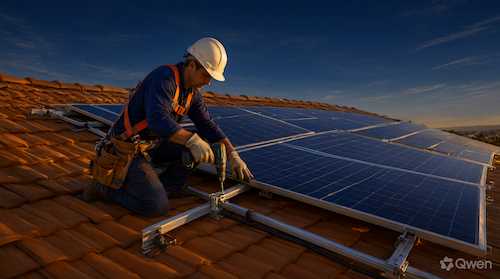
Boston is not a difficult place to make electricity from sunlight, but it is a difficult place to find a roof that suits an array without complications. Two thirds of the housing stock predates 1980, the inner-ring buildings are frequently attached, the tree canopy is dense, and a meaningful share of addresses sit inside historic districts. A solar proposal that begins with an annual kilowatt-hour figure and works backwards is skipping the four questions that actually decide these projects: what the roof is made of, how old it is, who owns it, and what the utility will allow.
Slate, rubber, and everything in between
A slate roof — still common on older Boston and Cambridge buildings — is not a surface to drill casually. Slate is repairable by a specializt and expensive to damage, and mounting hardware requires a detail that respects how the covering sheds water. Low-slope roofs on triple-deckers usually carry a membrane, which is a different mounting problem again and is often nearing the end of its life. Ask what the roof covering is, how old it is, what its remaining service life is, and whether the installer has worked on that specific material. If the answer is vague, get a roofer's opinion before signing anything.
Shade in the city arrives from next door
In dense neighborhoods the shading object is often a neighboring building, not a tree on the property, and it changes with the season and with whatever gets built next. A summer afternoon shade study will miss the low winter sun that clears a roofline in December and February. Ask which hours of the year were modelled, whether the design uses micro-inverters or optimizers, and what happens if a neighbor adds a storey or a dormer. The last question has no contractual answer, which is why over-sizing a small clean plane is often better than spreading panels across a shaded one.
Who owns the roof matters more than the roof
Only 46.6% of metro housing units are single-family detached, so a large share of Boston-area solar interest comes from people who own a unit rather than a building. In a condo, the roof is usually common property and an installation needs association approval, an allocation of the benefit, and an agreement about what happens when the roof is replaced or the unit is sold. In a rented or landlord-owned building the question is the landlord's. Ask for the ownership structure in writing before commissioning a design, and ask who is responsible for removal and reinstallation if the roof is redone.
Historic districts and visible installations
Where a district or a local commission reviews exterior changes, a visible array can require approval, sometimes with conditions on placement or on how the equipment reads from the street. Ask whether the address is in a district, whether the installation would be visible from a public way, and whether the installer has dealt with that commission before. Planning for this early is much cheaper than discovering it after the equipment is ordered, and it is one of the few parts of a solar project where a delay is entirely predictable.
Interconnection and program rules keep changing
Massachusetts has revised its net metering and incentive structure several times, and the terms that apply are the ones in force when the application is processed. That makes paperwork timing a financial variable rather than an administrative detail. Ask who files the interconnection request with the utility, what the expected review window is, how exported power is credited under the current rules, and what happens if the program changes between the application and the approval. Get the answer in writing, since a verbal summary of a changing program is not something you can rely on later.
What to ask a solar installer here
Where this page stops
No production estimates, prices or incentives are published here, and they would be misleading without a site assessment. Roof condition, structural capacity and shading require inspection, while financial and regulatory questions belong to a qualified adviser and the utility.
Boston metro context
Census ACS 2024 5-year estimates put the metro at about 5.0 million residents, 1.94 million households and 2.06 million housing units, with 61.6% owner-occupied. Only 46.6% of units are single-family detached and 66.2% predate 1980, which is why roof ownership and roof material lead this page. NOAA's Logan station records January at 29.9°F, July at 74.1°F, 43.6 inches of precipitation and 49.2 inches of snow — a climate where snow usually clears between storms rather than sitting on an array for months.
Boston roof ownership context and seasonal conditions
| Indicator | Value | Source |
|---|---|---|
| Single-family detached share | 46.6% | U.S. Census Bureau |
| Housing units built before 1980 | 66.2% | U.S. Census Bureau |
| Owner-occupied share | 61.6% | U.S. Census Bureau |
| January mean temperature | 29.9°F | NOAA NCEI |
| July mean temperature | 74.1°F | NOAA NCEI |
| Annual snowfall | 49.2 in. | NOAA NCEI |
The detached share indicates how often a roof is shared or association-owned rather than controlled by one household. It says nothing about any individual building's suitability.
Frequently Asked Questions
Can solar panels be installed on a slate roof?
Sometimes, but it requires mounting details designed for slate and a contractor who has done it. Slate is expensive to repair and easy to damage, so the safer sequence is to have a slate specializt confirm the roof's condition before any array is designed.
What if my condo building has a shared roof?
The roof is usually common property, so installation needs association approval, a clear allocation of the electricity and credits, and an agreement about removal if the roof is replaced. Start with the association documents rather than with a solar quote.
Does snow stop production in Boston?
It reduces it for a few days at a time. Snow here usually clears between storms and often slides off pitched arrays, so the annual effect is smaller than in climates where snow sits for months. Production is still concentrated in the spring and summer months.
Will my energy bill go to zero?
Rarely. Billing has fixed charges, and the credit for exported power depends on the current program rules and on how much the household consumes when the array is producing. Ask for a monthly view rather than an annual total.
Do I need approval in a historic district?
Possibly, if the installation is visible from a public way or the district reviews exterior changes. Ask the local commission for the specific address before equipment is ordered, and ask whether the installer has worked there before.
What happens to the panels if the roof needs replacement?
They have to be removed and reinstalled, which is a real cost and should be planned for. If the roof is within a few years of replacement, doing it first avoids paying for the disconnection twice.
Sources and review date
- American Community Survey 2024 5-year estimates (CBSA tables) — U.S. Census Bureau, 2024 ACS 5-year estimates.
- 1991–2020 station normals — BOSTON LOGAN INTL AP, MA US (USW00014739) — NOAA National Centers for Environmental Information, 1991–2020 climate normals.
Reviewed on 2026-11-18.