
Boston, MA-NH · metro guide
Water Damage Restoration in Boston: Thaws, Flat Roofs, and Shared Ceilings
In a triple-decker, the water rarely stays in the unit where it started.
Metro snapshot
Boston in numbers
Sources named below each block
- Population
- 5.0M
- Households
- 1.9M
- Housing units
- 2.1M
- People / household
- 2.55
- population ÷ households
Owner-occupied homes 62%
The rest are rented. Owners are the ones who commission most exterior work.
Single-family detached 47%
Detached houses carry their own roof, gutters and exterior walls.
Built before 1980 66%
Older housing stock shapes what fails first: gutters, flashing, pipe material.
Season
The year in Boston
- Precipitation
- 43.6 in
- Snowfall
- 49.2 in
Average temperature by month, °F — the shape of the year is what decides when exterior work gets done.
Precipitation by month, inches.
Snowfall by month, inches.
| Month | Average temperature (°F) | Precipitation (in) | Snowfall (in) |
|---|---|---|---|
| January | 29.9°F | 3.39 in | 14.3 in |
| February | 31.8°F | 3.21 in | 14.4 in |
| March | 38.3°F | 4.17 in | 9.0 in |
| April | 48.6°F | 3.63 in | 1.6 in |
| May | 58.4°F | 3.25 in | 0.0 in |
| June | 68.0°F | 3.89 in | 0.0 in |
| July | 74.1°F | 3.27 in | 0.0 in |
| August | 72.7°F | 3.23 in | 0.0 in |
| September | 65.6°F | 3.56 in | 0.0 in |
| October | 54.8°F | 4.03 in | 0.2 in |
| November | 44.7°F | 3.66 in | 0.7 in |
| December | 35.7°F | 4.30 in | 9.0 in |
NOAA 1991–2020 climate normals, station BOSTON LOGAN INTL AP, MA US (USW00014739). Station observations, not a metro-wide average — a metro that spans a mountain range can differ by more than this record shows.
Population, households and housing shares: U.S. Census Bureau, American Community Survey 2024 5-year estimates, metropolitan statistical area.
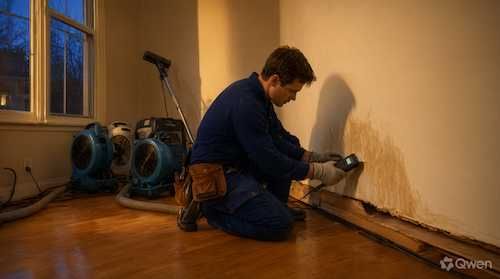
Boston's water damage pattern differs from the inland Midwest in two ways that matter. First, the winter is milder but far less stable — 49.2 inches of snow arrives in storms that are often followed by rain and a thaw, so the roof and the ground are repeatedly loaded and unloaded. Second, only 46.6% of metro housing units are single-family detached. A leak in a triple-decker in Somerville or a rowhouse in the South End starts in one unit and shows up in another, which turns a drying job into a conversation between neighbors, landlords and insurers.
The mid-winter thaw does the damage
A Boston January can produce twelve inches of snow and 45°F rain in the same week. Each cycle drives meltwater against the roof covering, into old masonry, and along the ground beside the foundation. Ice damming still happens on older roofs with warm attics, and the tell-tale stain appears at a ceiling near an exterior wall. The useful question after the water is controlled is what the repeated cycle is finding: failed flashing at a chimney or a dormer, a blocked roof drain, a masonry joint that has been repointed badly, or grading that sends the thaw toward the wall.
Low-slope roofs and where the leak actually is
Triple-deckers, rowhouse roofs added behind parapets, and rear additions often have low-slope or flat roofs drained by internal leaders or scuppers. Water on a flat roof can travel a long way before it appears indoors, so the stain on the third floor is frequently not below the hole — it is below wherever the deck finally sags. When a flat roof leak is investigated, ask how the source was identified, whether a drain or a scupper was cleared, and whether the parapet cap and base flashing were examined rather than just the field of the roof.
Basements in filled ground and high water tables
Parts of Boston and Cambridge sit on filled land where the water table is high and the basement is effectively below it. Those basements do not fail because of a crack in one wall; they take water through the floor and at the cove joint when the level rises. In the same storm, older combined sewers can back up through a floor drain, which looks like the same problem and is handled differently. Distinguishing groundwater from a sewer backup is the first technical question in any Boston basement, because it determines the cleanup protocol, the insurance claim and whether a sump or a backwater valve is the appropriate next step.
Water crosses unit lines, and so does responsibility
In a two- or three-family building, a supply failure on the second floor reaches the first floor ceiling within minutes, and the first-floor owner is now involved whether or not they own the pipe that failed. Condo and landlord policies divide responsibility in ways that are rarely obvious. Ask who is documenting the loss, whose adjuster is involved, and how the scope is being divided between units. Also ask whether the building's common areas — hall ceilings, stairwells, shared basement — are being recorded, because they are the most frequently overlooked part of a multi-unit claim.
Drying an old building takes longer than the chart says
Plaster and lath, solid masonry walls, and several layers of flooring hold water differently from modern assemblies. A drying plan built on standard drywall assumptions will call a plaster wall dry before it is. Ask for moisture readings by material and location, a stated dry standard, and a check-back before the rebuild. In masonry buildings, drying too fast with aggressive heat can also drive salts to the surface and damage the plaster, so the pace matters as much as the equipment.
Questions to ask in the first day
Where this page stops
This page does not assess a specific loss and publishes no prices. Sewage, active leaks and any suspected mold require on-site assessment. Coverage and responsibility questions belong to the insurers, the association and the policy documents.
Boston metro context
ACS 2024 5-year estimates report about 5.0 million residents in 1.94 million households and 2.06 million housing units. Only 46.6% are single-family detached and 61.6% are owner-occupied, while 66.2% of units were built before 1980 — an older, denser stock where water travels between units. NOAA's Logan station records January at 29.9°F, July at 74.1°F, 43.6 inches of precipitation and 49.2 inches of snow, with the snow arriving mostly in a few large storms separated by thaws.
Boston snow, thaw and housing type
| Indicator | Value | Source |
|---|---|---|
| Annual snowfall | 49.2 in. | NOAA NCEI |
| January mean temperature | 29.9°F | NOAA NCEI |
| Annual precipitation | 43.6 in. | NOAA NCEI |
| Single-family detached share | 46.6% | U.S. Census Bureau |
| Housing units built before 1980 | 66.2% | U.S. Census Bureau |
| Metro households | 1,940,688 | U.S. Census Bureau |
Precipitation normals are annual totals for one station. A January that alternates snow and rain produces more water at the roof and the foundation than the same total spread evenly.
Frequently Asked Questions
Why does my ceiling stain appear after a thaw rather than during the storm?
Because meltwater moves slowly through the assembly. It enters at a flashing, a masonry joint or an ice dam, travels along a joist or a wall cavity, and reaches the ceiling surface hours or days later. That delay is why tracing the entry point matters more than patching the stain.
My neighbor's pipe leaked into my unit. Whose insurance handles it?
It depends on the policies and the building's ownership structure, and the answer is rarely intuitive. Document your own loss independently, notify your insurer, and ask in writing how the two carriers intend to divide the scope rather than relying on a verbal understanding.
How do I tell a sewer backup from groundwater in the basement?
A sewer backup usually arrives through a floor drain or a fixture and may carry solids and odor; groundwater seeps at the wall base or the floor joint and is comparatively clear. The distinction matters because cleanup requirements and insurance treatment differ significantly.
Is a sump pump useful in a Boston basement?
In areas with high groundwater it can be, provided it discharges to a lawful point and has a backup for power loss. Where the problem is a combined sewer backing up rather than groundwater, a backwater valve addresses a different failure and the two are often confused.
How long should a plaster wall take to dry?
Longer than drywall, and longer than most standard drying charts assume, because lath and multiple coats hold water. Ask for readings rather than a day count, and for a recheck before the rebuild is scheduled.
Should common areas be included in the claim documentation?
Yes. Hall ceilings, stairwells and shared basements are frequently missed because each owner documents only their own unit. Photograph and record them at the same time as the unit interior, since they are part of the same event.
Sources and review date
- American Community Survey 2024 5-year estimates (CBSA tables) — U.S. Census Bureau, 2024 ACS 5-year estimates.
- 1991–2020 station normals — BOSTON LOGAN INTL AP, MA US (USW00014739) — NOAA National Centers for Environmental Information, 1991–2020 climate normals.
Reviewed on 2026-11-18.