
Chicago, IL-IN · metro guide
Painting in Chicago: Preparation, Products, and Timing
Chicago paint work succeeds or fails on preparation and moisture control, especially on exteriors that face freeze-thaw cycles and snow.
Metro snapshot
Chicago in numbers
Sources named below each block
- Population
- 9.4M
- Households
- 3.6M
- Housing units
- 3.9M
- People / household
- 2.57
- population ÷ households
Owner-occupied homes 66%
The rest are rented. Owners are the ones who commission most exterior work.
Single-family detached 52%
Detached houses carry their own roof, gutters and exterior walls.
Built before 1980 63%
Older housing stock shapes what fails first: gutters, flashing, pipe material.
Season
The year in Chicago
- Precipitation
- 37.9 in
- Snowfall
- 38.4 in
Average temperature by month, °F — the shape of the year is what decides when exterior work gets done.
Precipitation by month, inches.
Snowfall by month, inches.
| Month | Average temperature (°F) | Precipitation (in) | Snowfall (in) |
|---|---|---|---|
| January | 25.2°F | 1.99 in | 11.3 in |
| February | 28.8°F | 1.97 in | 10.7 in |
| March | 39.0°F | 2.45 in | 5.5 in |
| April | 49.7°F | 3.75 in | 1.3 in |
| May | 60.6°F | 4.49 in | 0.0 in |
| June | 70.6°F | 4.10 in | 0.0 in |
| July | 75.4°F | 3.71 in | 0.0 in |
| August | 73.8°F | 4.25 in | 0.0 in |
| September | 66.3°F | 3.19 in | 0.0 in |
| October | 54.0°F | 3.43 in | 0.2 in |
| November | 41.3°F | 2.42 in | 1.8 in |
| December | 30.5°F | 2.11 in | 7.6 in |
NOAA 1991–2020 climate normals, station CHICAGO OHARE INTL AP, IL US (USW00094846). Station observations, not a metro-wide average — a metro that spans a mountain range can differ by more than this record shows.
Population, households and housing shares: U.S. Census Bureau, American Community Survey 2024 5-year estimates, metropolitan statistical area.
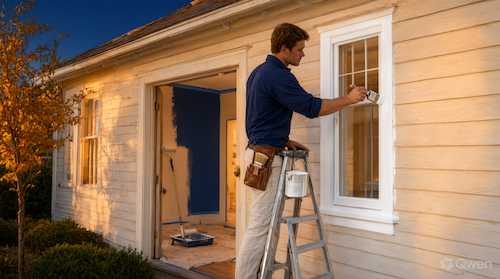
Chicago is hard on paint. January at O'Hare averages 25.2°F, the station records about 38.4 inches of snow and 37.9 inches of precipitation in a typical year, and older homes move with every freeze. A finish that looks good in June can be peeling by the second spring if the surface underneath was not prepared for that cycle.
Preparation is the part you cannot see later
Ask what happens before the first coat: washing, scraping, sanding, filling, caulking, spot priming, and masking. Each item should be described for the surfaces actually being painted, because trim, siding, masonry, and interior drywall fail differently. A proposal that lists a product and a coat count but not preparation is quoting the visible half of the job.
Moisture and freeze-thaw
Exterior failures often start where water gets behind the coating: failing caulk, gaps at trim, blocked weep holes, or downspouts that discharge against the wall. Painting over an active moisture path shortens the life of the new finish. Ask how the contractor handles cracks and whether any repairs are excluded, and confirm that surfaces are dry before priming.
Products, sheen, and the number of coats
The product line, sheen, and primer should match the surface and the exposure. Ask for the specific products rather than a generic 'premium paint', and ask why that primer was chosen. Coat count matters, but two well-prepped coats usually outperform three coats over a surface that was not cleaned or sanded.
Seasonal timing for exteriors and interiors
Exterior work depends on temperature, moisture, and wind, so scheduling around the freeze matters. Interior work depends on ventilation and cure time: in a cold month, the house may need to stay closed with heat on, which affects drying and odor. Ask for a sequence and for the conditions that would stop work.
Older homes need a different conversation
About 62.7% of metro housing units were built before 1980, according to ACS estimates. In older homes, ask how the contractor handles lead-safe work practices and how they will treat previously painted trim that may need stripping. Neither question is a diagnosis of your house; both are standard for the age of the stock.
Questions to put in the proposal
Limits of this guide
This page does not specify a coating system for a specific surface and does not publish local prices. Older homes may require lead-safe work practices, which must be confirmed with the responsible authority and a qualified professional.
Chicago metro context
The 2024 ACS 5-year estimates put the metro at about 9.4 million residents and 3.6 million households. About 65.5% of occupied homes are owner-occupied, and about 51.5% of housing units are single-family detached — the segment where exterior painting decisions usually sit with the owner. These figures describe the metro, not a particular house.
Chicago reference station and housing indicators
| Indicator | Value | Source |
|---|---|---|
| January mean temperature | 25.2°F | NOAA NCEI |
| July mean temperature | 75.4°F | NOAA NCEI |
| Annual precipitation | 37.9 in. | NOAA NCEI |
| Annual snowfall | 38.4 in. | NOAA NCEI |
| Metro population | 9,371,595 | U.S. Census Bureau |
| Housing units built before 1980 | 62.7% | U.S. Census Bureau |
Station normals are historical averages for one location, not a forecast. Census values describe the metro area, not an individual building.
Frequently Asked Questions
What matters more: preparation or the number of coats?
Preparation usually determines how the finish performs. Cleaning, repairs, sanding, and priming should be described explicitly; coat count alone does not show what was done first.
What is the difference between primer and paint?
Primer prepares the surface and improves adhesion or blocks stains; topcoat provides color and finish. Ask which primer is specified and why it fits the surface.
How should moisture stains be treated before painting?
The source of moisture should be addressed first, then the stain sealed with an appropriate primer. Painting over an active leak or a damp wall will not fix it.
How long should paint dry before furniture returns?
Drying and cure times depend on the product, temperature, humidity, and ventilation. Ask for the manufacturer's guidance for the specific product used, and allow more time in cold weather.
Do older Chicago homes need special painting precautions?
Paint in older homes may contain lead, and work practices depend on the condition of the surfaces and local requirements. Ask how the contractor handles lead-safe work and confirm requirements with the responsible authority.
What is the population of the Chicago metro area?
The U.S. Census Bureau's 2024 ACS 5-year estimates report about 9.4 million residents in the metro area. The figure describes regional scale, not the number of homes or providers.
Sources and review date
- American Community Survey 2024 5-year estimates (CBSA tables) — U.S. Census Bureau, 2024 ACS 5-year estimates.
- 1991–2020 station normals — CHICAGO OHARE INTL AP, IL US (USW00094846) — NOAA National Centers for Environmental Information, 1991–2020 climate normals.
Reviewed on 2026-11-17.