
Cincinnati, OH-KY-IN · metro guide
Painting in Cincinnati: Brick, Wood, and Freeze-Thaw
In a metro where more than half the houses predate 1980, painting is repair work on brick, wood, and decades of coatings.
Metro snapshot
Cincinnati in numbers
Sources named below each block
- Population
- 2.3M
- Households
- 907K
- Housing units
- 967K
- People / household
- 2.50
- population ÷ households
Owner-occupied homes 68%
The rest are rented. Owners are the ones who commission most exterior work.
Single-family detached 66%
Detached houses carry their own roof, gutters and exterior walls.
Built before 1980 56%
Older housing stock shapes what fails first: gutters, flashing, pipe material.
Season
The year in Cincinnati
- Precipitation
- 45.3 in
- Snowfall
- 23.3 in
Average temperature by month, °F — the shape of the year is what decides when exterior work gets done.
Precipitation by month, inches.
Snowfall by month, inches.
| Month | Average temperature (°F) | Precipitation (in) | Snowfall (in) |
|---|---|---|---|
| January | 31.4°F | 3.30 in | 7.7 in |
| February | 34.7°F | 3.17 in | 6.7 in |
| March | 43.6°F | 4.16 in | 3.4 in |
| April | 54.6°F | 4.53 in | 0.4 in |
| May | 64.1°F | 4.67 in | 0.0 in |
| June | 72.3°F | 4.75 in | 0.0 in |
| July | 75.9°F | 3.83 in | 0.0 in |
| August | 74.9°F | 3.43 in | 0.0 in |
| September | 68.1°F | 3.11 in | 0.0 in |
| October | 56.2°F | 3.35 in | 0.2 in |
| November | 44.4°F | 3.23 in | 0.8 in |
| December | 35.6°F | 3.73 in | 4.1 in |
NOAA 1991–2020 climate normals, station CINCINNATI NORTHERN KY AP, KY US (USW00093814). Station observations, not a metro-wide average — a metro that spans a mountain range can differ by more than this record shows.
Population, households and housing shares: U.S. Census Bureau, American Community Survey 2024 5-year estimates, metropolitan statistical area.
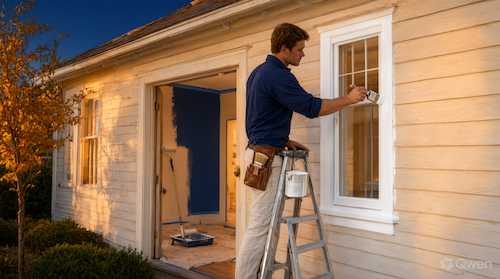
About 55.7% of Cincinnati metro housing units were built before 1980, according to ACS estimates, and many are much older. That means brick, wood trim, and several decades of coatings, plus the possibility of lead-based paint in anything built before 1978. The preparation is the scope, and the finish is the last step of it.
Brick and masonry
Ask how masonry is cleaned and whether a coating is appropriate at all. Brick that has been painted needs careful preparation, and moisture trapped behind a coating can spall the face of the brick. Ask what the contractor recommends and why, rather than accepting a generic exterior package.
Wood trim and caulk joints
Ask how failing wood, rotted trim, and open joints are repaired before coating. Water enters at seams, freezes, and opens them further each winter. Replacing failing caulk and back-priming trim is unglamorous work that decides how long the finish holds.
Lead-safe work practices
For homes built before 1978, ask whether the contractor follows lead-safe renovation practices, what containment they use, and how debris is handled. Ask for the documentation they provide. Disturbing old coatings without containment is a health question, not a scheduling one.
Timing between frosts
Ask how surface moisture and temperature are checked and what range the product requires. Cincinnati's shoulder seasons can bring warm afternoons and freezing nights, and a coating applied in the afternoon may cure in conditions the manufacturer did not intend.
Questions to ask before you sign
Where this page stops
This page does not estimate cost or specify products for a particular property, and it does not provide a lead assessment. Lead-safe requirements and any testing obligations depend on the property and the jurisdiction and should be confirmed with the responsible local authority.
Cincinnati metro context
The 2024 ACS 5-year estimates put the metro at about 2.3 million residents and 907,000 households. About 68.3% of occupied homes are owner-occupied, and about 66.3% of housing units are single-family detached, so most exterior work happens on owner-occupied houses. About 55.7% of housing units were built before 1980. This page reports Census indicators only; a NOAA station is not included for this metro in the site dataset.
Cincinnati metro housing indicators
| Indicator | Value | Source |
|---|---|---|
| Metro population | 2,270,706 | U.S. Census Bureau |
| Households | 906,675 | U.S. Census Bureau |
| Owner-occupied share | 68.3% | U.S. Census Bureau |
| Single-family detached share | 66.3% | U.S. Census Bureau |
| Housing units built before 1980 | 55.7% | U.S. Census Bureau |
Census values describe the metro area, not an individual property. A climate station is not reported for this metro in the site dataset.
Frequently Asked Questions
Should I paint brick in Cincinnati?
That is a technical decision rather than a cosmetic one. Painted brick needs careful preparation, and moisture trapped behind a coating can damage the masonry. Ask what the contractor recommends and why.
Do I need lead-safe practices?
Homes built before 1978 may contain lead-based paint, and disturbing it requires care and often specific work practices. Ask the contractor what they follow and what documentation they provide.
Why does paint peel around windows and trim?
Those areas take the most water and freeze-thaw cycles, especially where caulk has failed. Ask how joints are repaired and whether trim is back-primed.
When can exteriors be painted here?
It depends on the product's temperature and moisture requirements, and nights can freeze even when days are warm. Ask how the schedule accounts for that.
What should a painting estimate include?
Surface preparation, carpentry and caulking repair, priming, products with names and sheens, coat counts, containment and cleanup, schedule, exclusions, and the warranty.
What is the population of the Cincinnati metro area?
The U.S. Census Bureau's 2024 ACS 5-year estimates report about 2.3 million residents in the metro area. The figure describes regional scale, not the number of homes or providers.
Sources and review date
- American Community Survey 2024 5-year estimates (CBSA tables) — U.S. Census Bureau, 2024 ACS 5-year estimates.
Reviewed on 2026-11-18.