
Denver, CO · metro guide
Painting in Denver: Sun, Hail, and Freeze-Thaw
Denver coatings fail from sun and hail in summer and from freeze-thaw at every seam in winter.
Metro snapshot
Denver in numbers
Sources named below each block
- Population
- 3.0M
- Households
- 1.2M
- Housing units
- 1.3M
- People / household
- 2.46
- population ÷ households
Owner-occupied homes 64%
The rest are rented. Owners are the ones who commission most exterior work.
Single-family detached 57%
Detached houses carry their own roof, gutters and exterior walls.
Built before 1980 41%
Older housing stock shapes what fails first: gutters, flashing, pipe material.
Season
The year in Denver
- Precipitation
- 14.5 in
- Snowfall
- —
Average temperature by month, °F — the shape of the year is what decides when exterior work gets done.
Precipitation by month, inches.
| Month | Average temperature (°F) | Precipitation (in) | Snowfall (in) |
|---|---|---|---|
| January | 31.7°F | 0.38 in | — |
| February | 32.7°F | 0.41 in | — |
| March | 41.6°F | 0.86 in | — |
| April | 47.8°F | 1.68 in | — |
| May | 57.4°F | 2.16 in | — |
| June | 68.2°F | 1.94 in | — |
| July | 75.1°F | 2.14 in | — |
| August | 72.9°F | 1.58 in | — |
| September | 64.8°F | 1.35 in | — |
| October | 51.1°F | 0.99 in | — |
| November | 39.4°F | 0.64 in | — |
| December | 31.2°F | 0.35 in | — |
NOAA 1991–2020 climate normals, station DENVER INTL AP, CO US (USW00003017). Station observations, not a metro-wide average — a metro that spans a mountain range can differ by more than this record shows.
Population, households and housing shares: U.S. Census Bureau, American Community Survey 2024 5-year estimates, metropolitan statistical area.
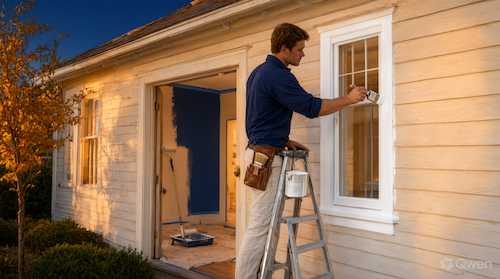
Denver's elevation means intense UV, and its winters mean repeated freezing and thawing at every joint, seam, and south-facing surface that warms during the day. Add hail that can bruise wood and chip stucco, and the useful question becomes how the surface was prepared rather than which color to choose.
UV and surface temperature
Ask which products are specified for the sunniest surfaces and why. High-altitude UV breaks down binders faster, and dark colors absorb more heat and show it first. Ask about sheen and product choice for each material, and get product names and coat counts in the written scope.
Prep and existing damage
Ask what washing, scraping, sanding, patching, and priming are included, and how hail bruises and impact marks are handled. Paint that has lost adhesion has to be removed or stabilized, not covered. Compare the prep descriptions line by line before comparing totals.
Seams, caulk, and freeze-thaw
Ask how caulk joints, window trim, and transitions between materials are treated. Water enters at seams, freezes, and opens them further each season. Replacing failing caulk and back-priming trim is unglamorous work that determines how long the finish holds.
Testing and timing
Ask how surface moisture is checked and what temperature range the product requires. Denver days can be warm while nights freeze, so a coating applied in the afternoon may cure in conditions the manufacturer did not intend. Ask how the schedule accounts for that.
Questions to ask before you sign
Where this page stops
This page does not estimate cost or specify products for a particular property. Coating performance depends on the substrate, moisture, preparation, and application, and lead-safe requirements apply to older housing, which should be confirmed with the responsible local authority.
Denver metro context
The 2024 ACS 5-year estimates put the metro at about 3.0 million residents and 1.2 million households. About 64.1% of occupied homes are owner-occupied, and about 57.1% of housing units are single-family detached, so most exterior painting happens on private homes. About 41.0% of housing units were built before 1980. NOAA's Denver station records January averaging 31.7°F, July 75.1°F, and about 14.5 inches of precipitation a year.
Denver reference station and housing indicators
| Indicator | Value | Source |
|---|---|---|
| January mean temperature | 31.7°F | NOAA NCEI |
| July mean temperature | 75.1°F | NOAA NCEI |
| Annual precipitation | 14.5 in. | NOAA NCEI |
| Metro population | 3,002,721 | U.S. Census Bureau |
| Owner-occupied share | 64.1% | U.S. Census Bureau |
| Housing units built before 1980 | 41.0% | U.S. Census Bureau |
Station normals are historical averages for one location, not a forecast. Census values describe the metro area, not an individual property.
Frequently Asked Questions
How often should a Denver exterior be repainted?
It depends on the substrate, sun exposure, and hail history. Ask a contractor to assess the current coating's condition rather than relying on a fixed interval.
Does high altitude affect paint?
Intense UV breaks down coatings faster, and temperature swings affect curing. Ask which products are specified for sun exposure and how the contractor manages application temperatures.
How are hail dents and chips handled before painting?
Damaged areas need patching, sanding, and priming before coating. Ask how impact damage is identified and repaired, and whether carpentry is included.
Why do caulk joints fail here?
Water enters, freezes, and expands, opening joints further each season. Ask whether failing caulk is removed and replaced and whether trim is back-primed.
When can exterior painting be done?
It depends on the product's temperature and moisture requirements, and nights can freeze even when days are warm. Ask how the schedule accounts for that.
What is the population of the Denver metro area?
The U.S. Census Bureau's 2024 ACS 5-year estimates report about 3.0 million residents in the metro area. The figure describes regional scale, not the number of homes or providers.
Sources and review date
- American Community Survey 2024 5-year estimates (CBSA tables) — U.S. Census Bureau, 2024 ACS 5-year estimates.
- 1991–2020 station normals — DENVER INTL AP, CO US (USW00003017) — NOAA National Centers for Environmental Information, 1991–2020 climate normals.
Reviewed on 2026-11-17.