
Denver, CO · metro guide
Window Cleaning in Denver: Altitude Sun, Dust and Hard Water
A mile up, the sun is stronger, the air is drier and the water in the bucket carries more minerals.
Metro snapshot
Denver in numbers
Sources named below each block
- Population
- 3.0M
- Households
- 1.2M
- Housing units
- 1.3M
- People / household
- 2.46
- population ÷ households
Owner-occupied homes 64%
The rest are rented. Owners are the ones who commission most exterior work.
Single-family detached 57%
Detached houses carry their own roof, gutters and exterior walls.
Built before 1980 41%
Older housing stock shapes what fails first: gutters, flashing, pipe material.
Season
The year in Denver
- Precipitation
- 14.5 in
- Snowfall
- —
Average temperature by month, °F — the shape of the year is what decides when exterior work gets done.
Precipitation by month, inches.
| Month | Average temperature (°F) | Precipitation (in) | Snowfall (in) |
|---|---|---|---|
| January | 31.7°F | 0.38 in | — |
| February | 32.7°F | 0.41 in | — |
| March | 41.6°F | 0.86 in | — |
| April | 47.8°F | 1.68 in | — |
| May | 57.4°F | 2.16 in | — |
| June | 68.2°F | 1.94 in | — |
| July | 75.1°F | 2.14 in | — |
| August | 72.9°F | 1.58 in | — |
| September | 64.8°F | 1.35 in | — |
| October | 51.1°F | 0.99 in | — |
| November | 39.4°F | 0.64 in | — |
| December | 31.2°F | 0.35 in | — |
NOAA 1991–2020 climate normals, station DENVER INTL AP, CO US (USW00003017). Station observations, not a metro-wide average — a metro that spans a mountain range can differ by more than this record shows.
Population, households and housing shares: U.S. Census Bureau, American Community Survey 2024 5-year estimates, metropolitan statistical area.
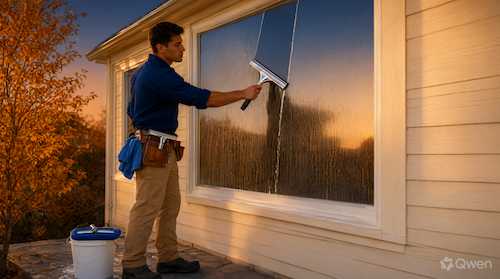
Denver's windows are attacked from three directions at once. The altitude means less atmosphere to filter ultraviolet light, so films and coatings break down faster and glass that would last elsewhere hazes sooner. The climate is dry — 14.5 inches of precipitation a year at the airport station, most of it outside summer — so dust from the plains and from construction sites travels easily and settles as a gray film. And the water is mineral-rich, which is why the spots on the glass after a sprinkler pass are not dirt but deposits that bond to the surface.
Dry air means dust travels further
In a humid climate dust sticks to whatever is near the road. Here it lifts and carries, so a window facing an open field, a new subdivision or a gravel alley collects a fine layer that rain does not always wash off — it can dry into a paste that needs actual cleaning. That is why exterior glass here re-soils uniformly rather than in streaks, and why treating the glass with a mask or a hydrophobic product is worth discussing rather than adding visits. Ask where the dust is coming from before deciding how often to clean.
Hard water and the spots it leaves
The metro is served largely by mountain snowmelt, which sounds clean but carries dissolved minerals picked up as it runs, and the spot pattern on glass is the evidence. Sprinklers are the usual culprit: a head that throws water onto a window leaves deposits on every cycle, and after a season those deposits can etch the surface. Water-fed pole cleaning exists precisely to avoid this, because the minerals are stripped out before the water touches the glass. Ask which method is used for the final rinse and whether any coated or filmed glass is in the scope.
Sloping sites and upper floors
A lot of the metro is built on ground that falls away from the street, which means a rear elevation can be a full storey higher from the garden side than from the front. Ladder placement on a slope needs levelling and a second person, while a water-fed pole from the ground avoids the problem entirely on exteriors. Ask how each elevation will be reached, because a quote built on the front of the house often misses what the back requires.
Hail, screens and the seasonal window
Hail is a normal summer event along the Front Range, and it damages screens and can pit older glass — so the timing of a cleaning visit matters. Cleaning before hail season means the glass is clean when the damage happens and the marks are easier to attribute; cleaning after it means the debris is gone but the evidence may be too. Ask the contractor to note pre-existing pitting or screen damage before the work starts, especially between May and August.
A mile up, the sun works faster
At this elevation the ultraviolet load is markedly higher and the air is thin and dry, so a wet surface dries in minutes rather than tens of minutes. On glass that means any solution left behind flashes off and leaves its solids on the pane, and the same sun that dries it also cures the film in place. It is the single most common reason a competent clean looks streaked here. Ask how the contractor sequences elevations through the day and whether shaded sides are scheduled for the middle of it.
What to pin down in the estimate
Where this page stops
No prices are quoted and no property is assessed here. Whether a mark on glass is a deposit, an etch or physical damage can only be judged at the window, and insurance questions belong to the insurer.
Denver metro context
The 2024 ACS 5-year estimates describe about 3.00 million residents in 1,221,636 households and 1,290,063 housing units, with 64.1% owner-occupied and 57.1% single-family detached. About 41.0% of units predate 1980. At the Denver reference station January averages 31.7°F and July 75.1°F, on 14.5 inches of annual precipitation — a dry climate with a wetter late-summer pattern.
Denver reference station and housing indicators
| Indicator | Value | Source |
|---|---|---|
| January mean temperature | 31.7°F | NOAA NCEI |
| July mean temperature | 75.1°F | NOAA NCEI |
| Annual precipitation | 14.5 in. | NOAA NCEI |
| Metro population | 3,002,721 | U.S. Census Bureau |
| Owner-occupied share | 64.1% | U.S. Census Bureau |
| Housing units built before 1980 | 41.0% | U.S. Census Bureau |
Station normals are historical averages for one location, not a forecast. A dry annual total with a late-summer wet season is what makes dust and mineral spotting — rather than rain streaking — the characteriztic problem here.
Frequently Asked Questions
Why do my windows look dusty rather than dirty?
Because the air is dry and dust travels. In a low-humidity climate, fine material lifts from fields, sites and gravel and settles as a uniform film instead of sticking near the road. Rain that dries on that film can leave a paste that needs cleaning rather than rinsing.
Why do sprinklers leave permanent marks on glass?
The water carries dissolved minerals. When a sprinkler wets a window and the water evaporates, the minerals stay and bond, and after a season they can etch the glass. Moving the head or switching the final rinse to purified water prevents it.
Do I need purified water cleaning at this altitude?
It is the method that avoids leaving minerals on the glass, and it allows a pole to reach upper floors from the ground. Whether it suits a particular building depends on access and on whether interiors, screens and tracks are in scope.
What happens to window cleaning during hail season?
Screens can be torn and older glass pitted, so the timing relative to a storm matters. Ask for the condition of screens and glass to be recorded before work starts, especially between late spring and late summer.
How does the slope of my lot affect the price?
A rear elevation can sit a full storey higher from the garden than from the street. Ladders on sloping ground need levelling and a second person, while a pole from the ground avoids it — but the access has to be planned for each elevation, not assumed.
Does UV really change how often glass needs cleaning?
It changes how fast films and coatings degrade. At altitude there is less atmosphere to filter ultraviolet, so deposits bake on and factory coatings break down sooner than at sea level. That argues for a shorter interval rather than a harder scrub.
Sources and review date
- American Community Survey 2024 5-year estimates (CBSA tables) — U.S. Census Bureau, 2024 ACS 5-year estimates.
- 1991–2020 station normals — DENVER INTL AP, CO US (USW00003017) — NOAA National Centers for Environmental Information, 1991–2020 climate normals.
Reviewed on 2026-11-18.