
Grand Rapids, MI · metro guide
Window Cleaning in Grand Rapids: Lake-Effect Snow, Salt and Spring Pollen
Half the housing predates 1980, and every winter throws salt and freeze-thaw at the glass on the street side.
Metro snapshot
Grand Rapids in numbers
Sources named below each block
- Population
- 1.2M
- Households
- 440K
- Housing units
- 468K
- People / household
- 2.64
- population ÷ households
Owner-occupied homes 75%
The rest are rented. Owners are the ones who commission most exterior work.
Single-family detached 69%
Detached houses carry their own roof, gutters and exterior walls.
Built before 1980 51%
Older housing stock shapes what fails first: gutters, flashing, pipe material.
Season
The year in Grand Rapids
- Precipitation
- 39.4 in
- Snowfall
- 77.6 in
Average temperature by month, °F — the shape of the year is what decides when exterior work gets done.
Precipitation by month, inches.
Snowfall by month, inches.
| Month | Average temperature (°F) | Precipitation (in) | Snowfall (in) |
|---|---|---|---|
| January | 24.8°F | 2.52 in | 22.6 in |
| February | 26.6°F | 2.12 in | 17.2 in |
| March | 35.7°F | 2.39 in | 7.6 in |
| April | 47.6°F | 3.99 in | 2.0 in |
| May | 59.2°F | 4.00 in | 0.0 in |
| June | 68.9°F | 3.94 in | 0.0 in |
| July | 72.8°F | 3.86 in | 0.0 in |
| August | 71.1°F | 3.55 in | 0.0 in |
| September | 63.5°F | 3.43 in | 0.0 in |
| October | 51.5°F | 4.02 in | 0.3 in |
| November | 40.0°F | 3.10 in | 7.1 in |
| December | 30.4°F | 2.48 in | 20.8 in |
NOAA 1991–2020 climate normals, station GRAND RAPIDS, MI US (USW00094860). Station observations, not a metro-wide average — a metro that spans a mountain range can differ by more than this record shows.
Population, households and housing shares: U.S. Census Bureau, American Community Survey 2024 5-year estimates, metropolitan statistical area.
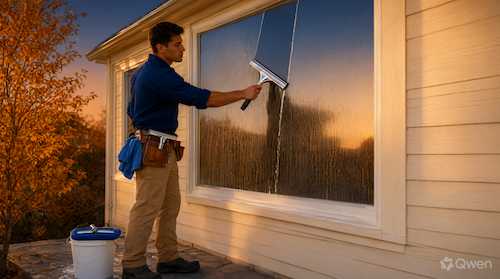
Grand Rapids is an old, owner-heavy metro: 51.0% of the housing predates 1980 and 74.6% of units are owner-occupied, so most glass belongs to a household with a long interest in maintaining it. The winter is the defining condition. Lake-effect snow and road salt combine to put a salt film on the street-facing glass that survives until spring, and repeated freeze-thaw works on wooden sashes, putty and frame joints that were not built for it.
Road salt on the street elevations
Salt spray from passing traffic lands on glass, frames and hardware, and it stays there because the melting and refreezing keeps it in contact. On aluminum frames it dulls the finish and corrodes fixings; on glass it leaves a film that looks like a permanent haze. The street elevation usually needs attention first in spring, not the garden side. Ask whether frames and hardware are being rinsed as well as the glass.
Freeze-thaw and old sashes
Water that gets into a joint, swells and then freezes is how putty and paint begin to fail on an older window. Half the stock here predates 1980, so a lot of the glass sits in sashes with many coats of paint and original putty. Ask how the contractor treats loose putty and flaking paint, because a cleaning method that soaks the frame speeds up the failure.
A short, intense spring
Once the freeze ends, the metro delivers a concentrated pollen season from the surrounding hardwoods and pines, and glass that was clean in March is coated by May. Cleaning early in the spring is largely wasted; the useful visit is after the pollen settles. Ask how the contractor schedules spring work around it.
Sand and grit from winter roads
Winter grit thrown onto glass is abrasive, and the first warm-weekend clean often drags it across the surface. That is how scratched panes appear on a house where nothing has changed except the season. Ask whether the glass is flushed before any wiping, particularly on the street side.
A short window between freeze and heat
Easterly work is limited by freezing temperatures: water on glass or on a ladder freezes, and water-fed poles can ice up. That concentrates exterior work into a few months and makes early booking matter. Ask how the schedule handles a job that would otherwise run into a cold snap.
What to pin down in the estimate
Where this page stops
No prices are quoted and no property is assessed here. Rot, failing putty and salt corrosion are findings that need inspection at the window, and any repair belongs to someone qualified to judge the frame.
Grand Rapids metro context
The 2024 ACS 5-year estimates describe about 1.16 million residents in 440,316 households and 467,528 housing units, with 74.6% owner-occupied and 68.6% single-family detached. About 51.0% of units predate 1980. No climate station is reported for this metro in the site dataset, so no temperature or precipitation normals appear on this page.
Grand Rapids housing indicators
| Indicator | Value | Source |
|---|---|---|
| Housing units built before 1980 | 51.0% | U.S. Census Bureau |
| Single-family detached share | 68.6% | U.S. Census Bureau |
| Owner-occupied share | 74.6% | U.S. Census Bureau |
| Metro households | 440,316 | U.S. Census Bureau |
| Housing units | 467,528 | U.S. Census Bureau |
| Metro population | 1,162,152 | U.S. Census Bureau |
Station normals are historical averages for one location, not a forecast. Glass condition depends on how often the surface is wetted and what the water carries.
Frequently Asked Questions
Why does one side of the house never look clean?
The street elevation collects salt and grit all winter. Until it is rinsed rather than wiped, the film returns after every wet freeze.
Does salt damage window frames?
It keeps metal damp and attacks fixings, which is why aluminum dulls and hardware corrodes. Cleaning the glass alone leaves the more expensive problem in place.
When is the best time to clean windows here?
After the pollen season settles in late spring, and before the first freeze. The usable exterior window is narrower than in a milder climate.
Can cleaning damage old windows?
If the frame is soaked or scraped, yes. Loose putty and flaking paint are the parts at risk, so the method should protect the frame rather than the other way round.
Why do I see scratches that were not there before?
Winter grit is abrasive. Wiping a dry pane drags it across the glass, and the scratch is permanent.
Do I need to be home?
Exterior work can usually be done unattended with agreed access. Interior work needs someone present to clear sills and floors.
Sources and review date
- American Community Survey 2024 5-year estimates (CBSA tables) — U.S. Census Bureau, 2024 ACS 5-year estimates.
Reviewed on 2026-11-18.