
Grand Rapids, MI · metro guide
HVAC in Grand Rapids: Lake-Effect Cold and Houses That Never Had Ducts
This side of the state gets the snow, and the heating system earns its keep.
Metro snapshot
Grand Rapids in numbers
Sources named below each block
- Population
- 1.2M
- Households
- 440K
- Housing units
- 468K
- People / household
- 2.64
- population ÷ households
Owner-occupied homes 75%
The rest are rented. Owners are the ones who commission most exterior work.
Single-family detached 69%
Detached houses carry their own roof, gutters and exterior walls.
Built before 1980 51%
Older housing stock shapes what fails first: gutters, flashing, pipe material.
Season
The year in Grand Rapids
- Precipitation
- 39.4 in
- Snowfall
- 77.6 in
Average temperature by month, °F — the shape of the year is what decides when exterior work gets done.
Precipitation by month, inches.
Snowfall by month, inches.
| Month | Average temperature (°F) | Precipitation (in) | Snowfall (in) |
|---|---|---|---|
| January | 24.8°F | 2.52 in | 22.6 in |
| February | 26.6°F | 2.12 in | 17.2 in |
| March | 35.7°F | 2.39 in | 7.6 in |
| April | 47.6°F | 3.99 in | 2.0 in |
| May | 59.2°F | 4.00 in | 0.0 in |
| June | 68.9°F | 3.94 in | 0.0 in |
| July | 72.8°F | 3.86 in | 0.0 in |
| August | 71.1°F | 3.55 in | 0.0 in |
| September | 63.5°F | 3.43 in | 0.0 in |
| October | 51.5°F | 4.02 in | 0.3 in |
| November | 40.0°F | 3.10 in | 7.1 in |
| December | 30.4°F | 2.48 in | 20.8 in |
NOAA 1991–2020 climate normals, station GRAND RAPIDS, MI US (USW00094860). Station observations, not a metro-wide average — a metro that spans a mountain range can differ by more than this record shows.
Population, households and housing shares: U.S. Census Bureau, American Community Survey 2024 5-year estimates, metropolitan statistical area.
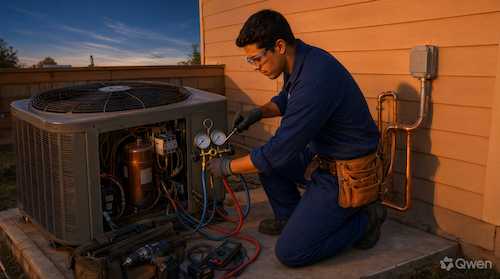
West Michigan sits where lake-effect weather delivers snow in repeated bands, and the heating season runs long. With 51.0% of metro housing predating 1980, a great deal of the stock was heated by a furnace or a boiler before ductwork was a design assumption, and cooling was an afterthought — window units in a couple of rooms. The result is a market where the heating system is the important equipment and the cooling question is often about what can be added without demolishing walls to make room for ducts.
What a heating system has to prove
Two measurements matter and are often skipped. The first is combustion: what the flue gases show about how the appliance is burning, which is a safety question before it is an efficiency one. The second is the heat exchanger, because a cracked exchanger in an older furnace is a genuine hazard and is not visible from the outside. Ask what the service includes, whether combustion analysis is performed, and whether the exchanger was inspected. A visit that changes a filter and lights the burner has not answered either question.
Boilers and radiators are still common
Older houses here often have hot water radiators fed by a boiler, sometimes steam. Both work well and both are maintained differently, and a contractor who treats one as the other will misdiagnose the problem. Ask which system the house has, what the boiler's condition is, whether the radiators will be balanced, and what the basement provides in venting and combustion air. Replacement is not automatically the right answer for a working hydronic system.
Adding cooling to a house without ducts
The realiztic routes are conventional ducts through chases and soffits, a high-velocity small-duct system, or ductless mini-splits. Each has trade-offs: small-duct systems need careful design and do not expand casually, and mini-splits serve rooms individually unless the layout is planned. Ask how many heads or outlets are proposed, which rooms they serve, what happens to the rooms left out, and where the outdoor unit will sit relative to a neighbor's window or a bedroom.
Sizing for a real winter
A heating-dominated climate punishes undersizing more obviously than oversizing, but both matter: a system that cycles constantly runs less efficiently and wears faster. Ask for a load calculation rather than a square-footage rule, and ask what outdoor design temperature was used. If a heat pump is proposed, ask what the balance point is, what the backup heat source is, and how many hours a year backup is expected to run — that number drives both comfort and the bill.
Outdoor equipment in a snowy climate
A heat pump or a high-efficiency furnace vents outdoors, and in a lake-effect winter that means snow and ice. Ask how the outdoor unit is elevated above expected snow depth, whether a shelter is recommended, and how the defrost cycle behaves in wet snow. A unit buried in a drift will not work well, and one that is sheltered badly can recirculate cold air.
Service before the first cold week
Equipment fails when it works hardest, and that is also when every contractor is booked. Autumn service on the heating side, spring on the cooling side, and a clean filter schedule cover most of the risk. Ask what the seasonal visit includes and whether priority scheduling is part of the agreement, and keep the reports — a documented service history is useful when the equipment eventually fails.
What a proposal should answer
Where this page stops
No prices and no equipment recommendations are published here. Sizing, combustion safety and refrigerant work require on-site assessment by a licensed professional, and permit questions belong to the local authority.
Grand Rapids metro context
ACS 2024 5-year estimates describe about 1.16 million residents in 440,316 households and 467,528 housing units, with 74.6% owner-occupied — the highest ownership rate on this site — and 68.6% single-family detached. About 51.0% of units were built before 1980, which is why pre-ductwork houses and older boilers are common. A climate station is not reported for this metro in the site dataset, so no temperature or snowfall normals appear here.
Grand Rapids housing indicators
| Indicator | Value | Source |
|---|---|---|
| Housing units built before 1980 | 51.0% | U.S. Census Bureau |
| Single-family detached share | 68.6% | U.S. Census Bureau |
| Owner-occupied share | 74.6% | U.S. Census Bureau |
| Metro households | 440,316 | U.S. Census Bureau |
| Housing units | 467,528 | U.S. Census Bureau |
| Metro population | 1,162,152 | U.S. Census Bureau |
No climate normals are shown because no station record is held for this metro in the site dataset. Lake-effect snowfall varies sharply over short distances, so local design conditions matter.
Frequently Asked Questions
How do I know if my furnace's heat exchanger is safe?
It has to be inspected, and in an older furnace that means opening the unit rather than looking at it. Ask specifically whether the exchanger was inspected and what combustion testing showed, and get the findings in writing.
Can central air be added to my house?
Often, but the route matters. Conventional ducts need space that older houses may not have, small-duct systems need careful design, and mini-splits serve individual rooms. Ask what each option would involve in your layout.
Should I keep my boiler and radiators?
Usually yes if the system works. Hydronic heat is comfortable and quiet, and ductwork in an older house means losing space. The common reason to change is air conditioning, which can often be added with a mini-split system instead.
Does lake-effect snow affect the equipment?
It can. An outdoor unit buried in a drift loses performance, and venting can be obstructed. Ask how the equipment is elevated and whether a shelter is appropriate for the layout.
How often should heating equipment be serviced?
Annually before the heating season, and a cooling check in spring. With a long heating season here, skipping the autumn visit is the expensive choice.
What is a balance point?
The outdoor temperature at which a heat pump can no longer meet the house's heating load on its own, so the backup heat takes over. It determines how much auxiliary heat runs and therefore what the winter bill looks like.
Sources and review date
- American Community Survey 2024 5-year estimates (CBSA tables) — U.S. Census Bureau, 2024 ACS 5-year estimates.
Reviewed on 2026-11-18.