
Detroit, MI · metro guide
HVAC in Detroit: Boilers, No Ductwork, and a Long Heating Season
Half the inner ring is heated by radiators, and the cooling question is what to do about a house with no ducts.
Metro snapshot
Detroit in numbers
Sources named below each block
- Population
- 4.4M
- Households
- 1.8M
- Housing units
- 1.9M
- People / household
- 2.47
- population ÷ households
Owner-occupied homes 71%
The rest are rented. Owners are the ones who commission most exterior work.
Single-family detached 70%
Detached houses carry their own roof, gutters and exterior walls.
Built before 1980 66%
Older housing stock shapes what fails first: gutters, flashing, pipe material.
Season
The year in Detroit
- Precipitation
- 34.3 in
- Snowfall
- 45 in
Average temperature by month, °F — the shape of the year is what decides when exterior work gets done.
Precipitation by month, inches.
Snowfall by month, inches.
| Month | Average temperature (°F) | Precipitation (in) | Snowfall (in) |
|---|---|---|---|
| January | 25.8°F | 2.23 in | 14.0 in |
| February | 28.0°F | 2.08 in | 12.5 in |
| March | 37.2°F | 2.43 in | 6.2 in |
| April | 48.9°F | 3.26 in | 1.5 in |
| May | 60.3°F | 3.72 in | 0.0 in |
| June | 69.9°F | 3.26 in | 0.0 in |
| July | 74.1°F | 3.51 in | 0.0 in |
| August | 72.3°F | 3.26 in | 0.0 in |
| September | 64.9°F | 3.22 in | 0.0 in |
| October | 53.0°F | 2.53 in | 0.0 in |
| November | 41.2°F | 2.57 in | 1.9 in |
| December | 31.3°F | 2.25 in | 8.9 in |
NOAA 1991–2020 climate normals, station DETROIT METRO AP, MI US (USW00094847). Station observations, not a metro-wide average — a metro that spans a mountain range can differ by more than this record shows.
Population, households and housing shares: U.S. Census Bureau, American Community Survey 2024 5-year estimates, metropolitan statistical area.
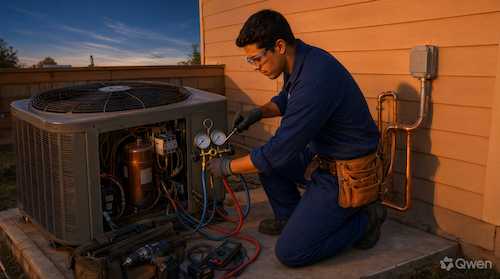
In a metro where 66.3% of the housing predates 1980, heating systems were installed before ductwork was standard: hot water radiators, steam radiators from earlier decades, and a boiler in the basement. Many of those systems still work well and are comfortable to live with. The complication is cooling. A 1925 Detroit bungalow has no chases for ductwork, and adding central air means either finding space in a house that has none or choosing a ductless approach. That single constraint drives most of the HVAC decisions in the inner ring.
Keeping a boiler is often the right answer
A working hydronic system is quiet, even and cheap to keep running relative to replacement. The important distinction is steam versus hot water, because they are maintained differently and a contractor who treats one as the other will misdiagnose the problem. Ask which system the house has, what the boiler's condition and efficiency are, whether the radiators will be balanced, and what venting and combustion air the basement provides. If replacement is proposed, ask why, and ask what happens to the distribution system.
Retrofitting cooling into a house with no ducts
There are three realiztic paths: conventional ducts run through chases and dropped soffits, a high-velocity small-duct system, or ductless mini-splits serving individual rooms. Each has real trade-offs. Small-duct systems need careful design and do not expand casually; mini-splits heat and cool room by room unless the layout is planned. Ask how many outlets or heads are proposed, which rooms they serve, what happens to the rooms left out, and where the outdoor unit will sit relative to the neighbor's bedroom window.
Sizing for the winter that actually happens
A heating-dominated climate punishes oversizing less obviously than a cooling-dominated one, but it still matters: a unit that cycles constantly runs less efficiently and wears faster. Ask for a load calculation rather than a square-footage rule, and ask what outdoor design temperature was used. If a heat pump is proposed, ask what the balance point is, what the backup heat source is, and how many hours a year the backup is expected to run — that number drives both comfort and the gas or electric bill.
Basements, damp and the equipment down there
Almost every house in this stock has a basement, and that is where the furnace or boiler sits. A damp basement is hard on equipment: corrosion at the flue, rust on the jacket, and moisture in the electronics. Ask whether the basement has a history of water, whether the flue and chimney have been inspected, and whether the equipment is raised off the floor. If the basement is being finished, plan the mechanical work before the walls go up rather than after.
Service before the season
The first cold week is the worst time to discover a failed circulator or ignitor, and it is also when every contractor is booked. Autumn service on the heating side, spring on the cooling side, and a clean filter schedule cover most of the risk. Ask what the seasonal visit includes — combustion verification, heat exchanger inspection, and a check of the expansion tank and relief valve — and whether priority scheduling is part of the agreement.
What a proposal should answer
Where this page stops
No prices and no equipment recommendations are published here. Sizing, combustion safety and refrigerant work require on-site assessment by a licensed professional, and permit questions belong to the local authority.
Detroit metro context
ACS 2024 5-year estimates describe about 4.38 million residents in 1,768,816 households and 1,926,157 housing units, with 71.2% owner-occupied and 69.8% single-family detached. About 66.3% of units were built before 1980, which is why boilers, radiators and ductless retrofits dominate the local conversation. A climate station is not reported for this metro in the site dataset, so no temperature normals appear on this page.
Detroit housing indicators
| Indicator | Value | Source |
|---|---|---|
| Housing units built before 1980 | 66.3% | U.S. Census Bureau |
| Single-family detached share | 69.8% | U.S. Census Bureau |
| Owner-occupied share | 71.2% | U.S. Census Bureau |
| Metro households | 1,768,816 | U.S. Census Bureau |
| Housing units | 1,926,157 | U.S. Census Bureau |
| Metro population | 4,376,828 | U.S. Census Bureau |
No climate normals are shown because no station record is held for this metro in the site dataset. Design loads must be calculated for the specific house rather than taken from a regional average.
Mapped in OpenStreetMap
HVAC businesses mapped in the Detroit metro
OpenStreetMap contributors have mapped 39 hvac entries inside the Detroit-Warren-Dearborn, MI CBSA; 38 have a name. This is a map-coverage indicator, not a count of all licensed hvac businesses in the metro.
- Mapped entries
- 39
- OSM features
- Phone listed
- 56%
- 22 of 39
- Website listed
- 51%
- 20 of 39
- Street address
- 87%
- 34 of 39
OSM coverage varies by area: a low count can mean low mapping activity, not a small market. OpenStreetMap does not record contractor licenses. To check a license, use the Michigan LARA skilled-trades lookup. Residential builder or maintenance & alteration licence from $600; electrical, plumbing and mechanical are separate.
Query: craft=hvac.
Snapshot: 2026-11-17. Data:
© OpenStreetMap contributors,
ODbL 1.0.
CBSA boundary:
U.S. Census Bureau, 2023.
Frequently Asked Questions
Should I keep my radiators or switch to forced air?
Radiators and a boiler in good condition are comfortable and worth keeping, especially where ductwork means losing space to chases. The common reason to switch is air conditioning, and a ductless system can often provide that without removing the radiators.
How do I tell steam from hot water heat?
Steam systems have a boiler that boils water, radiators with a vent near the top, and pipes that may knock. Hot water systems run a circulator pump. The distinction changes maintenance and repair, so confirm it before booking service.
Can central air be added to my house?
Often, but the route matters. Conventional ducts need space that older houses may not have, small-duct systems need careful design, and mini-splits serve rooms individually. Ask what each option would involve in your specific layout before choosing.
Why is the basement so important to the HVAC system?
Because that is where the equipment sits in most of this housing stock, and damp conditions corrode flues and jackets. A basement with a water history affects the equipment as well as the structure, so it belongs in the conversation.
How often should heating equipment be serviced?
Annually before the heating season for combustion equipment, plus a cooling check in spring. In this climate the heating side does most of the work, so skipping the autumn visit is the more expensive choice.
What should combustion testing include?
Measurement of the flue gases and verification that the appliance is venting properly, along with a heat exchanger inspection and a check of the venting and combustion air. A visit that only changes a filter has not done this.
Sources and review date
- American Community Survey 2024 5-year estimates (CBSA tables) — U.S. Census Bureau, 2024 ACS 5-year estimates.
- OpenStreetMap contributors — craft=hvac features in the Detroit-Warren-Dearborn, MI CBSA — OpenStreetMap contributors, Snapshot 2026-11-17.
Reviewed on 2026-11-18.