
Indianapolis, IN · metro guide
Gutter Cleaning in Indianapolis: Flat Lots, Clay and Basement Water
Flat ground and clay mean the discharge point is the whole problem.
Metro snapshot
Indianapolis in numbers
Sources named below each block
- Population
- 2.1M
- Households
- 843K
- Housing units
- 910K
- People / household
- 2.53
- population ÷ households
Owner-occupied homes 67%
The rest are rented. Owners are the ones who commission most exterior work.
Single-family detached 69%
Detached houses carry their own roof, gutters and exterior walls.
Built before 1980 47%
Older housing stock shapes what fails first: gutters, flashing, pipe material.
Season
The year in Indianapolis
- Precipitation
- 43.6 in
- Snowfall
- 25.5 in
Average temperature by month, °F — the shape of the year is what decides when exterior work gets done.
Precipitation by month, inches.
Snowfall by month, inches.
| Month | Average temperature (°F) | Precipitation (in) | Snowfall (in) |
|---|---|---|---|
| January | 28.5°F | 3.12 in | 8.8 in |
| February | 32.5°F | 2.43 in | 6.0 in |
| March | 42.4°F | 3.69 in | 3.2 in |
| April | 53.6°F | 4.34 in | 0.2 in |
| May | 63.6°F | 4.75 in | 0.0 in |
| June | 72.5°F | 4.95 in | 0.0 in |
| July | 75.8°F | 4.42 in | 0.0 in |
| August | 74.7°F | 3.20 in | 0.0 in |
| September | 67.8°F | 3.14 in | 0.0 in |
| October | 55.5°F | 3.22 in | 0.1 in |
| November | 43.3°F | 3.45 in | 0.8 in |
| December | 33.3°F | 2.92 in | 6.4 in |
NOAA 1991–2020 climate normals, station INDIANAPOLIS, IN US (USW00093819). Station observations, not a metro-wide average — a metro that spans a mountain range can differ by more than this record shows.
Population, households and housing shares: U.S. Census Bureau, American Community Survey 2024 5-year estimates, metropolitan statistical area.
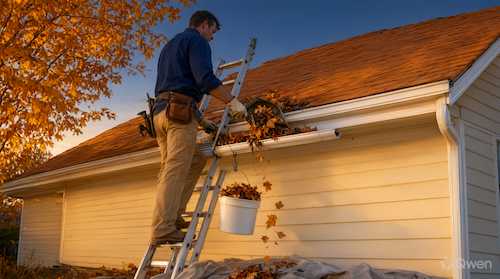
The terrain around Indianapolis is flat and the soil is clay, which together mean roof water does not leave the way it would on a slope or sandy ground. A downspout ending two feet from the wall sends the roof's water along the foundation rather than away from it, and that is where basement damp starts. The debris load is moderate — maples, ash and a heavy pollen season — and the storms arrive in bursts that test a partially blocked run.
Flat lots and slow drainage
With no fall away from the house, water that leaves a downspout sits where it lands. That is why discharge extensions and grading matter here more than the gutter's capacity. Ask where each downspout ends and whether the ground carries water away from the wall.
Basements and sump discharge
Many houses have basements and sump pumps, and where the sump discharges into the same wet area as the downspouts the result is a permanently damp corner. Ask how the two discharges relate, because fixing one without the other rarely helps.
Clay that will not take the water
Clay soil absorbs slowly and sheds what it cannot take, so water pools at the lowest point near the wall. Ask whether discharge is extended into a defined path rather than left at the foundation.
Thunderstorm bursts
Summer storms arrive quickly and heavily, and a restricted run overflows at the fascia and sends water down the wall. Ask whether the outlets are confirmed to flow rather than only cleared.
A moderate but real leaf load
Maples and ash drop over a few weeks, and the volume is enough to block a run without being dramatic. Ask when the autumn visit falls relative to the drop.
What to pin down in the estimate
Where this page stops
No prices are quoted and no property is assessed here. Basement waterproofing, grading and foundation repair are separate trades, and this page gives no drainage design advice.
Indianapolis metro context
The 2024 ACS 5-year estimates describe about 2.13 million residents in 842,765 households and 909,926 housing units, with 66.8% owner-occupied and 69.0% single-family detached. About 47.2% of units predate 1980. No climate station is reported for this metro in the site dataset, so no temperature or precipitation normals appear on this page.
Indianapolis housing indicators
| Indicator | Value | Source |
|---|---|---|
| Housing units built before 1980 | 47.2% | U.S. Census Bureau |
| Single-family detached share | 69.0% | U.S. Census Bureau |
| Owner-occupied share | 66.8% | U.S. Census Bureau |
| Metro households | 842,765 | U.S. Census Bureau |
| Housing units | 909,926 | U.S. Census Bureau |
| Metro population | 2,130,055 | U.S. Census Bureau |
Station normals are historical averages for one location, not a forecast. What a gutter has to carry depends on roof area, pitch, the debris the surrounding trees drop and whether downspouts discharge where the water can leave.
Frequently Asked Questions
Why does my basement get damp after storms?
Usually the discharge. Flat ground and clay mean roof water stays near the wall, and that is where basement damp begins.
Should the sump pump discharge near the downspouts?
It should not end up in the same wet spot. Two sources of water in one place is how a corner stays permanently damp.
How often should gutters be cleared here?
Twice a year, and the autumn visit should follow the leaf drop rather than precede it.
Does a clean gutter guarantee a dry basement?
No. It removes one source of water. Grading, the discharge point and the foundation all matter too.
What are the marks on my siding below the gutter?
Overflow staining. It means the run failed in a storm, which usually means a blocked outlet.
Do I need to be home?
Exterior work can be done with agreed access. Nothing inside the house is involved.
Sources and review date
- American Community Survey 2024 5-year estimates (CBSA tables) — U.S. Census Bureau, 2024 ACS 5-year estimates.
Reviewed on 2026-11-18.