
Cincinnati, OH-KY-IN · metro guide
Gutter Cleaning in Cincinnati: Hillside Lots, Leaf Load and Old Half-Round Runs
A hilly, heavily treed metro where the water has somewhere to go and the gutters are older than the trees above them.
Metro snapshot
Cincinnati in numbers
Sources named below each block
- Population
- 2.3M
- Households
- 907K
- Housing units
- 967K
- People / household
- 2.50
- population ÷ households
Owner-occupied homes 68%
The rest are rented. Owners are the ones who commission most exterior work.
Single-family detached 66%
Detached houses carry their own roof, gutters and exterior walls.
Built before 1980 56%
Older housing stock shapes what fails first: gutters, flashing, pipe material.
Season
The year in Cincinnati
- Precipitation
- 45.3 in
- Snowfall
- 23.3 in
Average temperature by month, °F — the shape of the year is what decides when exterior work gets done.
Precipitation by month, inches.
Snowfall by month, inches.
| Month | Average temperature (°F) | Precipitation (in) | Snowfall (in) |
|---|---|---|---|
| January | 31.4°F | 3.30 in | 7.7 in |
| February | 34.7°F | 3.17 in | 6.7 in |
| March | 43.6°F | 4.16 in | 3.4 in |
| April | 54.6°F | 4.53 in | 0.4 in |
| May | 64.1°F | 4.67 in | 0.0 in |
| June | 72.3°F | 4.75 in | 0.0 in |
| July | 75.9°F | 3.83 in | 0.0 in |
| August | 74.9°F | 3.43 in | 0.0 in |
| September | 68.1°F | 3.11 in | 0.0 in |
| October | 56.2°F | 3.35 in | 0.2 in |
| November | 44.4°F | 3.23 in | 0.8 in |
| December | 35.6°F | 3.73 in | 4.1 in |
NOAA 1991–2020 climate normals, station CINCINNATI NORTHERN KY AP, KY US (USW00093814). Station observations, not a metro-wide average — a metro that spans a mountain range can differ by more than this record shows.
Population, households and housing shares: U.S. Census Bureau, American Community Survey 2024 5-year estimates, metropolitan statistical area.
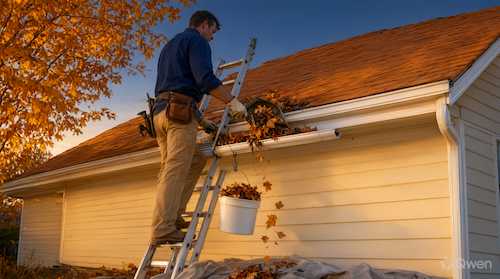
Cincinnati is 55.7% pre-1980 housing on hillsides above the Ohio, and that combination sets the gutter problem. Old houses often still carry the original gutter profile — narrow half-round or four-inch K-style — which has far less capacity than the five- and six-inch runs fitted today, and the hills mean the discharge point matters as much as the gutter: a downspout that empties onto a slope sends water at the foundation rather than away from it.
A heavy deciduous load in a short fall
The metro sits under mature oak, maple and sycamore, and leaf drop is concentrated into a few weeks. A run that is clear in October can be full by mid-November, and once the leaves mat they hold water and stop draining altogether. Ask whether the contractor clears after the drop rather than before it, because the timing decides whether the clean lasts.
Old gutters with less capacity
More than half the housing predates 1980, and many runs are four-inch or narrow half-round profiles sized for a smaller roof area than the house now presents after extensions and re-roofing. They fill faster and overflow at the fascia rather than at the downspout. Ask what profile is on the house and whether the downspout count matches the roof area.
Discharge on a slope
On a hillside lot the downspout may empty onto ground that falls away steeply, which sounds ideal but often means the water runs along the foundation on its way down or scours a channel into the slope. Ask where each downspout discharges and whether extensions or splash blocks are part of the work.
Ice at the valleys and the downspout mouth
Freeze-thaw winters put ice in the gutter and block the downspout outlet, and once that happens meltwater backs up under the roof edge. A gutter that is clear going into winter is the cheapest protection against that, and a blocked one is how ice dams begin. Ask when the late-autumn visit falls.
Fascia, soffit and overflow stains
When a run overflows, the water goes down the fascia and often into the soffit, and the result is paint failure and eventually rot that is invisible from the ground. Overflow stains on the fascia are the visible symptom. Ask whether the contractor reports what they see at the roofline rather than only clearing the channel.
What to pin down in the estimate
Where this page stops
No prices are quoted and no property is assessed here. Rot, failed hangers, ice-dam damage and drainage grading are findings that need inspection, and roof or masonry work belongs to a different trade.
Cincinnati metro context
The 2024 ACS 5-year estimates describe about 2.27 million residents in 906,675 households and 967,188 housing units, with 68.3% owner-occupied and 66.3% single-family detached. About 55.7% of units predate 1980. No climate station is reported for this metro in the site dataset, so no temperature or precipitation normals appear on this page.
Cincinnati housing indicators
| Indicator | Value | Source |
|---|---|---|
| Housing units built before 1980 | 55.7% | U.S. Census Bureau |
| Single-family detached share | 66.3% | U.S. Census Bureau |
| Owner-occupied share | 68.3% | U.S. Census Bureau |
| Metro households | 906,675 | U.S. Census Bureau |
| Housing units | 967,188 | U.S. Census Bureau |
| Metro population | 2,270,706 | U.S. Census Bureau |
Station normals are historical averages for one location, not a forecast. What a gutter has to carry depends on roof area, pitch, the debris the surrounding trees drop and whether downspouts discharge where the water can leave.
Frequently Asked Questions
How often do gutters need clearing here?
Typically twice a year, with the autumn visit after the leaves have fallen rather than during the drop. Homes under heavy canopy often need a third.
Why does water run down the fascia instead of the downspout?
Either the channel is blocked or the run is undersized for the roof area and overflows at the low point. Both look the same from the ground.
Can a blocked gutter cause an ice dam?
Yes. Water that cannot leave backs up under the roof edge and freezes there, which is how ice dams start.
Is a four-inch gutter a problem?
It is not a defect, but it holds less than the five- and six-inch runs fitted today, so it fills sooner and needs clearing more often.
Where should a downspout discharge on a slope?
Away from the foundation and into something that will not scour. On a hillside that usually means an extension or a defined path.
Do gutter guards remove the need for cleaning?
They reduce the load but do not eliminate it. Debris still collects on top and in the run, and fine material passes through.
Sources and review date
- American Community Survey 2024 5-year estimates (CBSA tables) — U.S. Census Bureau, 2024 ACS 5-year estimates.
Reviewed on 2026-11-18.