
Columbus, OH · metro guide
Gutter Cleaning in Columbus: Maple Leaf Load, Ice and Four-Inch Runs
A concentrated leaf fall into a channel that freezes, on half a metro's worth of narrow old runs.
Metro snapshot
Columbus in numbers
Sources named below each block
- Population
- 2.2M
- Households
- 865K
- Housing units
- 926K
- People / household
- 2.52
- population ÷ households
Owner-occupied homes 61%
The rest are rented. Owners are the ones who commission most exterior work.
Single-family detached 61%
Detached houses carry their own roof, gutters and exterior walls.
Built before 1980 48%
Older housing stock shapes what fails first: gutters, flashing, pipe material.
Season
The year in Columbus
- Precipitation
- 41.6 in
- Snowfall
- 28.2 in
Average temperature by month, °F — the shape of the year is what decides when exterior work gets done.
Precipitation by month, inches.
Snowfall by month, inches.
| Month | Average temperature (°F) | Precipitation (in) | Snowfall (in) |
|---|---|---|---|
| January | 29.6°F | 3.00 in | 9.5 in |
| February | 32.5°F | 2.41 in | 7.6 in |
| March | 41.6°F | 3.62 in | 4.1 in |
| April | 53.2°F | 3.85 in | 0.5 in |
| May | 63.3°F | 3.99 in | 0.0 in |
| June | 71.9°F | 4.33 in | 0.0 in |
| July | 75.4°F | 4.67 in | 0.0 in |
| August | 74.0°F | 3.74 in | 0.0 in |
| September | 67.2°F | 3.14 in | 0.0 in |
| October | 55.2°F | 2.90 in | 0.2 in |
| November | 43.6°F | 2.79 in | 1.2 in |
| December | 34.5°F | 3.13 in | 5.1 in |
NOAA 1991–2020 climate normals, station COLUMBUS PORT COLUMBUS INTL AP, OH US (USW00014821). Station observations, not a metro-wide average — a metro that spans a mountain range can differ by more than this record shows.
Population, households and housing shares: U.S. Census Bureau, American Community Survey 2024 5-year estimates, metropolitan statistical area.
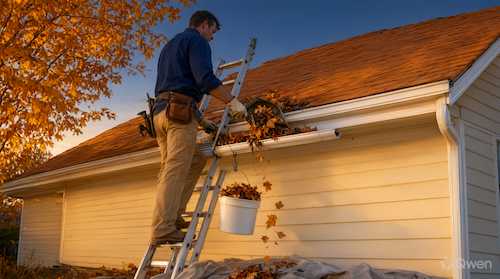
Columbus gets 41.6 inches of rain and 28.2 inches of snow, with a January mean of 29.6°F — cold enough that the gutter spends part of the winter frozen rather than flowing. Nearly half the housing predates 1980 and many of those runs are four-inch or narrow half-round with a single downspout per side, which is the configuration that fails first when leaves arrive and the temperature drops behind them.
Maple and ash drop heavily and late
The region's maples and ashes release their leaves over a few concentrated weeks, and the drop often continues after the first hard frost. A run cleared too early fills again. Ask when the autumn visit is scheduled relative to the drop, not relative to the calendar.
A channel that freezes solid
Once leaves are in the run and the temperature drops, the debris freezes into a plug, and the downspout mouth freezes too. Meltwater then backs up under the roof edge. The clean that matters most here is the one that happens before the first hard freeze, not after.
Narrow runs on older houses
With 47.7% of the stock predating 1980, four-inch K-style and half-round runs with one downspout per elevation are still common, and they were sized for the roof as it was when built. Ask what profile is fitted and whether the downspouts are clear at the outlet, not just at the top.
Downspouts that drain into trouble
Many older houses discharge onto a splash block that has been buried or displaced, or into a buried line that has silted up. Water then sits at the foundation through the winter and refreezes. Ask where each downspout actually ends.
The spring thaw and what it reveals
When the last of the ice goes, the run carries a season's worth of grit and shingle granules at once, and that is when soffit and fascia damage from the winter becomes visible. Ask whether the contractor checks the roofline in spring as well as clearing.
What to pin down in the estimate
Where this page stops
No prices are quoted and no property is assessed here. Ice-dam causes, rot and drainage repair are findings that need inspection, and roof ventilation is a separate question entirely.
Columbus metro context
The 2024 ACS 5-year estimates describe about 2.18 million residents in 864,663 households and 926,466 housing units, with 61.3% owner-occupied and 61.0% single-family detached. About 47.7% of units predate 1980. At the Columbus Port Columbus Intl Ap reference station January averages 29.6°F and July 75.4°F, on 41.6 inches of annual precipitation.
Columbus reference station and housing indicators
| Indicator | Value | Source |
|---|---|---|
| January mean temperature | 29.6°F | NOAA NCEI |
| July mean temperature | 75.4°F | NOAA NCEI |
| Annual precipitation | 41.6 in. | NOAA NCEI |
| Metro population | 2,175,788 | U.S. Census Bureau |
| Owner-occupied share | 61.3% | U.S. Census Bureau |
| Housing units built before 1980 | 47.7% | U.S. Census Bureau |
Station normals are historical averages for one location, not a forecast. What a gutter has to carry depends on roof area, pitch, the debris the surrounding trees drop and whether downspouts discharge where the water can leave.
Frequently Asked Questions
When should gutters be cleaned here?
After the leaves have fallen and before the first hard freeze. A late-November visit is usually the one that matters.
Why does my downspout freeze?
Water standing in it, or debris holding water at the mouth. A clear, free-draining run freezes far less often.
Can blocked gutters cause ice dams?
Yes. Water that cannot drain backs up under the roof edge and freezes there.
Is a four-inch gutter a defect?
No, but it holds less and needs clearing more often than the five- and six-inch runs fitted today.
Where should the downspout end?
Somewhere the water leaves the foundation, which on an older property often means fixing a buried or displaced splash block.
What appears in spring?
Grit, shingle granules and the damage the winter did to fascia and soffit. The spring visit is when that gets noticed.
Sources and review date
- American Community Survey 2024 5-year estimates (CBSA tables) — U.S. Census Bureau, 2024 ACS 5-year estimates.
- 1991–2020 station normals — COLUMBUS PORT COLUMBUS INTL AP, OH US (USW00014821) — NOAA National Centers for Environmental Information, 1991–2020 climate normals.
Reviewed on 2026-11-18.