
Cleveland, OH · metro guide
Gutter Cleaning in Cleveland: Rusted Steel Runs and Lake Snow
The oldest housing stock here, much of it still carrying steel gutters that are rusting from the inside out.
Metro snapshot
Cleveland in numbers
Sources named below each block
- Population
- 2.2M
- Households
- 931K
- Housing units
- 1.0M
- People / household
- 2.33
- population ÷ households
Owner-occupied homes 67%
The rest are rented. Owners are the ones who commission most exterior work.
Single-family detached 66%
Detached houses carry their own roof, gutters and exterior walls.
Built before 1980 72%
Older housing stock shapes what fails first: gutters, flashing, pipe material.
Season
The year in Cleveland
- Precipitation
- 41 in
- Snowfall
- 63.8 in
Average temperature by month, °F — the shape of the year is what decides when exterior work gets done.
Precipitation by month, inches.
Snowfall by month, inches.
| Month | Average temperature (°F) | Precipitation (in) | Snowfall (in) |
|---|---|---|---|
| January | 29.1°F | 2.99 in | 18.4 in |
| February | 31.1°F | 2.49 in | 15.1 in |
| March | 38.9°F | 3.06 in | 10.8 in |
| April | 50.4°F | 3.75 in | 2.7 in |
| May | 61.2°F | 3.79 in | 0.0 in |
| June | 70.4°F | 3.83 in | 0.0 in |
| July | 74.5°F | 3.67 in | 0.0 in |
| August | 73.0°F | 3.56 in | 0.0 in |
| September | 66.4°F | 3.93 in | 0.0 in |
| October | 55.1°F | 3.60 in | 0.1 in |
| November | 44.0°F | 3.37 in | 4.5 in |
| December | 34.3°F | 2.99 in | 12.2 in |
NOAA 1991–2020 climate normals, station CLEVELAND, OH US (USW00014820). Station observations, not a metro-wide average — a metro that spans a mountain range can differ by more than this record shows.
Population, households and housing shares: U.S. Census Bureau, American Community Survey 2024 5-year estimates, metropolitan statistical area.
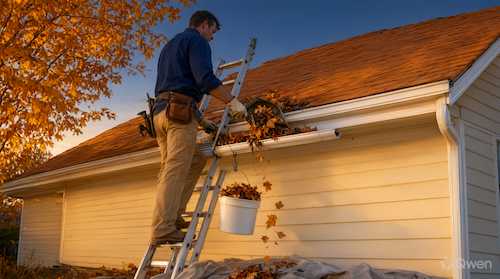
Cleveland has 72.0% of its housing built before 1980 — the highest share in this set — and a lot of that stock still has the original galvanized steel runs. Steel gutters do not fail by filling up quietly; they fail from the inside, where damp debris sits along the base seam for years. Add lake-effect snow and a long freeze and the failures cluster along the bottom of the run and at the outlet.
Steel runs that rust from inside
Debris held in a steel gutter keeps the base metal wet, and rust starts along the bottom seam where it cannot be seen. By the time a stain appears on the fascia the section is usually past patching. Ask whether the material and condition are assessed rather than only cleared.
Ice at the outlet and under the roof edge
A blocked run freezes, and once the outlet is plugged the meltwater backs up under the roof covering. On a house with steel gutters that water also sits against rust. Ask when the autumn clean falls relative to the first freeze.
Lake snow load
Snow off the lake is heavy and can pull a run away from the fascia, especially on old hangers that have been holding for decades. Ask whether hangers and alignment are checked in spring.
Old roofs, old capacity
With nearly three in four units predating 1980, narrow runs sized for the original roof are the norm, and any addition or re-roof has usually increased the area they drain. Ask what profile is fitted and whether the run is carrying more roof than it was sized for.
Salt on the lower runs
Road salt reaches the downspouts and the lower runs on the street side and holds moisture against metal through freeze-thaw, so corrosion is fastest exactly where the run is hardest to see.
What to pin down in the estimate
Where this page stops
No prices are quoted and no property is assessed here. Rust perforation, fascia rot and hanger repair need inspection, and replacing a run is a separate job.
Cleveland metro context
The 2024 ACS 5-year estimates describe about 2.17 million residents in 931,377 households and 1,018,605 housing units, with 66.5% owner-occupied and 66.2% single-family detached. About 72.0% of units predate 1980. No climate station is reported for this metro in the site dataset, so no temperature or precipitation normals appear on this page.
Cleveland housing indicators
| Indicator | Value | Source |
|---|---|---|
| Housing units built before 1980 | 72.0% | U.S. Census Bureau |
| Single-family detached share | 66.2% | U.S. Census Bureau |
| Owner-occupied share | 66.5% | U.S. Census Bureau |
| Metro households | 931,377 | U.S. Census Bureau |
| Housing units | 1,018,605 | U.S. Census Bureau |
| Metro population | 2,171,526 | U.S. Census Bureau |
Station normals are historical averages for one location, not a forecast. What a gutter has to carry depends on roof area, pitch, the debris the surrounding trees drop and whether downspouts discharge where the water can leave.
Frequently Asked Questions
How do I know if my steel gutter has rusted through?
Staining on the fascia and water running behind the run are the usual signs. By then the section is often past patching.
Why does my downspout freeze every winter?
A blocked outlet or debris holding water. A free-draining run freezes far less often.
Can lake snow pull a gutter off?
Heavy snow and sliding snow can pull old hangers out of the fascia. That is a repair, not a cleaning issue.
When should gutters be cleared in Cleveland?
Late autumn, before the freeze, and again in spring to deal with what the winter left.
Is a four-inch run a problem?
It holds less than a modern run and many roofs have grown since it was fitted.
Does salt affect gutters?
It holds moisture against metal on the street side and speeds corrosion there.
Sources and review date
- American Community Survey 2024 5-year estimates (CBSA tables) — U.S. Census Bureau, 2024 ACS 5-year estimates.
Reviewed on 2026-11-18.