
Las Vegas, NV · metro guide
Electrical in Las Vegas: Cooling Load, Stucco Walls, and No Basement
Only 17.5% of the housing predates 1980 — so the wiring is young, but the loads have grown fast.
Metro snapshot
Las Vegas in numbers
Sources named below each block
- Population
- 2.3M
- Households
- 863K
- Housing units
- 949K
- People / household
- 2.70
- population ÷ households
Owner-occupied homes 58%
The rest are rented. Owners are the ones who commission most exterior work.
Single-family detached 60%
Detached houses carry their own roof, gutters and exterior walls.
Built before 1980 18%
Older housing stock shapes what fails first: gutters, flashing, pipe material.
Season
The year in Las Vegas
- Precipitation
- 4.2 in
- Snowfall
- 0.2 in
Average temperature by month, °F — the shape of the year is what decides when exterior work gets done.
Precipitation by month, inches.
Snowfall by month, inches.
| Month | Average temperature (°F) | Precipitation (in) | Snowfall (in) |
|---|---|---|---|
| January | 49.5°F | 0.56 in | 0.0 in |
| February | 53.5°F | 0.80 in | 0.0 in |
| March | 60.8°F | 0.42 in | 0.0 in |
| April | 67.7°F | 0.20 in | 0.0 in |
| May | 77.3°F | 0.07 in | 0.0 in |
| June | 87.6°F | 0.04 in | 0.0 in |
| July | 93.2°F | 0.38 in | 0.0 in |
| August | 91.7°F | 0.32 in | 0.0 in |
| September | 83.6°F | 0.32 in | 0.0 in |
| October | 70.4°F | 0.32 in | 0.0 in |
| November | 57.2°F | 0.30 in | 0.0 in |
| December | 48.2°F | 0.45 in | 0.2 in |
NOAA 1991–2020 climate normals, station LAS VEGAS MCCARRAN AP, NV US (USW00023169). Station observations, not a metro-wide average — a metro that spans a mountain range can differ by more than this record shows.
Population, households and housing shares: U.S. Census Bureau, American Community Survey 2024 5-year estimates, metropolitan statistical area.
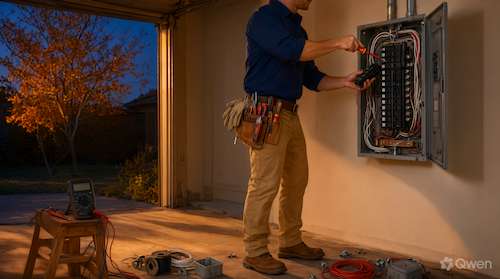
Las Vegas is the inverse of an old Eastern city electrically. ACS estimates put just 17.5% of metro housing before 1980, so knob-and-tube and fuse boxes are rare curiosities rather than a routine part of the job. What the metro has instead is a large stock of houses built between 1980 and 2010 whose panels were sized when the biggest load in the house was a single air conditioner — and those houses have since acquired a pool pump, a spa, an EV charger and, in many cases, a second air conditioner for a converted garage or an addition.
Cooling is the load that defines the service
In a cold climate the sizing conversation is about heating. Here it is about compressors, and the arithmetic is unforgiving: a main air conditioner, a second unit for a two-storey addition, a pool pump that runs most of the day, and a spa heater all draw at the same hour of the same afternoon. Ask for a load calculation that includes the pool equipment and every condenser on the property, not just the appliances inside the house. A panel that looks comfortable on a mild day can be marginal at 5 p.m. in July with everything running.
Where the panel is, on a house with no basement
Slab-on-grade construction puts the panel and the meter on an exterior wall, usually beside the garage, in full afternoon sun. That matters for two reasons: equipment in a hot location derates, and any work needs the utility to disconnect at a location that neighbors and inspectors can reach. If the service is being replaced as part of a solar or EV project, ask where the new equipment goes, how it is shaded, and whether the utility requires a visible disconnect. Also ask about working clearance — a panel boxed in by a fence, a storage cabinet or a stucco alcove is a problem that surfaces at inspection.
Pools, spas and the bonding question
A pool adds a category of electrical work that many homeowners have never heard of until an inspector raises it: bonding. Metal parts of the pool structure, the water, the pump and any surrounding equipment have to be bonded together so that stray voltage has a path, and this is separate from grounding. If a pool is being added, resurfaced or re-equipped, ask how the bonding is being handled and whether the existing bonding grid was inspected. A pool pump on a circuit without proper protection is the kind of finding that halts a real-estate transaction.
Stucco and block do not open easily
Interior walls are drywall over wood frame, but exterior walls are stucco over sheathing or block, and a new circuit that has to reach an outdoor kitchen, a patio cover, a detached casita or a garage workshop runs through material that is slow to open and expensive to match afterwards. Ask how the run will be routed — attic, exterior surface conduit, or through the wall — and who patches the stucco. Surface-mounted conduit is common and legitimate here, but it should be described in the estimate rather than discovered on the day.
Permits, inspection, and the age of the addition
Electrical work is permitted and inspected locally, and in a metro where a great deal of housing was built during fast growth periods, unpermitted additions and garage conversions are common. That can produce a job where the electrician finds a subpanel nobody documented. Ask who pulls the permit, what the inspection covers, and how the contract handles a finding outside the original scope. If a property has been extended over the years, it is worth asking for the panel schedule to be verified against what is actually installed rather than copied forward.
What to settle before approving work
Where this page stops
No specific property is assessed here and no prices are published. Electrical hazards, service capacity and code compliance require on-site evaluation by a licensed electrician, and permit and inspection requirements belong to the local authority.
Las Vegas metro context
The 2024 ACS 5-year estimates count about 2.3 million residents in 862,518 households across 948,995 housing units. Owner occupancy is 57.8%, about 60.2% of units are single-family detached, and only 17.5% were built before 1980 — a housing stock that is mostly a few decades old, which shifts the work from rewiring to adding capacity. A climate station is not reported for this metro in the site dataset, so no temperature or precipitation figures are published on this page.
Las Vegas housing indicators
| Indicator | Value | Source |
|---|---|---|
| Metro population | 2,329,548 | U.S. Census Bureau |
| Metro households | 862,518 | U.S. Census Bureau |
| Housing units | 948,995 | U.S. Census Bureau |
| Housing units built before 1980 | 17.5% | U.S. Census Bureau |
| Single-family detached share | 60.2% | U.S. Census Bureau |
| Owner-occupied share | 57.8% | U.S. Census Bureau |
A climate station is not reported for this metro in the site dataset, so no temperature or precipitation normals are shown here. Census values describe the metro area, not an individual property.
Frequently Asked Questions
Is a 100-amp panel enough in a Las Vegas house?
It depends on what is connected, and the deciding factor is usually the pool equipment and the condensers rather than the appliances. Ask for a load calculation that includes outdoor equipment before accepting either a yes or a no.
What is pool bonding and why does it matter?
Bonding connects the metal parts of the pool, the water and the associated equipment so stray voltage has a safe path. It is required by code and is separate from grounding the pump circuit. Any pool work should include a check that the bonding is intact.
Can I add an EV charger and a spa to an existing service?
Sometimes, particularly with load management devices that prevent the two from drawing at once. Ask how the calculation treats the car charging overnight while the pool pump runs and the air conditioning cycles.
Why does my panel get so hot?
Exterior panels in direct sun run warmer, and loose connections also generate heat. Warmth alone is not a diagnosis, but a panel that is hot to the touch or smells of hot plastic should be evaluated promptly rather than watched.
Do I need a permit to add a circuit for an outdoor kitchen?
In most jurisdictions, yes, and outdoor circuits have specific protection requirements. Confirm with the local building department for the address, and ask the electrician whether permit handling and inspection are in the scope.
How old is the typical electrical service in the metro?
Given that 82.5% of the housing was built after 1980, most services are a few decades old at most. Age is a poor guide on its own; what matters is the service rating and the condition of the connections inside the panel.
Sources and review date
- American Community Survey 2024 5-year estimates (CBSA tables) — U.S. Census Bureau, 2024 ACS 5-year estimates.
Reviewed on 2026-11-18.
Other Home Services in Las Vegas–Henderson–North Las Vegas
All guides for the Las Vegas–Henderson–North Las Vegas metro area