
Las Vegas, NV · metro guide
HVAC in Las Vegas: An Air Conditioner That Never Gets a Rest
Equipment here is not old, it is tired. Runtime, not the calendar, is what wears a system out.
Metro snapshot
Las Vegas in numbers
Sources named below each block
- Population
- 2.3M
- Households
- 863K
- Housing units
- 949K
- People / household
- 2.70
- population ÷ households
Owner-occupied homes 58%
The rest are rented. Owners are the ones who commission most exterior work.
Single-family detached 60%
Detached houses carry their own roof, gutters and exterior walls.
Built before 1980 18%
Older housing stock shapes what fails first: gutters, flashing, pipe material.
Season
The year in Las Vegas
- Precipitation
- 4.2 in
- Snowfall
- 0.2 in
Average temperature by month, °F — the shape of the year is what decides when exterior work gets done.
Precipitation by month, inches.
Snowfall by month, inches.
| Month | Average temperature (°F) | Precipitation (in) | Snowfall (in) |
|---|---|---|---|
| January | 49.5°F | 0.56 in | 0.0 in |
| February | 53.5°F | 0.80 in | 0.0 in |
| March | 60.8°F | 0.42 in | 0.0 in |
| April | 67.7°F | 0.20 in | 0.0 in |
| May | 77.3°F | 0.07 in | 0.0 in |
| June | 87.6°F | 0.04 in | 0.0 in |
| July | 93.2°F | 0.38 in | 0.0 in |
| August | 91.7°F | 0.32 in | 0.0 in |
| September | 83.6°F | 0.32 in | 0.0 in |
| October | 70.4°F | 0.32 in | 0.0 in |
| November | 57.2°F | 0.30 in | 0.0 in |
| December | 48.2°F | 0.45 in | 0.2 in |
NOAA 1991–2020 climate normals, station LAS VEGAS MCCARRAN AP, NV US (USW00023169). Station observations, not a metro-wide average — a metro that spans a mountain range can differ by more than this record shows.
Population, households and housing shares: U.S. Census Bureau, American Community Survey 2024 5-year estimates, metropolitan statistical area.
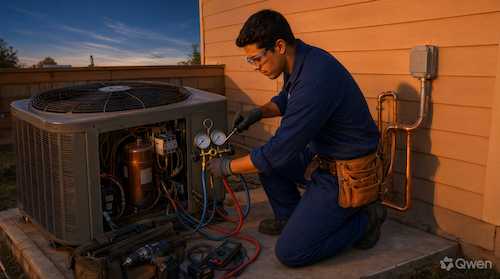
Most of the housing in this metro is comparatively new — 82.5% of units were built after 1980 — so the furnaces and air conditioners being replaced now are not antique, they are worn. Cooling equipment here runs far more hours per year than the same model would run almost anywhere else in the country, and it runs against dust, high outdoor temperatures and ductwork routed through an attic that becomes an oven. That combination changes what maintenance is for: not preserving a machine against time, but protecting it against the number of hours it is asked to work.
Judge the system on hours, not years
"It is only twelve years old" is a less useful statement in Las Vegas than in most places, because twelve years here can mean twice the compressor hours of twelve years somewhere milder. Ask how the system has been maintained, whether the refrigerant charge has ever been verified, and how the equipment behaved in the previous summer rather than how old it is. A unit that struggled through the last August is telling you something about the next one, and replacing it in April is considerably more comfortable than replacing it during a heat wave with a house full of people.
Dust is the local wear mechanism
Desert air carries fine particulate that settles on condenser coils and loads filters faster than the packaging suggests. A dirty condenser coil raises the head pressure and cuts efficiency, then shortens compressor life. Ask what the service visit includes: coil cleaning on the outdoor unit, a check of the indoor coil, verification of the refrigerant charge by subcooling or superheat rather than a guess, and a filter schedule sized for the actual dust load. A "tune-up" that only changes a filter and rinses a screen is not the same service.
The ducts run through the hottest space in the house
In a single-storey house with attic ductwork, the ducts pass through an unconditioned space that becomes extremely hot during the day, so any leak or missing insulation is a direct efficiency loss and a source of hot air at the supply registers. Ask whether the attic ducts will be inspected, whether disconnected or crushed sections will be repaired, and whether insulation levels meet what the equipment assumes. Register temperature is a simple test: if the air coming out of a supply vent feels only slightly cooler than the room, the problem may be distribution rather than the machine.
A two-storey house needs a two-part answer
Hot air stratifies, so the upper floor of a two-storey house is the hardest part to keep comfortable while the ground floor satisfies its thermostat first. Zoning with dampers and separate thermostats, a second system, or a ductless head for the upstairs rooms are all reasonable approaches, and the choice depends on how the ducts are already arranged. Ask how the proposal addresses the upstairs rooms specifically, and whether the answer is more capacity for the whole house or a separate control for the part that struggles. Adding tonnage to fix an upstairs problem usually makes the downstairs colder and the humidity worse.
Book the service before the season, not during it
The week the first sustained heat arrives is the worst possible time to discover a failed capacitor, and it is also the week when every contractor's schedule is full. Spring service on the cooling side, a check of the heating side in autumn, and a spare filter on the shelf cover most of the risk. Ask what the seasonal service includes, whether it is a maintenance agreement with priority scheduling or a one-off visit, and what the response looks like when the outdoor temperature is at its highest. Also ask how the system is protected if power fails — a surge at the end of an outage can take out a compressor start component.
Questions a proposal should answer
Where this page stops
No equipment recommendation and no prices are published here. Load calculations, refrigerant handling and combustion work require on-site assessment by a licensed professional, and rebate or permit questions belong to the utility and the local authority.
Las Vegas metro context
ACS 2024 5-year estimates report about 2.3 million residents in 862,518 households and 948,995 housing units, with 57.8% owner-occupied and 60.2% single-family detached. Only 17.5% of units predate 1980, which is why this page treats equipment condition and runtime as the primary facts rather than age. A climate station is not reported for this metro in the site dataset, so no temperature normals appear here.
Las Vegas housing and ownership indicators
| Indicator | Value | Source |
|---|---|---|
| Housing units built before 1980 | 17.5% | U.S. Census Bureau |
| Single-family detached share | 60.2% | U.S. Census Bureau |
| Owner-occupied share | 57.8% | U.S. Census Bureau |
| Metro households | 862,518 | U.S. Census Bureau |
| Metro population | 2,329,548 | U.S. Census Bureau |
| Housing units | 948,995 | U.S. Census Bureau |
No NOAA climate normals are shown for this metro because no station record is held in the site dataset. Census values describe the metro area, not an individual property.
Frequently Asked Questions
How long does an air conditioner last in Las Vegas?
There is no reliable calendar figure, because the equipment here runs far more hours per year than in milder climates. The useful measures are how the system performed last summer and whether the coils and charge have been maintained. A well-serviced unit with clean coils lasts considerably longer than a neglected one of the same age.
How often should filters be changed?
More often than the package suggests, because of dust. Check monthly during the cooling season and change when visibly loaded rather than waiting for a fixed interval. A restricted filter strains the blower and reduces airflow across the coil.
Why is my upstairs always warmer than downstairs?
Warm air rises and the upper floor also takes more radiant heat from the roof. Zoning, a second system or a ductless head for the upstairs rooms addresses it directly, while adding capacity to the existing system usually overcools the downstairs without fixing the upstairs.
Does a maintenance agreement make sense here?
It often does, because the cooling season is long and the equipment works hard. What matters is what the agreement includes — coil cleaning, charge verification, priority scheduling — rather than the discount on parts that is usually advertised.
Should I replace working equipment before it fails?
Consider it when the system struggled through the previous summer, when the coils or the charge are in poor condition, or when a repair would cost a large fraction of replacement. Replacing in the shoulder season avoids doing it in an emergency.
What about heating in Las Vegas?
Heating exists but is a small part of the load compared with cooling, and a heat pump covers both directions. The equipment should still be checked annually, since a heating failure in winter is inconvenient even where the season is short.
Sources and review date
- American Community Survey 2024 5-year estimates (CBSA tables) — U.S. Census Bureau, 2024 ACS 5-year estimates.
Reviewed on 2026-11-18.
Other Home Services in Las Vegas–Henderson–North Las Vegas
All guides for the Las Vegas–Henderson–North Las Vegas metro area