
Las Vegas, NV · metro guide
Solar Panels in Las Vegas: Strong Sun, Hot Panels, and Dust
The sun is not the problem. Heat, dust and roof age are what decide the return.
Metro snapshot
Las Vegas in numbers
Sources named below each block
- Population
- 2.3M
- Households
- 863K
- Housing units
- 949K
- People / household
- 2.70
- population ÷ households
Owner-occupied homes 58%
The rest are rented. Owners are the ones who commission most exterior work.
Single-family detached 60%
Detached houses carry their own roof, gutters and exterior walls.
Built before 1980 18%
Older housing stock shapes what fails first: gutters, flashing, pipe material.
Season
The year in Las Vegas
- Precipitation
- 4.2 in
- Snowfall
- 0.2 in
Average temperature by month, °F — the shape of the year is what decides when exterior work gets done.
Precipitation by month, inches.
Snowfall by month, inches.
| Month | Average temperature (°F) | Precipitation (in) | Snowfall (in) |
|---|---|---|---|
| January | 49.5°F | 0.56 in | 0.0 in |
| February | 53.5°F | 0.80 in | 0.0 in |
| March | 60.8°F | 0.42 in | 0.0 in |
| April | 67.7°F | 0.20 in | 0.0 in |
| May | 77.3°F | 0.07 in | 0.0 in |
| June | 87.6°F | 0.04 in | 0.0 in |
| July | 93.2°F | 0.38 in | 0.0 in |
| August | 91.7°F | 0.32 in | 0.0 in |
| September | 83.6°F | 0.32 in | 0.0 in |
| October | 70.4°F | 0.32 in | 0.0 in |
| November | 57.2°F | 0.30 in | 0.0 in |
| December | 48.2°F | 0.45 in | 0.2 in |
NOAA 1991–2020 climate normals, station LAS VEGAS MCCARRAN AP, NV US (USW00023169). Station observations, not a metro-wide average — a metro that spans a mountain range can differ by more than this record shows.
Population, households and housing shares: U.S. Census Bureau, American Community Survey 2024 5-year estimates, metropolitan statistical area.
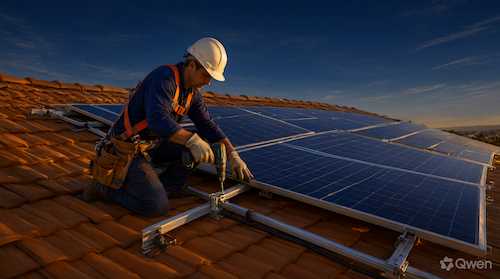
Las Vegas has one of the strongest solar resources in the country, and that fact alone sells a lot of systems. It is also the reason a naive estimate can disappoint. Photovoltaic modules lose efficiency as they heat up, so the same panel produces less on a 110°F roof than the flash-test rating suggests, and desert dust settles on glass in a way that rain rarely clears. Add a housing stock where 82.5% of units were built after 1980 — many of them with roofs now reaching the end of their first covering — and the useful conversation is about derating, cleaning and roof life rather than about sunshine.
Heat derating is not a small correction
Every module has a temperature coefficient that describes how much output it loses as cell temperature rises above the standard test condition. On a roof in full sun here, cell temperature runs far above air temperature, and the effect compounds with mounting: panels flush to a hot shingle surface run hotter than panels with an air gap behind them. Ask what the proposal assumes for cell temperature, whether the design allows airflow under the array, and whether the production figure was produced by a modelling tool that accounts for local ambient conditions rather than a generic sun-hours multiplier.
Dust accumulates and rain does not clear it
In a wet climate, panels are largely self-cleaning. Here, dust, pollen and the fine material that comes with a monsoon outflow settle on the glass and stay, and soiling losses build until somebody washes the array. Ask what cleaning interval the production estimate assumes, who is expected to do it, and what the safe method is on a pitched roof. Watering a dusty array during the hottest part of the day is a bad idea for both the glass and the person; early morning and a soft brush are the usual practice.
A young roof stock, not a young roof
Most houses in this metro were built in the last few decades, which means many roofs are on their original covering or their first replacement, and a number are within a few years of needing one. Panels installed now would have to come off and go back. Ask how old the covering is, what the remaining service life is judged to be, and whether the installer will put their view in writing. On a flat or low-slope roof, the membrane and the mounting detail matter more than the module, and a penetration that is not properly flashed will find a way in during a monsoon storm.
Billing rules change, so ask for the current ones
Nevada's rules for crediting exported solar have been revised more than once, and the terms that apply to a new system are the ones in force when it is interconnected. That makes the timing of the application a financial variable. Ask how exported energy is currently credited, whether the credit is valued differently at different times of day, what fixed charges remain on the bill, and what happens to accumulated credits at the end of a period. Get the answers in writing from the installer and confirm them with the utility rather than relying on a summary.
Shade here is more about walls than trees
The default assumption in a desert suburb is an unobstructed roof, and often that is true. Where it is not, the obstruction is frequently a neighboring two-storey wall, a parapet, or a rooftop mechanical unit rather than a tree. Ask which hours of the day were modelled, whether the design uses string inverters or per-panel electronics, and how much production is lost if a future neighbor adds height. In new subdivisions where lots are close together, the shading question is worth asking explicitly rather than assuming open sky.
What to ask a Las Vegas installer
Where this page stops
No prices, incentives or production figures are published here, because they cannot be produced honestly without a site assessment. Roof condition and structural capacity require inspection, and financial and regulatory questions belong to a qualified adviser and the utility.
Las Vegas metro context
The 2024 ACS 5-year estimates count about 2.3 million residents in 862,518 households across 948,995 housing units, with 57.8% owner-occupied and 60.2% single-family detached. Only 17.5% of units predate 1980, which is the detail that matters most here: a large share of the roofs receiving bids now are on their first or second covering. A climate station is not reported for this metro in the site dataset, so no temperature or precipitation normals appear on this page.
Las Vegas housing and ownership indicators
| Indicator | Value | Source |
|---|---|---|
| Housing units built before 1980 | 17.5% | U.S. Census Bureau |
| Single-family detached share | 60.2% | U.S. Census Bureau |
| Owner-occupied share | 57.8% | U.S. Census Bureau |
| Housing units | 948,995 | U.S. Census Bureau |
| Metro households | 862,518 | U.S. Census Bureau |
| Metro population | 2,329,548 | U.S. Census Bureau |
No NOAA climate normals are shown for this metro because no station record is held in the site dataset. Irradiance and cell temperature must be modelled for the specific roof rather than inferred from a metro average.
Frequently Asked Questions
Do panels work less well in extreme heat?
Yes. Output falls as cell temperature rises, and cells run much hotter than the air on a sunny roof. The effect is accounted for in a proper production model through the module's temperature coefficient, so ask whether it was included rather than whether heat matters.
How often do panels need cleaning here?
More often than in a climate with regular rain, because dust and monsoon material settle and stay. The interval depends on the site, the roof pitch and nearby dust sources. The important point is that the production estimate should state what soiling assumption it used.
Will the panels damage my roof?
Not if the roof is sound and the penetrations are flashed correctly, which matters more on low-slope roofs and during intense summer storms. Ask how flashing is detailed and what the workmanship warranty covers.
Is my roof too old for solar?
If it is near the end of its life, replacing it first is usually cheaper than removing and reinstalling an array later. Ask the installer for a written view of the roof's remaining life and a roofer's opinion if the two disagree.
What happens if the utility changes its crediting rules?
The terms that apply are generally the ones in force when the system is interconnected, and rules have changed in Nevada before. That is why the application timeline is a financial question, and why the expected credit structure should be documented in writing.
How do I know the system is producing what was promised?
Monitoring at the inverter or per panel, compared against the modelled estimate month by month. Ask what the monitoring covers, how underperformance is detected, and who is responsible for investigating it, rather than waiting for a bill that looks wrong.
Sources and review date
- American Community Survey 2024 5-year estimates (CBSA tables) — U.S. Census Bureau, 2024 ACS 5-year estimates.
Reviewed on 2026-11-18.
Other Home Services in Las Vegas–Henderson–North Las Vegas
All guides for the Las Vegas–Henderson–North Las Vegas metro area