
Las Vegas, NV · metro guide
Water Damage Restoration in Las Vegas: Condensate, Monsoon, and Attic Tanks
This is a desert, and most of the water damage here is manufactured by the house itself.
Metro snapshot
Las Vegas in numbers
Sources named below each block
- Population
- 2.3M
- Households
- 863K
- Housing units
- 949K
- People / household
- 2.70
- population ÷ households
Owner-occupied homes 58%
The rest are rented. Owners are the ones who commission most exterior work.
Single-family detached 60%
Detached houses carry their own roof, gutters and exterior walls.
Built before 1980 18%
Older housing stock shapes what fails first: gutters, flashing, pipe material.
Season
The year in Las Vegas
- Precipitation
- 4.2 in
- Snowfall
- 0.2 in
Average temperature by month, °F — the shape of the year is what decides when exterior work gets done.
Precipitation by month, inches.
Snowfall by month, inches.
| Month | Average temperature (°F) | Precipitation (in) | Snowfall (in) |
|---|---|---|---|
| January | 49.5°F | 0.56 in | 0.0 in |
| February | 53.5°F | 0.80 in | 0.0 in |
| March | 60.8°F | 0.42 in | 0.0 in |
| April | 67.7°F | 0.20 in | 0.0 in |
| May | 77.3°F | 0.07 in | 0.0 in |
| June | 87.6°F | 0.04 in | 0.0 in |
| July | 93.2°F | 0.38 in | 0.0 in |
| August | 91.7°F | 0.32 in | 0.0 in |
| September | 83.6°F | 0.32 in | 0.0 in |
| October | 70.4°F | 0.32 in | 0.0 in |
| November | 57.2°F | 0.30 in | 0.0 in |
| December | 48.2°F | 0.45 in | 0.2 in |
NOAA 1991–2020 climate normals, station LAS VEGAS MCCARRAN AP, NV US (USW00023169). Station observations, not a metro-wide average — a metro that spans a mountain range can differ by more than this record shows.
Population, households and housing shares: U.S. Census Bureau, American Community Survey 2024 5-year estimates, metropolitan statistical area.
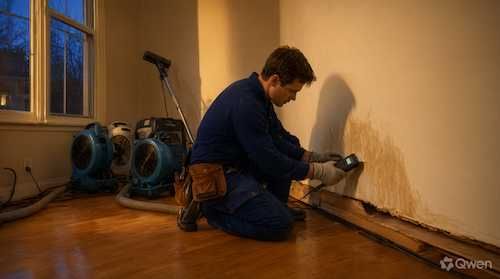
Water damage in a desert sounds like a contradiction, and it is the reason the local causes are so different from anywhere else. In a wet climate the water comes from outside; here it usually starts inside the building. An air conditioner pulling moisture out of the air all summer produces condensate, and when the drain line clogs that water has to go somewhere — usually into the ceiling below an attic air handler. Add a water heater installed in an attic, a supply line under a slab, and a monsoon storm that delivers a season of rain in an hour, and the list of likely sources looks nothing like a coastal city's.
The condensate line is the number one suspect
Cooling equipment here runs almost continuously through the hot months, which means the drain produces a steady trickle for weeks. Dust, algae and insect debris find that line, and a partial blockage becomes a full one. A pan with a float switch shuts the system down before it overflows; a pan without one lets it fill. Ask where the air handler is, whether the pan has a float switch, where the secondary drain discharges, and when the line was last cleared. If a ceiling stain appears in the middle of summer under a mechanical space, this is the first thing to check.
Appliances above the ceiling
A water heater in an attic, a condensate pump above a closet, an air handler above a hallway — in a single-storey house on a slab there is nowhere else to put them, so equipment sits above finished rooms. That turns a minor leak into a drywall and insulation job. Ask whether the water heater sits in a pan, whether the pan drain is plumbed to the exterior or terminated in the attic, and how the equipment is accessed for service. The second question is the one that most often reveals a problem, because a drain that ends two feet away is effectively no drain at all.
Leaks you cannot see
Supply lines under a slab show up as a warm patch on a tile floor, a water bill that climbs without explanation, or the sound of running water with the house quiet. Concrete and flooring have to be assessed before anyone starts breaking, and the choice between a spot repair and a reroute through the attic or the walls is a real comparison rather than a formality. Ask how the leak was located, what evidence supports the location, how much finished floor will be affected, and what the drying scope is for a leak that has been running for weeks before it was noticed.
The storm that arrives in an hour
Monsoon season brings short, violent rainfall, and a landscape and roof designed for dry conditions can shed a great deal of water quickly. The failures cluster in predictable places: a roof penetration around a swamp cooler or a vent, a scupper or drain that has been blocked by debris since the last storm, a patio cover that collects water against the wall, and grading that has settled toward the house since it was built. Ask whether the entry point was identified, not just the stain, and whether the repair addresses the flashing or only the drywall.
Drying in very dry air is fast, and that has a catch
Low ambient humidity helps evaporation, which sounds like good news and partly is. It also means that materials can look and read dry at the surface while the assembly behind them is still wet, especially where water has run inside a wall cavity or under tile. Ask for readings by material and location, a stated dry standard, and a recheck before the rebuild. In slab construction, water under a hard floor is the case that most often gets declared finished too early.
Questions to ask on the first visit
Where this page stops
This page does not assess a specific loss and publishes no prices. Sewage, mold and any active intrusion require on-site assessment, and coverage questions belong to your insurer and policy documents.
Las Vegas metro context
ACS 2024 5-year estimates report about 2.3 million residents in 862,518 households and 948,995 housing units, with 57.8% owner-occupied and 60.2% single-family detached. Only 17.5% of units predate 1980, so the housing stock is dominated by slab-on-grade construction with mechanical equipment in the attic or garage — the arrangement that shapes most of the losses described here. A climate station is not reported for this metro in the site dataset, so no precipitation figures are published on this page.
Las Vegas housing and ownership indicators
| Indicator | Value | Source |
|---|---|---|
| Housing units built before 1980 | 17.5% | U.S. Census Bureau |
| Single-family detached share | 60.2% | U.S. Census Bureau |
| Owner-occupied share | 57.8% | U.S. Census Bureau |
| Metro households | 862,518 | U.S. Census Bureau |
| Housing units | 948,995 | U.S. Census Bureau |
| Metro population | 2,329,548 | U.S. Census Bureau |
A climate station is not reported for this metro in the site dataset, so no precipitation normals are shown. Monsoon intensity varies sharply from one season to the next, which is why roof and drainage defects can stay hidden for years.
Frequently Asked Questions
Why is there a water stain on my ceiling in the middle of summer?
The most likely cause in this climate is the air conditioner condensate line, especially where the air handler sits in the attic. A blocked drain overflows the pan and the water finds the ceiling below. Check whether the pan has a float switch and whether the line has been cleared.
Does homeowners insurance cover a slab leak?
It depends on the policy and on how the loss is classified, and the treatment of the pipe itself may differ from the resulting water damage. Ask the insurer directly and in writing, and document the extent before any flooring or concrete is removed.
What is a float switch and do I need one?
A device in the condensate pan that shuts the cooling system off when the pan fills, preventing an overflow. It is inexpensive and it converts a potential ceiling repair into a service call, which is why it is worth confirming that one is fitted.
How do monsoon storms cause indoor damage?
Usually through a defective penetration or a blocked drainage path rather than through the roof field: a swamp cooler curb, a vent flashing, a scupper full of debris, or a patio cover that holds water against the wall. Finding the actual entry point is the repair; patching the stain is not.
Can materials dry out quickly in this air?
Surfaces dry quickly because the air is dry, but assemblies can stay wet behind them. That is why readings by material and location matter more than a visual check, particularly for water trapped under tile or inside a wall cavity.
What should I do first when I find water?
Stop the source if it can be stopped safely, keep people off wet surfaces near electrical equipment, and photograph the extent before anything is moved. Then arrange extraction and drying. Documentation made in the first hour is difficult to reconstruct later.
Sources and review date
- American Community Survey 2024 5-year estimates (CBSA tables) — U.S. Census Bureau, 2024 ACS 5-year estimates.
Reviewed on 2026-11-18.
Other Home Services in Las Vegas–Henderson–North Las Vegas
All guides for the Las Vegas–Henderson–North Las Vegas metro area