
Las Vegas, NV · metro guide
Landscaping in Las Vegas: Caliche, Water Rules, and Shade That Pays
A planting plan here is an irrigation plan first, and a shade plan second. Neither is optional.
Metro snapshot
Las Vegas in numbers
Sources named below each block
- Population
- 2.3M
- Households
- 863K
- Housing units
- 949K
- People / household
- 2.70
- population ÷ households
Owner-occupied homes 58%
The rest are rented. Owners are the ones who commission most exterior work.
Single-family detached 60%
Detached houses carry their own roof, gutters and exterior walls.
Built before 1980 18%
Older housing stock shapes what fails first: gutters, flashing, pipe material.
Season
The year in Las Vegas
- Precipitation
- 4.2 in
- Snowfall
- 0.2 in
Average temperature by month, °F — the shape of the year is what decides when exterior work gets done.
Precipitation by month, inches.
Snowfall by month, inches.
| Month | Average temperature (°F) | Precipitation (in) | Snowfall (in) |
|---|---|---|---|
| January | 49.5°F | 0.56 in | 0.0 in |
| February | 53.5°F | 0.80 in | 0.0 in |
| March | 60.8°F | 0.42 in | 0.0 in |
| April | 67.7°F | 0.20 in | 0.0 in |
| May | 77.3°F | 0.07 in | 0.0 in |
| June | 87.6°F | 0.04 in | 0.0 in |
| July | 93.2°F | 0.38 in | 0.0 in |
| August | 91.7°F | 0.32 in | 0.0 in |
| September | 83.6°F | 0.32 in | 0.0 in |
| October | 70.4°F | 0.32 in | 0.0 in |
| November | 57.2°F | 0.30 in | 0.0 in |
| December | 48.2°F | 0.45 in | 0.2 in |
NOAA 1991–2020 climate normals, station LAS VEGAS MCCARRAN AP, NV US (USW00023169). Station observations, not a metro-wide average — a metro that spans a mountain range can differ by more than this record shows.
Population, households and housing shares: U.S. Census Bureau, American Community Survey 2024 5-year estimates, metropolitan statistical area.
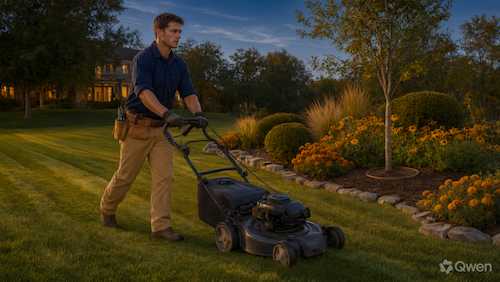
Landscaping in the Las Vegas valley is unlike the rest of the country in one decisive way: water is the design constraint, not an input. Planting decisions that work in a temperate city fail here on the water bill long before they fail on temperature, and a plan that treats irrigation as an accessory will be re-landscaped within a few years. The other local reality is the ground itself — caliche, a cemented layer of calcium carbonate that resists a shovel and changes how water moves — plus the summer monsoon, which delivers intense runoff to a landscape designed for the opposite condition.
The ground may not accept water where you expect
Caliche forms in layers that can be harder than concrete, and a planting hole dug into it becomes a bucket: water fills it and does not drain, which kills plants more reliably than drought does. The remedy is not more water but a different approach — breaking through the layer where possible, planting on a mound above grade, choosing species that tolerate poor drainage, or grading so water moves away. Ask the contractor how they intend to handle caliche on the site, whether they have assessed it before quoting, and what happens to the quote if the subsurface is worse than assumed.
Irrigation is the whole design
Drip lines on separate valves, matched emission rates, a controller that can be adjusted seasonally, and a way to find leaks quickly. Turf, where it exists, needs different hardware from shrubs and trees, and mixing the two on one valve guarantees that one of them will be overwatered. Ask what zones are proposed and what each serves, whether the controller is a smart type that responds to weather, and whether the system will be pressure-tested and flushed before planting. An irrigation plan that is drawn after the plant list is a plan that will be redrawn.
Local water rules shape what can be installed
Water use in the valley is regulated, and the rules on turf area and on irrigation schedules have tightened over the years, with programs encouraging conversion from lawn to desert planting. Those rules change, and they vary by jurisdiction, so the practical advice is to ask the contractor to confirm the current requirements for the specific address before the design is fixed, and to build a plan that would still comply if the rules tighten again. A landscape that depends on an exemption is a landscape with an expiry date.
The summer storm arrives all at once
Monsoon season brings short intense rainfall that a graded desert yard may not be able to absorb, and the water has to go somewhere deliberate — a swale, a basin, a channel, or the street. What it must not do is run against the house, into the garage or under a patio slab. Ask where the site drains in a heavy storm, whether the grading sends water toward or away from the structure, and whether any low point near the foundation needs a channel or a berm. This is also the moment to check that landscape walls and raised beds do not trap water against the building.
Shade is a cooling measure that happens to be a plant
Trees placed on the west and south sides reduce the heat load on the house, which is a landscaping decision with an energy consequence in a climate where cooling dominates the bill. That makes tree placement a design question rather than decoration: distance from the wall, mature canopy, root behavior near slabs and walls, and whether the species is suited to the soil and the water budget. Ask what the mature canopy size will be rather than the nursery size, and whether the tree is being placed for shade on the building or for appearance from the street.
What to put in a landscaping brief
Where this page stops
This page does not evaluate a property and publishes no prices. Soil, caliche and drainage conditions must be assessed on site, and water-use rules and rebate programs change — confirm them with the local authority for the address.
Las Vegas metro context
The 2024 ACS 5-year estimates count about 2.3 million residents in 862,518 households across 948,995 housing units. About 60.2% of units are single-family detached and 57.8% are owner-occupied, and only 17.5% were built before 1980 — a young, largely suburban stock where most yards were landscaped in the last few decades and are now being replanted. A climate station is not reported for this metro in the site dataset, so no temperature or precipitation figures are published here.
Las Vegas housing and ownership indicators
| Indicator | Value | Source |
|---|---|---|
| Single-family detached share | 60.2% | U.S. Census Bureau |
| Owner-occupied share | 57.8% | U.S. Census Bureau |
| Housing units built before 1980 | 17.5% | U.S. Census Bureau |
| Metro households | 862,518 | U.S. Census Bureau |
| Housing units | 948,995 | U.S. Census Bureau |
| Metro population | 2,329,548 | U.S. Census Bureau |
A climate station is not reported for this metro in the site dataset, so no temperature or precipitation normals are shown. Water-use rules and irrigation schedules are set locally and change over time.
Frequently Asked Questions
What is caliche and why does it matter?
A cemented layer of calcium carbonate in the soil that can be nearly as hard as concrete and restricts drainage. A planting hole that stops at the caliche layer holds water and can drown a plant, so the design has to break through it, mound above it, or choose plants that tolerate the conditions.
Can I still have a lawn in Las Vegas?
Rules on turf area and irrigation have tightened and differ by jurisdiction, and there are programs encouraging conversion to desert planting. Confirm the current requirements for the address before designing, and assume the rules may tighten further rather than relying on an exemption.
How often should drip irrigation run?
It depends on the plant type, the soil and the season, and the controller should be adjusted several times a year rather than set once. The more useful question is whether the system is zoned by plant water need, since a single schedule for mixed planting guarantees that something is overwatered.
Do trees actually reduce cooling costs here?
Shade on west and south exposures reduces the heat load on the building, and in a climate where cooling dominates the energy bill that is meaningful. Placement, mature canopy size and root behavior near slabs and walls all matter as much as the species.
What happens to my yard during monsoon season?
Short intense storms deliver more water than the ground can absorb, so it needs a deliberate path — a swale, a basin or the street. The critical check is that grading moves water away from the house, the garage and any patio slab rather than trapping it against them.
Is artificial turf a reasonable choice?
Some homeowners use it for small areas where real turf would be impractical, and it removes irrigation from that zone entirely. It also gets very hot in direct sun and has its own maintenance and lifespan considerations, so it is a trade-off rather than a free solution.
Sources and review date
- American Community Survey 2024 5-year estimates (CBSA tables) — U.S. Census Bureau, 2024 ACS 5-year estimates.
Reviewed on 2026-11-18.
Other Home Services in Las Vegas–Henderson–North Las Vegas
All guides for the Las Vegas–Henderson–North Las Vegas metro area