
Memphis, TN-MS-AR · metro guide
Electrical in Memphis: Summer Load, Storm Outages, and Older Panels
The load peaks in August, and the outages arrive with the thunderstorms.
Metro snapshot
Memphis in numbers
Sources named below each block
- Population
- 1.3M
- Households
- 523K
- Housing units
- 580K
- People / household
- 2.57
- population ÷ households
Owner-occupied homes 61%
The rest are rented. Owners are the ones who commission most exterior work.
Single-family detached 70%
Detached houses carry their own roof, gutters and exterior walls.
Built before 1980 46%
Older housing stock shapes what fails first: gutters, flashing, pipe material.
Season
The year in Memphis
- Precipitation
- 54.9 in
- Snowfall
- 2.7 in
Average temperature by month, °F — the shape of the year is what decides when exterior work gets done.
Precipitation by month, inches.
Snowfall by month, inches.
| Month | Average temperature (°F) | Precipitation (in) | Snowfall (in) |
|---|---|---|---|
| January | 42.1°F | 4.14 in | 0.9 in |
| February | 46.1°F | 4.55 in | 1.0 in |
| March | 54.2°F | 5.74 in | 0.5 in |
| April | 63.2°F | 5.87 in | 0.0 in |
| May | 72.1°F | 5.27 in | 0.0 in |
| June | 79.9°F | 3.99 in | 0.0 in |
| July | 82.8°F | 4.82 in | 0.0 in |
| August | 82.1°F | 3.37 in | 0.0 in |
| September | 76.0°F | 3.03 in | 0.0 in |
| October | 64.6°F | 3.98 in | 0.0 in |
| November | 52.7°F | 4.69 in | 0.1 in |
| December | 44.8°F | 5.49 in | 0.2 in |
NOAA 1991–2020 climate normals, station MEMPHIS INTL AP, TN US (USW00013893). Station observations, not a metro-wide average — a metro that spans a mountain range can differ by more than this record shows.
Population, households and housing shares: U.S. Census Bureau, American Community Survey 2024 5-year estimates, metropolitan statistical area.
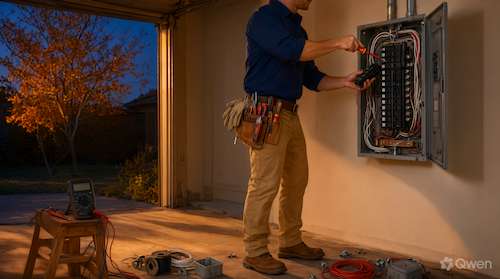
Memphis has a housing stock where roughly 46.1% of units were built before 1980 and a climate that asks air conditioning to run for months rather than weeks. The two combine into a familiar local situation: a house wired when a window unit cooled one room now runs central air for a whole house, with a second refrigerator in the garage and a dehumidifier in the crawl space. Add a storm season that interrupts power often enough for generators to be a normal purchase, and the electrical questions shift from age to capacity and from capacity to how the house behaves when the grid goes away.
The cooling load is the sizing story
Air conditioning here is not a seasonal luxury; it runs through a long humid summer and pulls far more current than the lighting load the original service was sized around. A heat pump with electric auxiliary heat adds a second large load in the opposite season. Ask whether the service rating has ever been checked, whether a load calculation has been done for the equipment actually installed, and what the panel does when the compressor, the dryer and the water heater run at once. In a house built in 1965, that combination is often the edge of what the panel can carry.
Post-war panels and the wiring behind them
Homes built from the 1950s through the 1970s frequently have 100-amp panels that are serviceable but full, and some have aluminum branch circuits from the late 1960s and early 1970s. Neither is automatically a hazard and neither is automatically fine. What matters is the condition of the connections and whether the panel has any capacity left. Ask which circuits are on the older wiring, what was inspected inside the panel, and whether the answer includes a proposal that adds capacity rather than simply moving breakers around to make room.
Generators, interlocks, and the transfer question
Thunderstorms and the occasional ice event knock out power often enough that portable and standby generators are common. The electrical detail that matters is how the generator connects to the house: a proper transfer switch or an interlock kit that prevents the main and the generator from being energized at the same time. A cord run to a dryer outlet or a breaker backfed without an interlock endangers the people working on the lines outside. Ask what transfer equipment is proposed, who installs it, whether the panel accepts an interlock for that model, and whether the generator's capacity covers what the household intends to run.
Humidity and outdoor equipment
Long humid summers are hard on exterior equipment: a panel on a south-facing garage wall, receptacles on a patio, a condenser disconnect, landscape lighting connections. Corrosion at terminations and moisture inside enclosures are the usual findings during inspection. Ask whether exterior devices are rated for wet locations, whether covers are intact, and whether ground-fault protection exists on outdoor and bathroom circuits. These are inexpensive items that prevent expensive troubleshooting later.
Permits and what the inspection looks for
Electrical work is permitted and inspected locally, and older Memphis-area housing frequently includes unpermitted additions, converted carports and garage apartments. That can turn a simple panel job into a scope discussion. Ask who pulls the permit, what the inspection covers, and how the contract handles a finding outside the original scope. If the property has been extended over time, ask for the panel schedule to be verified against what is actually installed rather than assumed.
What to settle before approving work
Where this page stops
No specific property is assessed here and no prices are published. Electrical hazards, service capacity and code compliance require on-site evaluation by a licensed electrician, and permit requirements belong to the authority with jurisdiction over the address.
Memphis metro context
The 2024 ACS 5-year estimates count about 1.34 million residents in 522,879 households across 580,185 housing units. Owner occupancy is 60.5%, about 69.9% of units are single-family detached, and 46.1% were built before 1980 — a metro with a large detached, post-war housing stock where panel capacity is the recurring question. A climate station is not reported for this metro in the site dataset, so no temperature figures are published on this page.
Memphis housing indicators
| Indicator | Value | Source |
|---|---|---|
| Metro population | 1,341,924 | U.S. Census Bureau |
| Metro households | 522,879 | U.S. Census Bureau |
| Housing units | 580,185 | U.S. Census Bureau |
| Housing units built before 1980 | 46.1% | U.S. Census Bureau |
| Single-family detached share | 69.9% | U.S. Census Bureau |
| Owner-occupied share | 60.5% | U.S. Census Bureau |
A climate station is not reported for this metro in the site dataset, so no temperature normals are shown here. Census values describe the metro area, not an individual property.
Frequently Asked Questions
Is a 100-amp panel enough with central air in Memphis?
It can be, and it depends on what else is connected and what the heat source is. A load calculation covering the air conditioner, any electric auxiliary heat, the water heater and the dryer running together is the only honest answer. Ask for it rather than a rule of thumb.
Can I connect a generator to my panel without a transfer switch?
Backfeeding a panel without an interlock is dangerous and is not a legal installation. A transfer switch or a listed interlock kit prevents the main and the generator from being live at the same time, which protects utility workers and your own household.
What does a panel inspection actually check?
Breaker condition, the bus connections, grounding and bonding, signs of heat or moisture, and whether the breakers match the wires they serve. It should also verify that the schedule corresponds to what is actually installed, which is frequently not the case in older houses.
Do I need a permit to replace a panel?
In most jurisdictions, yes, and a service change certainly requires one. Confirm with the local building department for the address, and ask the electrician whether permit handling and the inspection visit are included in the scope.
Why do my outdoor outlets keep corroding?
Humidity, rain and irrigation spray attack unprotected terminations. Devices rated for wet locations with intact covers and ground-fault protection last far longer than the alternative, and replacing them is inexpensive compared with tracing a fault later.
My carport was converted before I bought the house. Does that matter?
It can, both for the electrical inspection and for insurance. Ask the electrician to verify what serves the converted space and whether it was permitted, since unpermitted work is a common finding in this housing stock.
Sources and review date
- American Community Survey 2024 5-year estimates (CBSA tables) — U.S. Census Bureau, 2024 ACS 5-year estimates.
Reviewed on 2026-11-18.