
Milwaukee, WI · metro guide
Window Cleaning in Milwaukee: Lake Snow, Salt and Old Brick Flats
Two-thirds of the housing predates 1980, and every winter puts salt on the side that faces the street.
Metro snapshot
Milwaukee in numbers
Sources named below each block
- Population
- 1.6M
- Households
- 656K
- Housing units
- 702K
- People / household
- 2.39
- population ÷ households
Owner-occupied homes 60%
The rest are rented. Owners are the ones who commission most exterior work.
Single-family detached 54%
Detached houses carry their own roof, gutters and exterior walls.
Built before 1980 67%
Older housing stock shapes what fails first: gutters, flashing, pipe material.
Season
The year in Milwaukee
- Precipitation
- 34.6 in
- Snowfall
- 48.7 in
Average temperature by month, °F — the shape of the year is what decides when exterior work gets done.
Precipitation by month, inches.
Snowfall by month, inches.
| Month | Average temperature (°F) | Precipitation (in) | Snowfall (in) |
|---|---|---|---|
| January | 24.0°F | 1.79 in | 14.9 in |
| February | 27.1°F | 1.69 in | 11.8 in |
| March | 36.4°F | 2.20 in | 6.7 in |
| April | 46.3°F | 3.86 in | 2.1 in |
| May | 57.1°F | 3.54 in | 0.0 in |
| June | 67.6°F | 4.38 in | 0.0 in |
| July | 73.3°F | 3.40 in | 0.0 in |
| August | 72.3°F | 3.65 in | 0.0 in |
| September | 65.0°F | 3.16 in | 0.0 in |
| October | 53.0°F | 2.78 in | 0.3 in |
| November | 40.4°F | 2.24 in | 2.5 in |
| December | 29.5°F | 1.88 in | 10.4 in |
NOAA 1991–2020 climate normals, station MILWAUKEE MITCHELL AP, WI US (USW00014839). Station observations, not a metro-wide average — a metro that spans a mountain range can differ by more than this record shows.
Population, households and housing shares: U.S. Census Bureau, American Community Survey 2024 5-year estimates, metropolitan statistical area.
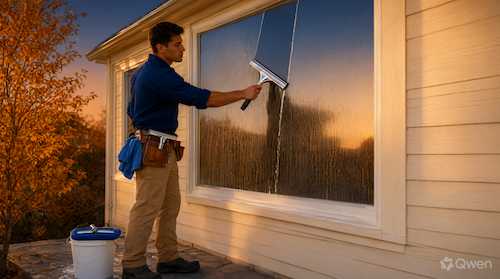
Milwaukee's stock is old and only half detached — 66.9% of units predate 1980 and 54.3% are detached — which means a lot of the region's glass sits in brick duplexes and flats where the upper floor belongs to a different household. Winter is the defining condition: lake snow, heavy road salt and a long freeze that keeps brine on the street-facing glass for months and squeezes exterior work into a short season.
Salt on the street face, all winter
Road salt holds moisture against glass, frames and hardware, dulling aluminum and corroding fixings while the glass looks merely hazy. On a brick flat the salt also draws moisture into the masonry and that wash lands on the sills. Ask whether frames and hardware are rinsed as well as the glass.
Duplexes, flats and shared elevations
In a brick duplex the upper flat's windows are reached from outside, and access may cross a shared porch, a rear stair or a neighbor's yard. Whoever books the work may not be the person who grants access. Ask who is being asked, and confirm the rear elevation is included rather than assumed.
Brick run-off and mortar dust
Older Milwaukee brick sheds mortar dust and accumulated soot whenever it rains, and it lands on the sills and glass below. A window under a weathered wall does not stay clean. Ask whether the contractor sets expectations for that rather than promising a lasting finish.
Old sashes, storms and putty
With 66.9% of the stock predating 1980, wood sashes with storm panels and failing putty are the norm, and some of that paint predates 1978. Soaking those frames does damage and forcing a sash open is a repair. Ask how both are handled.
A short season around the freeze
Exterior work stops when water freezes on glass, ladders or poles, and here that is a large part of the year, which concentrates demand into spring and autumn. Ask how far ahead the season is booked and what happens to a visit that a cold snap interrupts.
What to pin down in the estimate
Where this page stops
No prices are quoted and no property is assessed here. Rot, failed putty, lead paint and masonry condition are findings that need inspection, and shared-building access belongs to the owners involved.
Milwaukee metro context
The 2024 ACS 5-year estimates describe about 1.57 million residents in 656,436 households and 701,558 housing units, with 60.4% owner-occupied and 54.3% single-family detached. About 66.9% of units predate 1980. No climate station is reported for this metro in the site dataset, so no temperature or precipitation normals appear on this page.
Milwaukee housing indicators
| Indicator | Value | Source |
|---|---|---|
| Housing units built before 1980 | 66.9% | U.S. Census Bureau |
| Single-family detached share | 54.3% | U.S. Census Bureau |
| Owner-occupied share | 60.4% | U.S. Census Bureau |
| Metro households | 656,436 | U.S. Census Bureau |
| Housing units | 701,558 | U.S. Census Bureau |
| Metro population | 1,568,938 | U.S. Census Bureau |
Station normals are historical averages for one location, not a forecast. Glass condition depends on how often the surface is wetted and what the water carries.
Frequently Asked Questions
Why does the front never look clean in spring?
Salt and grit sit on the street face all winter. It needs rinsing rather than a wipe before it comes off.
Can you clean just the upper flat?
Usually yes, but the access is external and may cross shared space. Confirm who is authorizing it and how the rear is reached.
Do storm windows come off?
For the inner glass, yes. Ask whether removal and refitting are part of the job.
Why do sills below brick walls stain?
Rain carries soot and mortar dust out of the masonry. The window is clean; the wall above it is not.
Is lead paint a concern?
On pre-1978 windows it is. Disturbing old paint needs lead-safe practice, not just care.
When is the best time to book?
Early spring, once the salt has stopped going down, and again in autumn before the first hard freeze.
Sources and review date
- American Community Survey 2024 5-year estimates (CBSA tables) — U.S. Census Bureau, 2024 ACS 5-year estimates.
Reviewed on 2026-11-18.