
Minneapolis, MN-WI · metro guide
Window Cleaning in Minneapolis: Extreme Cold, Interior Condensation and Salt
A January mean of 16.2°F does something to windows that milder metros never see: it puts the moisture on the inside.
Metro snapshot
Minneapolis in numbers
Sources named below each block
- Population
- 3.7M
- Households
- 1.5M
- Housing units
- 1.6M
- People / household
- 2.51
- population ÷ households
Owner-occupied homes 71%
The rest are rented. Owners are the ones who commission most exterior work.
Single-family detached 60%
Detached houses carry their own roof, gutters and exterior walls.
Built before 1980 49%
Older housing stock shapes what fails first: gutters, flashing, pipe material.
Season
The year in Minneapolis
- Precipitation
- 31.6 in
- Snowfall
- 51.2 in
Average temperature by month, °F — the shape of the year is what decides when exterior work gets done.
Precipitation by month, inches.
Snowfall by month, inches.
| Month | Average temperature (°F) | Precipitation (in) | Snowfall (in) |
|---|---|---|---|
| January | 16.2°F | 0.89 in | 11.0 in |
| February | 20.6°F | 0.87 in | 9.5 in |
| March | 33.3°F | 1.68 in | 8.2 in |
| April | 47.1°F | 2.91 in | 3.5 in |
| May | 59.5°F | 3.91 in | 0.0 in |
| June | 69.7°F | 4.58 in | 0.0 in |
| July | 74.3°F | 4.06 in | 0.0 in |
| August | 71.8°F | 4.34 in | 0.0 in |
| September | 63.5°F | 3.02 in | 0.0 in |
| October | 49.5°F | 2.58 in | 0.8 in |
| November | 34.8°F | 1.61 in | 6.8 in |
| December | 22.0°F | 1.17 in | 11.4 in |
NOAA 1991–2020 climate normals, station MINNEAPOLIS/ST PAUL AP, MN US (USW00014922). Station observations, not a metro-wide average — a metro that spans a mountain range can differ by more than this record shows.
Population, households and housing shares: U.S. Census Bureau, American Community Survey 2024 5-year estimates, metropolitan statistical area.
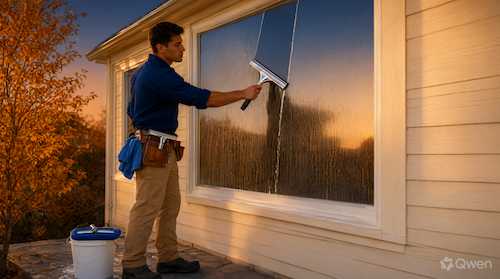
Minneapolis–St. Paul has a January mean of 16.2°F, 51.2 inches of snow and a July mean of 74.3°F. That range makes the glass work in two opposite directions. In winter, indoor humidity condenses on cold panes, freezes at the bottom of the glass and runs onto sills and frames when it thaws, which is a problem no exterior clean addresses. In summer, the same housing collects pollen and cottonwood seed and gets a genuine exterior season of only a few months.
Interior condensation and frost
In sustained cold, moisture from cooking, showers and humidifiers condenses on the coldest part of the pane, freezes, and then melts onto the sill when the temperature rises. Over a winter that damages paint and putty and leaves a mineral-and-dust ring at the bottom of the glass. Ask whether interior glass is in scope, because the exterior clean does nothing for it.
Road salt and a long brine season
Salt goes down early and stays, so street-facing glass, frames and hardware are in contact with brine for months. Aluminum storms dull and fixings corrode while the glass looks hazy. Ask whether frames and hardware are rinsed as well.
Storms, triple-track and old sashes
With 49.0% of the stock predating 1980, storm windows — often triple-track — are everywhere, and the inner glass is only reachable with the storm opened or removed. Ask whether that is in the scope and who refits them.
A compressed pollen and cottonwood season
Once the freeze ends the metro moves quickly through pollen and cottonwood seed, and glass that was clean in May is coated by June. Cleaning before the seed falls is largely wasted. Ask how spring scheduling accounts for it.
Two work seasons
Exterior work runs from spring to the first hard freeze, and interior work is what carries the winter. That split is a scheduling fact rather than a preference, and it makes spring booking decisive. Ask how far ahead the season is booked.
What to pin down in the estimate
Where this page stops
No prices are quoted and no property is assessed here. Frost damage to frames, rot and failed seals are findings that need inspection, and indoor humidity control is a building-performance question rather than a cleaning one.
Minneapolis metro context
The 2024 ACS 5-year estimates describe about 3.71 million residents in 1,477,259 households and 1,551,396 housing units, with 70.7% owner-occupied and 60.2% single-family detached. About 49.0% of units predate 1980. At the Minneapolis/St Paul Ap reference station January averages 16.2°F and July 74.3°F, on 31.6 inches of annual precipitation.
Minneapolis reference station and housing indicators
| Indicator | Value | Source |
|---|---|---|
| January mean temperature | 16.2°F | NOAA NCEI |
| July mean temperature | 74.3°F | NOAA NCEI |
| Annual precipitation | 31.6 in. | NOAA NCEI |
| Metro population | 3,713,668 | U.S. Census Bureau |
| Owner-occupied share | 70.7% | U.S. Census Bureau |
| Housing units built before 1980 | 49.0% | U.S. Census Bureau |
Station normals are historical averages for one location, not a forecast. Glass condition depends on how often the surface is wetted and what the water carries.
Frequently Asked Questions
Why is there ice at the bottom of my windows?
Indoor moisture condenses on the coldest part of the pane, freezes, then melts onto the sill. It is an interior humidity issue, not a dirty exterior.
Can exterior cleaning fix that?
No. It has to be addressed from the inside, and the sill damage it causes is a repair question.
Do triple-track storms have to come out?
They can usually be opened for access, but the inner glass is only fully reachable with them opened or removed. Confirm which is included.
When should windows be cleaned here?
Once the salt has stopped going down in spring, and after the cottonwood seed falls, then again before the freeze.
Can windows be cleaned in January?
Interior work, yes. Exterior work stops when water freezes on glass or equipment.
Why do the frames corrode so fast?
Months of brine on metal. The glass looks merely hazy while the frames and fixings take the real damage.
Sources and review date
- American Community Survey 2024 5-year estimates (CBSA tables) — U.S. Census Bureau, 2024 ACS 5-year estimates.
- 1991–2020 station normals — MINNEAPOLIS/ST PAUL AP, MN US (USW00014922) — NOAA National Centers for Environmental Information, 1991–2020 climate normals.
Reviewed on 2026-11-18.
Other Home Services in Minneapolis–St. Paul–Bloomington
All guides for the Minneapolis–St. Paul–Bloomington metro area