
Minneapolis, MN-WI · metro guide
Roofing in Minneapolis: Ice Dams, Hail, and the Layers Underneath
This roof holds 51 inches of snow a year, then has to shed the melt without letting it in.
Metro snapshot
Minneapolis in numbers
Sources named below each block
- Population
- 3.7M
- Households
- 1.5M
- Housing units
- 1.6M
- People / household
- 2.51
- population ÷ households
Owner-occupied homes 71%
The rest are rented. Owners are the ones who commission most exterior work.
Single-family detached 60%
Detached houses carry their own roof, gutters and exterior walls.
Built before 1980 49%
Older housing stock shapes what fails first: gutters, flashing, pipe material.
Season
The year in Minneapolis
- Precipitation
- 31.6 in
- Snowfall
- 51.2 in
Average temperature by month, °F — the shape of the year is what decides when exterior work gets done.
Precipitation by month, inches.
Snowfall by month, inches.
| Month | Average temperature (°F) | Precipitation (in) | Snowfall (in) |
|---|---|---|---|
| January | 16.2°F | 0.89 in | 11.0 in |
| February | 20.6°F | 0.87 in | 9.5 in |
| March | 33.3°F | 1.68 in | 8.2 in |
| April | 47.1°F | 2.91 in | 3.5 in |
| May | 59.5°F | 3.91 in | 0.0 in |
| June | 69.7°F | 4.58 in | 0.0 in |
| July | 74.3°F | 4.06 in | 0.0 in |
| August | 71.8°F | 4.34 in | 0.0 in |
| September | 63.5°F | 3.02 in | 0.0 in |
| October | 49.5°F | 2.58 in | 0.8 in |
| November | 34.8°F | 1.61 in | 6.8 in |
| December | 22.0°F | 1.17 in | 11.4 in |
NOAA 1991–2020 climate normals, station MINNEAPOLIS/ST PAUL AP, MN US (USW00014922). Station observations, not a metro-wide average — a metro that spans a mountain range can differ by more than this record shows.
Population, households and housing shares: U.S. Census Bureau, American Community Survey 2024 5-year estimates, metropolitan statistical area.
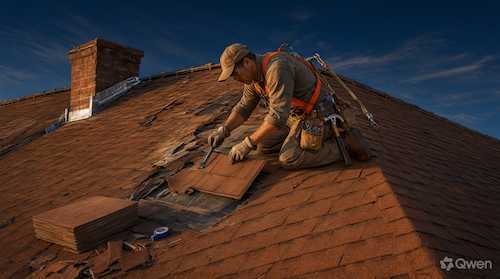
A roofing decision in the Twin Cities is a decision about water management, not about shingle color. Snow accumulates through December and January, sits on the deck for months, and releases in a melt that arrives all at once. The roof has to survive that cycle repeatedly while also absorbing summer hail and the wind that comes with a spring front. Because 49% of metro housing was built before 1980, many roofs being replaced now are on their second or third layer with attic construction that was never designed for the ventilation modern shingles want.
Eave protection is the detail that matters most here
Water ice-damming back up the roof is the normal failure mode in this climate, not an edge case. The defense is a waterproof membrane under the shingles along the eave, and what determines whether it works is how far up the roof it runs. Ask how far the membrane extends, whether it also covers valleys and penetrations, and whether the answer comes from the manufacturer's instructions or from habit. This is the single question where a bid in this metro reveals whether the roofer is building for Minneapolis or for a milder place.
How many layers are already up there
A house built in 1962 may carry two layers of three-tab shingles, the second installed over the first in the 1990s. Recovering over existing layers is cheaper and sometimes legal, but it hides the deck, adds weight, and makes the next replacement harder. If a bid assumes a layover and the deck turns out to be soft at the eave, the number changes. Ask what happens if the deck needs repair, whether it is priced per sheet, and whether the quote includes a full tear-off and disposal.
The attic decides whether the ice dam forms
Ventilation is the part of a roofing job that has no visible result and therefore gets cut. Intake at the soffit and exhaust at the ridge need to be balanced and unobstructed — insulation blown over the soffit vents defeats the whole system, and a bathroom fan discharging into the attic adds moisture directly to the deck. Ask what the ventilation plan is, whether baffles will be installed to keep the intake clear, and whether the contractor will check the bath fan termination while the roof is open.
Hail damage is not always visible from the ground
Twin Cities storms produce hail that bruises shingle mats and knocks granules loose without necessarily cracking anything. The evidence is on the slopes and on the soft metals — vents, flashing, gutter aprons. If an insurance claim is involved, ask how the contractor documents damage, whether they will meet the adjuster on site, and what happens if the approved scope is smaller than what they recommend. A roofer who will not put their findings in writing for the adjuster is a roofer to skip.
Gutters, downspouts, and frost
A downspout that discharges two feet from the foundation is the cheapest water damage in the metro. During the melt, that water goes straight back to the basement wall. Ice in the gutters through January is normal; ice that pulls the gutter away from the fascia is a fastening and pitch problem. Ask whether the scope includes new hangers, whether downspout extensions reach a slope that carries water away, and whether the splash area is protected with something other than mulch.
Questions to ask before signing
Where this page stops
This page does not inspect roofs and does not publish local prices. Condition, deck integrity and storm damage have to be assessed on the property, and insurance coverage questions belong to the carrier and the policy.
Twin Cities metro context
Census ACS 2024 5-year estimates put the metro at about 3.7 million residents in 1.48 million households and 1.55 million housing units, with 70.7% owner-occupied and 60.2% single-family detached; 49.0% of units were built before 1980. NOAA's Minneapolis–St. Paul station reports 51.2 inches of annual snowfall, 31.6 inches of precipitation, January averaging 16.2°F and July 74.3°F. The snowfall figure is why eave protection and attic ventilation lead this page rather than appearance.
Twin Cities snow load season and housing age
| Indicator | Value | Source |
|---|---|---|
| Annual snowfall | 51.2 in. | NOAA NCEI |
| January mean temperature | 16.2°F | NOAA NCEI |
| Annual precipitation | 31.6 in. | NOAA NCEI |
| Housing units built before 1980 | 49.0% | U.S. Census Bureau |
| Owner-occupied share | 70.7% | U.S. Census Bureau |
| Metro housing units | 1,551,396 | U.S. Census Bureau |
Snowfall normals are a 30-year average for one station. Actual snow depth on a roof depends on drifting, roof pitch and how long the snow sits before a melt.
Mapped in OpenStreetMap
Roofing businesses mapped in the Minneapolis metro
OpenStreetMap contributors have mapped 29 roofing entries inside the Minneapolis-St. Paul-Bloomington, MN-WI CBSA; 29 have a name. This is a map-coverage indicator, not a count of all licensed roofing businesses in the metro.
- Mapped entries
- 29
- OSM features
- Phone listed
- 83%
- 24 of 29
- Website listed
- 83%
- 24 of 29
- Street address
- 90%
- 26 of 29
OSM coverage varies by area: a low count can mean low mapping activity, not a small market. OpenStreetMap does not record contractor licenses. To check a license, use the Minnesota DLI license and registration lookup. Residential building contractor or roofer licence. Specialty contractors who offer only one skill are exempt, as is anyone whose gross annual receipts for licensed specialty work stay under $15,000 (Minn. Stat. § 326B.805, subd. 6).
Query: craft=roofer.
Snapshot: 2026-11-17. Data:
© OpenStreetMap contributors,
ODbL 1.0.
CBSA boundary:
U.S. Census Bureau, 2023.
Frequently Asked Questions
How do I stop ice dams on a Twin Cities roof?
By keeping the roof deck cold: sealing air leaks at the ceiling plane, insulating to the current standard, and making sure the soffit intake and ridge exhaust are clear. Heat cable and raking manage symptoms. A new roof alone does not fix an attic problem.
Is it cheaper to roof over the old shingles?
Usually, up front. It also hides the deck, adds weight and raises the cost of the next replacement, since two layers have to come off. Whether it is allowed depends on the number of existing layers; ask for the count in writing.
How do I know whether hail damage is worth a claim?
Look for dented vents and gutter aprons, granule loss in gutters, and bruised spots on the slopes. Insurers typically expect an inspection rather than a phone estimate, so ask for damage documented per slope and per item before deciding.
Why do my gutters fill with ice every January?
Some ice is unavoidable here. Ice that forms heavily and pulls the gutter loose usually points to warm attic air reaching the roof edge, missing eave membrane, or a run that cannot drain. Fixing the attic is more durable than adding more heat cable.
How long does a shingle roof last in Minnesota?
Manufacturer ratings assume ventilation and installation within spec, and both are frequently compromised on older homes. The practical life also depends on pitch, sun exposure on south and west slopes, and hail events. Ask what ventilation is being corrected, since that affects lifespan as much as the shingle.
Should the bath fan vent through the roof?
Where it terminates matters less than that it terminates outside, with an insulated and short run. A fan discharging into the attic adds moisture to the deck and works against every other measure taken to prevent ice dams.
Sources and review date
- American Community Survey 2024 5-year estimates (CBSA tables) — U.S. Census Bureau, 2024 ACS 5-year estimates.
- 1991–2020 station normals — MINNEAPOLIS/ST PAUL AP, MN US (USW00014922) — NOAA National Centers for Environmental Information, 1991–2020 climate normals.
- OpenStreetMap contributors — craft=roofer features in the Minneapolis-St. Paul-Bloomington, MN-WI CBSA — OpenStreetMap contributors, Snapshot 2026-11-17.
Reviewed on 2026-11-18.
Other Home Services in Minneapolis–St. Paul–Bloomington
All guides for the Minneapolis–St. Paul–Bloomington metro area