
Minneapolis, MN-WI · metro guide
Water Damage Restoration in Minneapolis: Snowmelt, Ice Dams, Frozen Pipes
Most water here arrives in two waves: the March melt, and a frozen line on the coldest night of the year.
Metro snapshot
Minneapolis in numbers
Sources named below each block
- Population
- 3.7M
- Households
- 1.5M
- Housing units
- 1.6M
- People / household
- 2.51
- population ÷ households
Owner-occupied homes 71%
The rest are rented. Owners are the ones who commission most exterior work.
Single-family detached 60%
Detached houses carry their own roof, gutters and exterior walls.
Built before 1980 49%
Older housing stock shapes what fails first: gutters, flashing, pipe material.
Season
The year in Minneapolis
- Precipitation
- 31.6 in
- Snowfall
- 51.2 in
Average temperature by month, °F — the shape of the year is what decides when exterior work gets done.
Precipitation by month, inches.
Snowfall by month, inches.
| Month | Average temperature (°F) | Precipitation (in) | Snowfall (in) |
|---|---|---|---|
| January | 16.2°F | 0.89 in | 11.0 in |
| February | 20.6°F | 0.87 in | 9.5 in |
| March | 33.3°F | 1.68 in | 8.2 in |
| April | 47.1°F | 2.91 in | 3.5 in |
| May | 59.5°F | 3.91 in | 0.0 in |
| June | 69.7°F | 4.58 in | 0.0 in |
| July | 74.3°F | 4.06 in | 0.0 in |
| August | 71.8°F | 4.34 in | 0.0 in |
| September | 63.5°F | 3.02 in | 0.0 in |
| October | 49.5°F | 2.58 in | 0.8 in |
| November | 34.8°F | 1.61 in | 6.8 in |
| December | 22.0°F | 1.17 in | 11.4 in |
NOAA 1991–2020 climate normals, station MINNEAPOLIS/ST PAUL AP, MN US (USW00014922). Station observations, not a metro-wide average — a metro that spans a mountain range can differ by more than this record shows.
Population, households and housing shares: U.S. Census Bureau, American Community Survey 2024 5-year estimates, metropolitan statistical area.
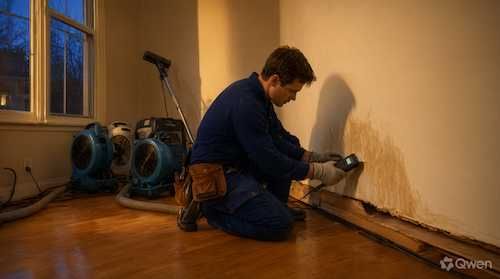
Water damage in the Twin Cities runs on a calendar that homeowners learn the hard way. Fifty-one inches of snow accumulates through the winter, and when it melts in March and April the ground underneath is often still frozen, so the water runs along the surface and along the foundation wall instead of soaking in. That is one wave. The second wave comes mid-January at 16°F, when a supply line in an exterior wall or a hose bib that was never drained lets go, and a homeowner finds out at 6 a.m. with an inch of water in the basement and a bulge in the ceiling below the bathroom.
The spring melt has nowhere to go
Frozen ground is the detail that surprises people. A sump pit that looked fine in November can turn into a running pump for three weeks in April, and a pump that has not cycled all winter is exactly the pump that fails on the first night it runs continuously. Grade that slopes back toward the house, a downspout that dumps beside the foundation, a window well without a cover — each of these is a small thing on its own and a flooded finished basement when they line up. When seepage appears, the useful sequence is to stop the source, document the extent, and only then start drying.
Nearly every house here has a basement
That is not true in Phoenix or Miami, and it changes what restoration means. A finished basement — framing, insulation, drywall, carpet, a bathroom — is a much larger drying job than an unfinished one, and it also hides where the water went. Two sources get confused constantly: groundwater seeping through the wall or floor, and a sanitary sewer backup through the floor drain during a heavy melt. They look similar in the morning and they are treated very differently, both in cleanup protocol and in insurance coverage. Find out which one it is before anyone starts cutting.
Ice dams are an attic problem wearing a roof costume
Heat escaping into the attic warms the roof deck, snow melts, refreezes at the cold eave, and the ice dam backs water up under the shingles. It comes in at the ceiling, inside the exterior wall, and sometimes into the top of a window frame. Removing the icicles does nothing. So the two questions that matter are these: how will the wet materials be dried or removed, and what stops the next one — air sealing and insulation at the ceiling plane, and ventilation that actually works. Ask the restoration contractor which of those they will recommend, and ask it before the invoice, not after.
Frozen lines, and the ones that are usually missed
Hose bibs left connected, rim joist cavities in a 1920s house, a kitchen sink cabinet on a north-facing wall, the unheated porch that was converted into a bedroom in 1948, a bathroom over a garage. Pipes freeze where cold air reaches them and where nobody looks in December. If a line does freeze, thawing it is only half the job: the leak usually appears at the split, which may be inside the wall, and the wall may need to be opened to find it. Ask how the contractor will confirm there is no second leak before closing anything up.
What to record before the equipment arrives
Photograph the water line on the wall and the furniture, keep the damaged materials visible until they are documented, and get the moisture readings in writing — which rooms, which materials, what the dry standard is. If mold is a concern, the window is generally measured in days rather than weeks, and cold weather slows drying rather than preventing it. Ask what is covered for contents, how the insurance scope compares with the contractor's scope, and who signs off that a room is dry before the rebuild starts.
Questions to ask before work begins
Where this page stops
This page does not judge a specific loss and does not publish local prices. Active water intrusion, sewage, and any suspected mold growth should be assessed on site. Coverage questions belong to your insurer and policy documents.
Twin Cities metro context
The 2024 ACS 5-year estimates report about 3.7 million residents in 1.48 million households and 1.55 million housing units. About 70.7% of occupied homes are owner-occupied, 60.2% of units are single-family detached, and 49.0% were built before 1980 — which means a large share of basements and exterior walls predate modern waterproofing. NOAA's station records January at 16.2°F, 51.2 inches of annual snowfall, and 31.6 inches of precipitation.
Twin Cities snow, melt and housing indicators
| Indicator | Value | Source |
|---|---|---|
| Annual snowfall | 51.2 in. | NOAA NCEI |
| January mean temperature | 16.2°F | NOAA NCEI |
| Annual precipitation | 31.6 in. | NOAA NCEI |
| Metro households | 1,477,259 | U.S. Census Bureau |
| Housing units built before 1980 | 49.0% | U.S. Census Bureau |
| Owner-occupied share | 70.7% | U.S. Census Bureau |
Snowfall and temperature normals describe a station record over 30 years. They show the seasonal pattern a building faces, not what will happen this winter.
Frequently Asked Questions
Why does water come in during the spring thaw instead of during rain?
Because the ground is still frozen or saturated, so meltwater cannot drain downward. It flows along the surface, collects against the foundation, and finds cracks, window wells or a floor drain. Grading and downspout discharge decide how much of it reaches the wall.
Is basement seepage covered by insurance?
Often not, and the distinction usually turns on the source: groundwater pushing through a wall is typically treated differently from a sudden discharge inside the house or a sewer backup. Read the policy language and ask the insurer direct questions before assuming either way.
How fast does mold become a concern after a leak?
Guidance generally measures the window in days rather than weeks when materials stay wet, and wet drywall and insulation are the usual starting points. Extraction and drying should begin as soon as the source is controlled; if materials cannot be dried, removal is faster than waiting.
Will fixing the ice dam stop the ceiling stain from coming back?
Only if the cause is addressed. Ice dams form when attic heat melts snow on the roof and it refreezes at the cold eave. Air sealing and insulation at the ceiling plane, plus working ventilation, are the durable fixes; roof raking and heat cable treat symptoms.
Can a restoration crew dry a basement in January?
Yes, with equipment sized for the conditions. Cold slows evaporation and can require longer run times or heated drying, so ask for a drying plan with target readings rather than a fixed number of days.
What should I photograph before anything is moved?
The water line on walls and stored items, damaged furniture and flooring, the source of the water if it is visible, and any readings the crew takes. Insurers rely on documentation made before cleanup, and it is difficult to reconstruct afterwards.
Sources and review date
- American Community Survey 2024 5-year estimates (CBSA tables) — U.S. Census Bureau, 2024 ACS 5-year estimates.
- 1991–2020 station normals — MINNEAPOLIS/ST PAUL AP, MN US (USW00014922) — NOAA National Centers for Environmental Information, 1991–2020 climate normals.
Reviewed on 2026-11-18.
Other Home Services in Minneapolis–St. Paul–Bloomington
All guides for the Minneapolis–St. Paul–Bloomington metro area