
Minneapolis, MN-WI · metro guide
Plumbing in Minneapolis: Frozen Risers, Clay Laterals, and Hard Water
Three things go wrong here more than anywhere: a pipe in an outside wall, a 1920s sewer lateral, and scale.
Metro snapshot
Minneapolis in numbers
Sources named below each block
- Population
- 3.7M
- Households
- 1.5M
- Housing units
- 1.6M
- People / household
- 2.51
- population ÷ households
Owner-occupied homes 71%
The rest are rented. Owners are the ones who commission most exterior work.
Single-family detached 60%
Detached houses carry their own roof, gutters and exterior walls.
Built before 1980 49%
Older housing stock shapes what fails first: gutters, flashing, pipe material.
Season
The year in Minneapolis
- Precipitation
- 31.6 in
- Snowfall
- 51.2 in
Average temperature by month, °F — the shape of the year is what decides when exterior work gets done.
Precipitation by month, inches.
Snowfall by month, inches.
| Month | Average temperature (°F) | Precipitation (in) | Snowfall (in) |
|---|---|---|---|
| January | 16.2°F | 0.89 in | 11.0 in |
| February | 20.6°F | 0.87 in | 9.5 in |
| March | 33.3°F | 1.68 in | 8.2 in |
| April | 47.1°F | 2.91 in | 3.5 in |
| May | 59.5°F | 3.91 in | 0.0 in |
| June | 69.7°F | 4.58 in | 0.0 in |
| July | 74.3°F | 4.06 in | 0.0 in |
| August | 71.8°F | 4.34 in | 0.0 in |
| September | 63.5°F | 3.02 in | 0.0 in |
| October | 49.5°F | 2.58 in | 0.8 in |
| November | 34.8°F | 1.61 in | 6.8 in |
| December | 22.0°F | 1.17 in | 11.4 in |
NOAA 1991–2020 climate normals, station MINNEAPOLIS/ST PAUL AP, MN US (USW00014922). Station observations, not a metro-wide average — a metro that spans a mountain range can differ by more than this record shows.
Population, households and housing shares: U.S. Census Bureau, American Community Survey 2024 5-year estimates, metropolitan statistical area.
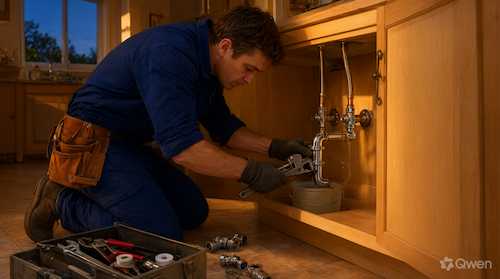
Plumbing in the Twin Cities is shaped by the housing stock and the water. Two thirds of the homes in the older neighborhoods were plumbed when a bathroom on an exterior wall was normal practice, the sewers under the front lawns are often the original clay tile from the 1920s or 1950s, and the water that arrives is hard enough to leave scale on everything it touches. Those three facts generate most of the repairs: a split supply line in January, a lateral that roots have found, and a water heater that gives up years earlier than its rating suggests.
Supply lines that run through the cold side of the house
Kitchen sinks under a north-facing window, bathrooms added over a porch in the 1940s, hose bibs that were never drained, rim joist cavities where the pipe passes through the band. At 16.2°F in an average January, a line in an exterior wall is a contest between the pipe and the wind. The permanent fix is to move the run inside the thermal envelope or to insulate and heat the cavity properly, not to leave a cabinet door open all winter. Ask what the proposed repair actually changes, since thawing the same pipe twice costs more than re-routing it once.
Galvanized pipe closes from the inside
Houses plumbed before the 1960s often have galvanized steel supply lines, which corrode inward until the flow drops and the water runs brown after a shutoff. Pinhole leaks near joints are the usual first symptom. The decision is rarely whether to replace it — it is how much to replace at once and whether to open the walls once. Ask what will be replaced, how the new material will connect to what stays, and how much wall and ceiling repair the job implies.
The sewer under the lawn is probably original
Clay tile laterals crack at the joints, and roots find them within a season or two. A slow drain that comes back after snaking is the classic sign, and so is a backup that appears in the floor drain during a heavy rain. A camera inspection is the only way to know the condition, and it produces a recording worth keeping if a sale is anywhere in the future. Ask who is responsible for the section under the street versus under the yard, because that boundary differs between cities in this metro.
Hard water is a maintenance item, not an emergency
Source water here carries a lot of dissolved mineral, which shows up as scale on fixtures, crust in the kettle, shorter water heater life and soap that will not lather. A softener is the usual answer, but the details matter: whether the unit is sized for the household, whether it is bypassed for outdoor hose bibs, and who maintains it. Ask the plumber to look at the anode rod and the sediment in the tank during any water heater service — that is where hardness takes its money.
Before the burst becomes a flood
Know where the main shutoff is, and test that it turns. In an older house with a gate valve that has not moved in twenty years, the valve itself can fail when someone finally needs it. Label the shutoffs at fixtures, keep the meter location written down, and if a line freezes, shut off the supply before thawing so the leak that appears at the split does not run inside the wall. When water does escape, stopping it and documenting the extent matters more than finding a contractor in the first ten minutes.
Questions for a plumbing estimate
Where this page stops
This page does not diagnose a system and does not publish prices. Gas piping, sewer work and water heater installation are regulated tasks that require a licensed plumber and, depending on the address, a permit and inspection.
Twin Cities metro context
ACS 2024 5-year estimates report about 3.7 million residents across 1.55 million housing units, of which 49.0% were built before 1980 and 60.2% are single-family detached — the pre-1980 share is the reason galvanized pipe and clay laterals are still a live topic here. NOAA's station records January at 16.2°F, July at 74.3°F, 31.6 inches of precipitation and 51.2 inches of snowfall, which together set both the freeze risk and the spring water table.
Twin Cities freeze risk and housing age
| Indicator | Value | Source |
|---|---|---|
| January mean temperature | 16.2°F | NOAA NCEI |
| Annual snowfall | 51.2 in. | NOAA NCEI |
| Annual precipitation | 31.6 in. | NOAA NCEI |
| Housing units built before 1980 | 49.0% | U.S. Census Bureau |
| Metro housing units | 1,551,396 | U.S. Census Bureau |
| Owner-occupied share | 70.7% | U.S. Census Bureau |
Temperature and snowfall normals describe one station over 30 years. Freeze risk in a particular wall depends on insulation, air sealing and how the pipe is routed.
Frequently Asked Questions
Why do my pipes freeze every January in the same place?
Because that section sits in a cold zone: an exterior wall, a rim joist cavity, a cabinet on a north wall, or an unheated space. Thawing it restores flow but does not change the cause. Insulating or re-routing the run is the durable answer.
Should I replace all the galvanized pipe at once?
Often it is the better value if walls are already open, since the second phase costs more in access than in material. Ask for a plan showing what gets replaced now, what can wait, and how the two phases will connect.
How do I know if my sewer lateral needs work?
Recurring slow drains, backups at the floor drain during heavy rain, and sewage odors in the yard are the usual signals. A camera inspection gives you the actual condition and a recording that is useful for any future sale.
Do I need a water softener in the Twin Cities?
Many households use one because the source water is hard, but it is a maintenance decision rather than a requirement. If you install one, have it sized for the household and keep the outdoor taps bypassed so softened water is not wasted on the garden.
Where is my main water shutoff?
Usually where the supply enters the house, often in the basement near the front wall or the meter. Find it before you need it, and check that the valve actually turns, since old gate valves can seize or fail when operated after years of neglect.
Who is responsible for the pipe under the street?
It varies by city and by the point where the private lateral meets the public main. Ask the local public works department for your address before assuming either way, and get the answer before approving a repair.
Sources and review date
- American Community Survey 2024 5-year estimates (CBSA tables) — U.S. Census Bureau, 2024 ACS 5-year estimates.
- 1991–2020 station normals — MINNEAPOLIS/ST PAUL AP, MN US (USW00014922) — NOAA National Centers for Environmental Information, 1991–2020 climate normals.
Reviewed on 2026-11-18.
Other Home Services in Minneapolis–St. Paul–Bloomington
All guides for the Minneapolis–St. Paul–Bloomington metro area