
New Orleans, LA · metro guide
Electrical in New Orleans: Raised Houses, Old Panels, and Storm Season
Where the panel sits above the ground is as important here as what is inside it.
Metro snapshot
New Orleans in numbers
Sources named below each block
- Population
- 982K
- Households
- 399K
- Housing units
- 465K
- People / household
- 2.46
- population ÷ households
Owner-occupied homes 61%
The rest are rented. Owners are the ones who commission most exterior work.
Single-family detached 58%
Detached houses carry their own roof, gutters and exterior walls.
Built before 1980 64%
Older housing stock shapes what fails first: gutters, flashing, pipe material.
Season
The year in New Orleans
- Precipitation
- 63.4 in
- Snowfall
- 0 in
Average temperature by month, °F — the shape of the year is what decides when exterior work gets done.
Precipitation by month, inches.
| Month | Average temperature (°F) | Precipitation (in) | Snowfall (in) |
|---|---|---|---|
| January | 54.3°F | 5.18 in | 0.0 in |
| February | 58.0°F | 4.13 in | 0.0 in |
| March | 63.8°F | 4.36 in | 0.0 in |
| April | 70.1°F | 5.22 in | 0.0 in |
| May | 77.1°F | 5.64 in | 0.0 in |
| June | 82.4°F | 7.62 in | 0.0 in |
| July | 83.9°F | 6.79 in | 0.0 in |
| August | 84.0°F | 6.91 in | 0.0 in |
| September | 80.8°F | 5.11 in | 0.0 in |
| October | 72.5°F | 3.70 in | 0.0 in |
| November | 62.4°F | 3.87 in | 0.0 in |
| December | 56.6°F | 4.82 in | 0.0 in |
NOAA 1991–2020 climate normals, station NEW ORLEANS INTL AP, LA US (USW00012916). Station observations, not a metro-wide average — a metro that spans a mountain range can differ by more than this record shows.
Population, households and housing shares: U.S. Census Bureau, American Community Survey 2024 5-year estimates, metropolitan statistical area.
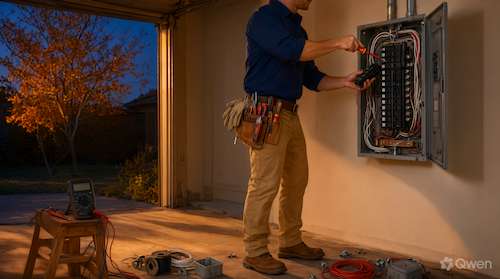
Electrical work in New Orleans begins with elevation. In a metro where much of the housing stands on piers, and where construction in flood zones is regulated around how high equipment sits, the position of a panel, a meter, a condenser or a generator connection is a code question before it is a convenience question. That is layered onto a housing stock where 63.5% of units predate 1980 and a large part of it predates 1950, much of it built as raised or shotgun houses with service equipment added and extended over decades. The result is that a straightforward-sounding job often has a site question at its center.
Height above grade is part of the specification
Property in flood zones is subject to requirements about how high electrical equipment is installed, and the rules have been revised over the years. A panel moved during a renovation, a condenser set on the ground, or a meter reinstalled at the old height can all become compliance problems later. Ask where the equipment will be mounted, what elevation the address requires, and whether the contractor has verified that with the local permitting authority rather than assuming the previous installation was correct. This is the single most local question in the whole trade here.
Wiring from several eras in the same wall
A raised house built in the 1920s and renovated in the 1970s and again after 2005 commonly contains three generations of wiring: original knob-and-tube in parts of the walls, non-metallic cable from a mid-century upgrade, and modern romex from a recent kitchen. Each renovation added what was current without removing what was there. Ask which circuits are still on the oldest wiring, whether equipment grounding is continuous on the circuits serving modern appliances, and whether the panel schedule reflects what is actually installed. In a house that has been reworked repeatedly, verifying the schedule is not optional.
Humidity attacks terminations
Long humid seasons are hard on electrical equipment: corrosion at terminals, moisture inside exterior enclosures, and connections that degrade slowly under a house that stands open to the air. Under a raised floor, wiring is exposed to the same damp conditions as the structure. Ask whether exterior and under-floor devices are rated for wet locations, whether covers and gaskets are intact, and whether ground-fault protection exists where it should. These are inexpensive components that prevent the kind of fault that is hard to trace.
Generators and the transfer question
Storm season makes backup power a normal purchase rather than a specialty item, and the electrical detail that matters is how a generator connects. A transfer switch or a listed interlock prevents the main and the generator from being energized at the same time, which protects utility crews working on lines outside as well as the household. Ask what transfer equipment is proposed, whether the panel accepts an interlock for that model, what the generator is expected to carry, and where the equipment will be mounted relative to flood elevation.
Permits, inspection and historic review
Electrical work is permitted and inspected locally, and parts of the metro are inside historic districts where exterior changes — a meter relocation, a new disconnect, equipment visible from the street — can require review in addition to the electrical permit. Ask who pulls the permit, who meets the inspector, whether the address is in a district, and what happens if the inspection finds work that predates the current job. In a stock this old, that last question is common enough to be planned for rather than treated as bad luck.
What to settle before approving work
Where this page stops
No specific property is assessed here and no prices are published. Electrical hazards, service capacity and flood-zone compliance require on-site evaluation by a licensed electrician, and permit and elevation requirements belong to the local authority.
New Orleans metro context
The 2024 ACS 5-year estimates count about 982,000 residents in 398,564 households across 465,148 housing units. Owner occupancy is 60.6%, about 58.4% of units are single-family detached — lower than in most Southern metros, reflecting the number of doubles and multi-unit buildings — and 63.5% were built before 1980. A climate station is not reported for this metro in the site dataset, so no temperature figures are published on this page.
New Orleans housing indicators
| Indicator | Value | Source |
|---|---|---|
| Metro population | 981,662 | U.S. Census Bureau |
| Metro households | 398,564 | U.S. Census Bureau |
| Housing units | 465,148 | U.S. Census Bureau |
| Housing units built before 1980 | 63.5% | U.S. Census Bureau |
| Single-family detached share | 58.4% | U.S. Census Bureau |
| Owner-occupied share | 60.6% | U.S. Census Bureau |
A climate station is not reported for this metro in the site dataset, so no temperature normals are shown. Flood-zone elevation requirements are set by the local authority and vary by address.
Frequently Asked Questions
How high does my electrical panel have to be?
That depends on the flood zone and the elevation requirement for the specific address, and the rules have changed over time. Ask the local permitting authority first, then have the electrician document the proposed height in the scope rather than matching what was there before.
My house is raised. Where does the wiring run?
Typically under the floor in the open space below, which exposes it to damp air and, in some cases, to movement. Ask whether the under-floor devices are rated for wet locations, how the runs are supported, and whether any of it was disturbed by earlier work on the piers or the foundation.
Can I connect a generator without a transfer switch?
No. Backfeeding a panel without an interlock endangers utility workers and the household. A transfer switch or a listed interlock kit is the correct approach, and its location also has to respect the elevation requirements for the address.
Do I need a permit to replace a panel here?
Yes in most cases, and a service change certainly requires one. Historic districts may add a review step for exterior equipment. Confirm the requirements with the local authority for the address before work begins.
Why do connections corrode so quickly?
Humidity plus salt-laden air in coastal parts of the metro accelerates corrosion, especially at terminals and in exterior enclosures. Devices rated for wet locations with intact covers last considerably longer than the alternative.
My house was rewired after 2005. Does that mean it is fine?
It means part of it was. Partial rewiring is common, and the untouched circuits are often the oldest ones. Ask for a circuit-by-circuit assessment rather than assuming a renovation addressed everything.
Sources and review date
- American Community Survey 2024 5-year estimates (CBSA tables) — U.S. Census Bureau, 2024 ACS 5-year estimates.
Reviewed on 2026-11-18.