
New Orleans, LA · metro guide
Solar Panels in New Orleans: Heat, Hurricanes, and Historic Roofs
The array has to survive the storm that the roof was already supposed to survive.
Metro snapshot
New Orleans in numbers
Sources named below each block
- Population
- 982K
- Households
- 399K
- Housing units
- 465K
- People / household
- 2.46
- population ÷ households
Owner-occupied homes 61%
The rest are rented. Owners are the ones who commission most exterior work.
Single-family detached 58%
Detached houses carry their own roof, gutters and exterior walls.
Built before 1980 64%
Older housing stock shapes what fails first: gutters, flashing, pipe material.
Season
The year in New Orleans
- Precipitation
- 63.4 in
- Snowfall
- 0 in
Average temperature by month, °F — the shape of the year is what decides when exterior work gets done.
Precipitation by month, inches.
| Month | Average temperature (°F) | Precipitation (in) | Snowfall (in) |
|---|---|---|---|
| January | 54.3°F | 5.18 in | 0.0 in |
| February | 58.0°F | 4.13 in | 0.0 in |
| March | 63.8°F | 4.36 in | 0.0 in |
| April | 70.1°F | 5.22 in | 0.0 in |
| May | 77.1°F | 5.64 in | 0.0 in |
| June | 82.4°F | 7.62 in | 0.0 in |
| July | 83.9°F | 6.79 in | 0.0 in |
| August | 84.0°F | 6.91 in | 0.0 in |
| September | 80.8°F | 5.11 in | 0.0 in |
| October | 72.5°F | 3.70 in | 0.0 in |
| November | 62.4°F | 3.87 in | 0.0 in |
| December | 56.6°F | 4.82 in | 0.0 in |
NOAA 1991–2020 climate normals, station NEW ORLEANS INTL AP, LA US (USW00012916). Station observations, not a metro-wide average — a metro that spans a mountain range can differ by more than this record shows.
Population, households and housing shares: U.S. Census Bureau, American Community Survey 2024 5-year estimates, metropolitan statistical area.
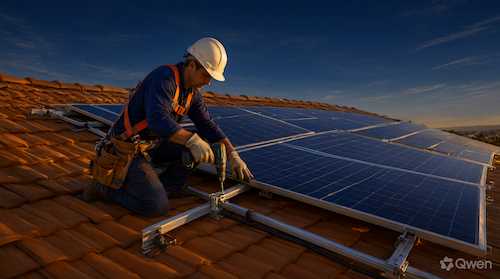
Solar in this metro is a structural and insurance conversation as much as an energy one. The city gets plenty of sun, but it also gets tropical systems, and an array is a permanent attachment to a roof that is already the part of the building most likely to be lost in a storm. Meanwhile the heat works against production, the humidity works against equipment, and 63.5% of the housing was built before 1980 on roofs that may be slate, low-slope or inside a historic district. A proposal that leads with an annual kilowatt-hour figure is skipping every question that decides whether the project is sensible.
Warm, humid air and the output it costs
Module output falls as cell temperature rises, and cells on a roof here run well above air temperature for much of the year. Humidity adds its own complication, since it reduces the benefit of the clear-sky conditions that production modelling often assumes. Ask what cell temperature the estimate assumes, whether the design leaves an air gap behind the modules for airflow, and how the seasonal profile looks. A quote derived from generic sun-hours will not reflect what a July afternoon costs in a hot, hazy climate.
Wind rating, attachments and rapid shutdown
In a hurricane-exposed metro the mounting matters more than the module. Ask what wind speed the system is engineered for, how the attachments are sealed and flashed, whether the array is designed to be removed ahead of a storm if that is practical, and whether the system includes rapid shutdown at the array so responders can work safely. Also ask how the equipment is protected from surge and water intrusion, and whether the installation is included in the homeowner's insurance policy — in this market that is not a detail to leave until after signing.
Which roof, and how much life is left in it
Older New Orleans roofs come in several types that each present a different mounting problem: slate and tile that cannot be drilled casually, low-slope membranes on rear additions and commercial-style buildings, and metal standing seam that may be clampable without penetration. Ask what the covering is, how old it is, what its remaining service life is judged to be, and whether the installer has mounted on that material. If the roof is within a few years of replacement, doing it first avoids paying for disconnection and reinstallation twice.
Historic districts and visible arrays
A significant part of the metro is covered by historic district review, and an array visible from a public way can require approval with conditions on placement or appearance. Ask whether the address is in a district, whether the installation would be visible, and whether the installer has worked with that commission before. Discovering this after equipment is ordered is expensive, and unlike many delays in construction it is entirely predictable.
What the utility credits has changed before
Louisiana's rules for crediting exported solar have been revised, and the terms that apply to a new system are those in force when it is interconnected. That makes the application timeline a financial variable. Ask who files the interconnection request, what the expected review window is, how exported energy is credited under the current rules, what fixed charges remain, and what happens to accumulated credits at the end of a period. Confirm the structure with the utility rather than relying on a verbal summary.
What to ask a New Orleans installer
Where this page stops
No prices, incentives or production figures are published here, because none can be produced honestly without a site assessment. Roof condition and structural capacity require inspection, and insurance, financial and regulatory questions belong to a qualified adviser, the insurer and the utility.
New Orleans metro context
The 2024 ACS 5-year estimates count about 982,000 residents in 398,564 households across 465,148 housing units, with 60.6% owner-occupied and 58.4% single-family detached — the low detached share means a meaningful portion of the stock is in doubles or multi-unit buildings where the roof is shared. About 63.5% of units were built before 1980. A climate station is not reported for this metro in the site dataset, so no temperature or precipitation normals appear on this page.
New Orleans housing and ownership indicators
| Indicator | Value | Source |
|---|---|---|
| Owner-occupied share | 60.6% | U.S. Census Bureau |
| Single-family detached share | 58.4% | U.S. Census Bureau |
| Housing units built before 1980 | 63.5% | U.S. Census Bureau |
| Housing units | 465,148 | U.S. Census Bureau |
| Metro households | 398,564 | U.S. Census Bureau |
| Metro population | 981,662 | U.S. Census Bureau |
No climate normals are shown because no station record is held for this metro in the site dataset. Wind exposure and flood considerations are set by location and by the requirements applicable to the address.
Frequently Asked Questions
Can solar survive a hurricane here?
Equipment and mounting are engineered and rated for wind, and the quality of the attachment and flashing is what decides the outcome. Ask for the wind rating and for how the system is designed and documented, and confirm that the array is included in your insurance.
What is rapid shutdown and do I need it?
A feature that reduces voltage at the array so responders can work safely near a damaged system. It is required by code for many installations and is particularly relevant where storm damage is a realiztic scenario. Ask whether it is included.
Does the heat really reduce output that much?
It reduces it predictably, and the amount depends on the module's temperature coefficient and on how hot the cells run in service. A proper production model accounts for it; a simple sun-hours estimate does not.
Can panels go on a slate or tile roof?
Sometimes, with mounting designed for that material and an installer who has done it. Both are expensive to damage, so the roof should be assessed by someone experienced with the covering before any array is specified.
What if my building is in a historic district?
A visible installation may require review and could come with conditions on placement. Ask the commission for the specific address before equipment is ordered, and ask the installer whether they have worked under that review before.
Will the utility credit all the power I export?
Louisiana's export credit rules have changed over time, and the terms depend on when the system is interconnected. Ask for the current structure in writing and confirm it with the utility rather than assuming a one-for-one credit.
Sources and review date
- American Community Survey 2024 5-year estimates (CBSA tables) — U.S. Census Bureau, 2024 ACS 5-year estimates.
Reviewed on 2026-11-18.