
New Orleans, LA · metro guide
Landscaping in New Orleans: Water, Wind, and Roots Under the House
Every planting decision here is also a drainage decision, and sometimes a plumbing one.
Metro snapshot
New Orleans in numbers
Sources named below each block
- Population
- 982K
- Households
- 399K
- Housing units
- 465K
- People / household
- 2.46
- population ÷ households
Owner-occupied homes 61%
The rest are rented. Owners are the ones who commission most exterior work.
Single-family detached 58%
Detached houses carry their own roof, gutters and exterior walls.
Built before 1980 64%
Older housing stock shapes what fails first: gutters, flashing, pipe material.
Season
The year in New Orleans
- Precipitation
- 63.4 in
- Snowfall
- 0 in
Average temperature by month, °F — the shape of the year is what decides when exterior work gets done.
Precipitation by month, inches.
| Month | Average temperature (°F) | Precipitation (in) | Snowfall (in) |
|---|---|---|---|
| January | 54.3°F | 5.18 in | 0.0 in |
| February | 58.0°F | 4.13 in | 0.0 in |
| March | 63.8°F | 4.36 in | 0.0 in |
| April | 70.1°F | 5.22 in | 0.0 in |
| May | 77.1°F | 5.64 in | 0.0 in |
| June | 82.4°F | 7.62 in | 0.0 in |
| July | 83.9°F | 6.79 in | 0.0 in |
| August | 84.0°F | 6.91 in | 0.0 in |
| September | 80.8°F | 5.11 in | 0.0 in |
| October | 72.5°F | 3.70 in | 0.0 in |
| November | 62.4°F | 3.87 in | 0.0 in |
| December | 56.6°F | 4.82 in | 0.0 in |
NOAA 1991–2020 climate normals, station NEW ORLEANS INTL AP, LA US (USW00012916). Station observations, not a metro-wide average — a metro that spans a mountain range can differ by more than this record shows.
Population, households and housing shares: U.S. Census Bureau, American Community Survey 2024 5-year estimates, metropolitan statistical area.
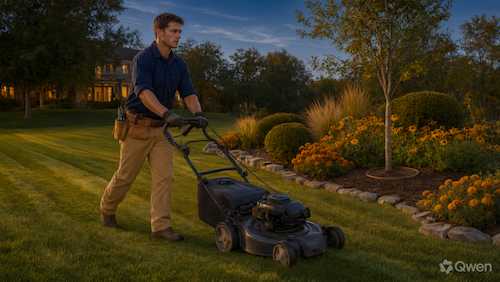
Gardening in this metro starts with the fact that the ground is low and the water table is high. Lots that sit barely above sea level drain slowly, and in a heavy rain the soil is saturated before the storm is halfway through. That turns drainage into the first design question rather than a detail, and it explains why so many local landscapes are built on raised beds and mounds. The second local constant is wind: tropical systems and the thunderstorms around them reshape trees, and a species that looks healthy in a catalog can be the first thing to come down in a yard where nothing has been pruned for wind.
Where the water goes decides everything else
In a slow-draining lot, a planting bed dug into the soil becomes a basin. Plants that tolerate wet roots survive; most do not. The practical approaches are to plant on mounds above grade, to build raised beds, to choose species that accept periodic saturation, and to grade the surface so water moves away from the house rather than sitting beside it. Ask the contractor where water stands after a storm, whether the design raises the planting above the surrounding grade, and whether a swale or a dry well has been considered. Also ask where the downspouts discharge, because that single detail often explains a wet corner.
Wind is a design input, not a misfortune
Trees that have grown with a dense canopy and no thinning become sails. The useful practices are structural pruning while the tree is young, choosing species with a form that resists wind, and keeping the largest trees far enough from the house that a limb failure is not a roof failure. Ask whether pruning is part of the scope, whether the contractor will evaluate existing trees for weak unions and included bark, and what the plan is for anything that has already been damaged. Removing a mature tree on a public right of way usually requires local approval.
Roots and the sewer line
Large trees and old clay or cast iron laterals are a difficult combination, and roots find the joints. Slow drains that return after clearing, gurgling, and odors in the yard are the signs. A landscape plan that adds a large shade tree should account for where the lateral runs, and a house that already has drainage problems should have the line inspected before the tree goes in. Ask whether the contractor knows where the lateral is, and whether root barriers are being used and where. It is much easier to plan planting around a pipe than to remove a tree afterwards.
What actually thrives here
The growing conditions are generous in warmth and moisture, which suits a wide range of species and also suits the things that eat them. Termite pressure is significant, so wood mulch against the house and wood structures in contact with soil are worth thinking about. Mosquito pressure shapes how a garden is used as much as what is planted, which argues for moving water and avoiding stagnant pockets. Ask what the maintenance regime is, how the beds are edged, and whether mulch will be kept away from the siding and the foundation.
Salt, surge, and the coastal edge
In parts of the metro close to open water, storm surge and wind-driven salt spray burn foliage and can leave soil saline enough to affect what will grow afterwards. Ask how the plant list accounts for salt exposure if the property is near the coast, and what the recovery plan is after a surge event — flushing, replacing soil in beds, and replanting with tolerant species. A landscape designed without that in mind can lose years of growth in a single storm.
What to put in a landscaping brief
Where this page stops
This page does not evaluate a property and publishes no prices. Drainage, soil and utility locations must be confirmed on site, and work on public trees or in historic districts is subject to local rules.
New Orleans metro context
The 2024 ACS 5-year estimates count about 982,000 residents in 398,564 households across 465,148 housing units. About 58.4% of units are single-family detached and 60.6% are owner-occupied, while 63.5% were built before 1980 — an old, dense stock where lots are small, established trees are large, and sewer laterals are often original. A climate station is not reported for this metro in the site dataset, so no temperature or precipitation figures are published here.
New Orleans housing and ownership indicators
| Indicator | Value | Source |
|---|---|---|
| Single-family detached share | 58.4% | U.S. Census Bureau |
| Owner-occupied share | 60.6% | U.S. Census Bureau |
| Housing units built before 1980 | 63.5% | U.S. Census Bureau |
| Metro households | 398,564 | U.S. Census Bureau |
| Housing units | 465,148 | U.S. Census Bureau |
| Metro population | 981,662 | U.S. Census Bureau |
No climate normals are shown because no station record is held for this metro in the site dataset. Ground elevation and drainage capacity vary from lot to lot across the metro.
Frequently Asked Questions
Why does water stand in my yard after rain?
Because the soil is saturated and the lot is low, so there is nowhere for it to drain quickly. Grading, raised beds, and redirecting downspouts help on the lot itself. Where the problem is regional drainage capacity, planting for wet conditions is often the realiztic answer.
Can I build raised beds here?
Yes, and they are a common solution for slow-draining soil and for anything edible. Height above grade, drainage at the base and the soil mix are the design decisions, and they matter more than the frame material.
Will a big tree damage my sewer line?
It can, especially where a lateral is old clay or cast iron with joints roots can enter. Knowing where the line runs before planting and using a barrier where appropriate reduces the risk. A tree that is already in the wrong place is a harder problem than one that has not been planted yet.
What should I plant for wind resistance?
Species with a strong form and a canopy that has been structurally pruned while young. No tree is immune to a strong enough storm, so placement relative to the house matters as much as species. Have large existing trees assessed for weak unions.
Does mulch attract termites?
Termites are a genuine local pressure. Keeping mulch away from the siding, avoiding wood in direct contact with soil, and maintaining a visible gap along the foundation are the practical precautions. Regular inspection matters more than the choice of mulch.
What happens to a garden after storm surge?
Salt can burn foliage and leave soil saline. Flushing with fresh water, replacing soil in beds and replanting with tolerant species is the usual recovery. Designing for salt exposure in advance is easier where the property is close to open water.
Sources and review date
- American Community Survey 2024 5-year estimates (CBSA tables) — U.S. Census Bureau, 2024 ACS 5-year estimates.
Reviewed on 2026-11-18.