
Orlando, FL · metro guide
Window Cleaning in Orlando: Pool Cages, Lake Humidity and Afternoon Storms
The newest housing in this set, plus a screen enclosure on the back of half the houses.
Metro snapshot
Orlando in numbers
Sources named below each block
- Population
- 2.8M
- Households
- 1.0M
- Housing units
- 1.1M
- People / household
- 2.73
- population ÷ households
Owner-occupied homes 63%
The rest are rented. Owners are the ones who commission most exterior work.
Single-family detached 59%
Detached houses carry their own roof, gutters and exterior walls.
Built before 1980 24%
Older housing stock shapes what fails first: gutters, flashing, pipe material.
Season
The year in Orlando
- Precipitation
- 51.5 in
- Snowfall
- 0 in
Average temperature by month, °F — the shape of the year is what decides when exterior work gets done.
Precipitation by month, inches.
| Month | Average temperature (°F) | Precipitation (in) | Snowfall (in) |
|---|---|---|---|
| January | 60.6°F | 2.48 in | 0.0 in |
| February | 63.6°F | 2.04 in | 0.0 in |
| March | 67.3°F | 3.03 in | 0.0 in |
| April | 72.2°F | 2.58 in | 0.0 in |
| May | 77.3°F | 4.02 in | 0.0 in |
| June | 81.2°F | 8.05 in | 0.0 in |
| July | 82.6°F | 7.46 in | 0.0 in |
| August | 82.6°F | 7.69 in | 0.0 in |
| September | 81.0°F | 6.37 in | 0.0 in |
| October | 75.5°F | 3.46 in | 0.0 in |
| November | 68.2°F | 1.79 in | 0.0 in |
| December | 63.3°F | 2.48 in | 0.0 in |
NOAA 1991–2020 climate normals, station ORLANDO INTL AP, FL US (USW00012815). Station observations, not a metro-wide average — a metro that spans a mountain range can differ by more than this record shows.
Population, households and housing shares: U.S. Census Bureau, American Community Survey 2024 5-year estimates, metropolitan statistical area.
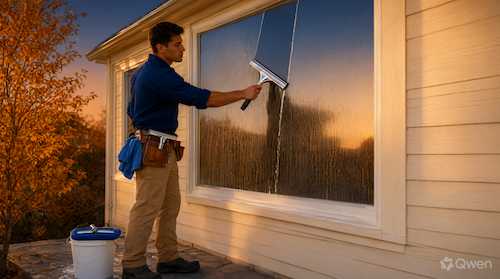
Orlando has the newest stock in this group — only 23.8% of units predate 1980 — and 58.5% is detached. The characteriztic local feature is not the glass at all but what stands in front of it: screened pool enclosures and lanai cages cover the rear elevations of a large share of the housing, and they change both the access and the cleaning. Behind them, lake humidity keeps tracks damp and summer storms arrive most afternoons, so growth returns quickly and dust is washed on rather than off.
Screened enclosures change the job
Where a pool cage covers the rear of the house, the glass behind it is sheltered from rain but not from humidity, and the screens themselves collect pollen, dust and growth. Access means working around or through the enclosure. Ask whether the enclosure panels are included and whether the rear glass is reachable without dismantling anything.
Lake humidity and growth in the tracks
With lakes throughout the metro and humidity that rarely drops, tracks and sills stay damp and become the reservoir for growth. Cleaning the pane alone leaves it. Ask whether tracks are cleaned and dried.
Afternoon storms that wash dirt on
Summer storms arrive most afternoons, and each one splashes soil and roof grit onto the lower glass and dries there. That is why lower panes and sills get dirty faster than the upper ones. Ask whether the lower course is treated separately.
HOA rules and vendor registration
Much of the newer housing sits in communities with their own requirements for exterior work, vendor registration and hours. A crew that has not worked the community can lose a morning at the gate. Ask what the community requires before the visit.
New coated glass and pool chemistry
With almost all the stock postdating 1980 and much of it recent, low-emissivity coatings are the norm, and they react badly to ammonia, abrasives and dry scraping. Near a pool, splash and chlorine residue add another film. Ask whether the glass is coated and how pool splash is handled.
What to pin down in the estimate
Where this page stops
No prices are quoted and no property is assessed here. Screen replacement, enclosure structure and pool chemistry are separate trades, and mold inside a living space needs a specializt.
Orlando metro context
The 2024 ACS 5-year estimates describe about 2.79 million residents in 1,022,315 households and 1,145,360 housing units, with 63.1% owner-occupied and 58.5% single-family detached. About 23.8% of units predate 1980. No climate station is reported for this metro in the site dataset, so no temperature or precipitation normals appear on this page.
Orlando housing indicators
| Indicator | Value | Source |
|---|---|---|
| Housing units built before 1980 | 23.8% | U.S. Census Bureau |
| Single-family detached share | 58.5% | U.S. Census Bureau |
| Owner-occupied share | 63.1% | U.S. Census Bureau |
| Metro households | 1,022,315 | U.S. Census Bureau |
| Housing units | 1,145,360 | U.S. Census Bureau |
| Metro population | 2,793,746 | U.S. Census Bureau |
Station normals are historical averages for one location, not a forecast. Glass condition depends on how often the surface is wetted and what the water carries.
Frequently Asked Questions
Can you clean windows behind a pool cage?
Usually, but the access has to be worked out around the enclosure. Confirm whether panels need to come out and who puts them back.
Do the pool screens get cleaned too?
That is a separate item, and worth asking for explicitly. Screens collect pollen and growth on their own.
Why do the lower windows get dirty faster?
Afternoon storms splash soil and roof grit up onto the lower glass, and it dries there.
Why does mold return so quickly?
Humidity keeps the tracks damp. Cleaning the glass without the track leaves the source in place.
Is cleaning safe for newer windows?
With the coating in mind. Ammonia and abrasives can damage low-emissivity glass permanently, and pool splash adds chlorine to the surface.
Do I need HOA approval?
Often for vendor access rather than for the work itself. Confirm the requirement before the crew arrives.
Sources and review date
- American Community Survey 2024 5-year estimates (CBSA tables) — U.S. Census Bureau, 2024 ACS 5-year estimates.
Reviewed on 2026-11-18.