
Orlando, FL · metro guide
HVAC in Orlando: Humidity Is the Load and the Drain Is the Risk
A system that reaches the set temperature but leaves the house clammy has failed at its actual job.
Metro snapshot
Orlando in numbers
Sources named below each block
- Population
- 2.8M
- Households
- 1.0M
- Housing units
- 1.1M
- People / household
- 2.73
- population ÷ households
Owner-occupied homes 63%
The rest are rented. Owners are the ones who commission most exterior work.
Single-family detached 59%
Detached houses carry their own roof, gutters and exterior walls.
Built before 1980 24%
Older housing stock shapes what fails first: gutters, flashing, pipe material.
Season
The year in Orlando
- Precipitation
- 51.5 in
- Snowfall
- 0 in
Average temperature by month, °F — the shape of the year is what decides when exterior work gets done.
Precipitation by month, inches.
| Month | Average temperature (°F) | Precipitation (in) | Snowfall (in) |
|---|---|---|---|
| January | 60.6°F | 2.48 in | 0.0 in |
| February | 63.6°F | 2.04 in | 0.0 in |
| March | 67.3°F | 3.03 in | 0.0 in |
| April | 72.2°F | 2.58 in | 0.0 in |
| May | 77.3°F | 4.02 in | 0.0 in |
| June | 81.2°F | 8.05 in | 0.0 in |
| July | 82.6°F | 7.46 in | 0.0 in |
| August | 82.6°F | 7.69 in | 0.0 in |
| September | 81.0°F | 6.37 in | 0.0 in |
| October | 75.5°F | 3.46 in | 0.0 in |
| November | 68.2°F | 1.79 in | 0.0 in |
| December | 63.3°F | 2.48 in | 0.0 in |
NOAA 1991–2020 climate normals, station ORLANDO INTL AP, FL US (USW00012815). Station observations, not a metro-wide average — a metro that spans a mountain range can differ by more than this record shows.
Population, households and housing shares: U.S. Census Bureau, American Community Survey 2024 5-year estimates, metropolitan statistical area.
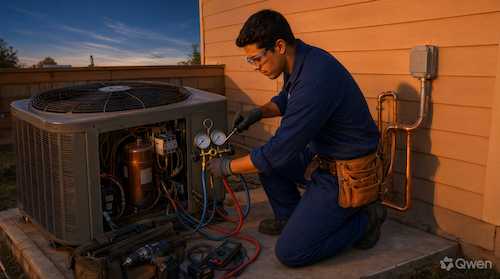
Air conditioning here runs most of the year, and the load it carries is dominated by moisture rather than by temperature. That single fact explains most of the complaints: rooms that reach the thermostat setting and still feel damp, condensation on ducts and registers, and an air handler in a hot attic working harder than its rating suggests. The housing stock compounds it — only 23.8% predates 1980, so most systems are in houses of the 1980s to 2000s, the era when air handlers and flex duct went into attics as a matter of course. In this climate those attics are the least forgiving place on the property to put the most important equipment.
Latent load, oversized equipment and the clammy house
A cooling system removes moisture only while the coil is cold and the air is moving across it. An oversized unit drops the temperature quickly, shuts off, and leaves the humidity where it was — which is why a system can be technically working and the house still feels wrong. The remedy is a load calculation that treats moisture as a design condition, equipment that can run longer at reduced capacity, and a fan setting that does not keep blowing humid air after the compressor stops. Ask whether the load calculation accounts for latent load, whether the system can modulate, and what the airflow setting will be.
The condensate drain is the failure that damages the house
Every hour of cooling produces water, and in this climate that is a lot of water. It leaves through a drain line that clogs with biological growth, and when it clogs, the pan overflows — usually in an attic or a closet above a ceiling. A float switch and a secondary drain are the difference between a service call and a water-damage claim. Ask whether a float switch is installed, whether the primary drain has a trap and is pitched correctly, and where the secondary or emergency drain actually discharges so that an overflow is visible rather than silent.
Equipment in an attic that fights it
An air handler and flex duct in an attic lose capacity to the space around them: unsealed plenums and boots pull hot attic air into the supply, and duct runs through a hot attic gain heat before they reach the room. The result is a system that performs worse than its label and a house with uneven temperatures. Sealing the cabinet, the plenum and the boots, and improving duct insulation, is often more valuable than a larger condenser. Ask whether the ducts will be inspected or tested, what insulation value is specified, and whether the air handler closet is sealed and insulated from the attic.
Heat pumps and the short cool season
Cooling dominates, but the metro does get cool winter mornings, and a heat pump provides both functions from one system. That makes the defrost cycle, the auxiliary heat and the thermostat configuration worth understanding, because a heat pump set up poorly is uncomfortable in exactly the few weeks it is needed for heat. Ask whether the proposal is a heat pump or a straight-cool system with a separate heat source, how the auxiliary heat is staged, and what the expected performance is on a cold morning.
Filtration, ventilation and indoor air
A house closed up against humidity for most of the year has a different air-quality profile: the system filters what circulates, the return path determines what actually gets filtered, and a leaky cabinet pulls air from a garage or attic straight into the supply. Kitchens and bathrooms also need to exhaust outside rather than into the attic, where the moisture ends up in the insulation. Ask whether the return path is sealed, what filter the equipment can support, and where the bath and kitchen exhaust ducts actually terminate.
What to pin down in the estimate
Where this page stops
No prices, sizes or efficiency figures are quoted here. Refrigerant rules and equipment ratings change, and the applicable version should be confirmed from the manufacturer's literature and the local authority rather than from any page.
Orlando metro context
The 2024 ACS 5-year estimates describe about 2.79 million residents in 1,022,315 households and 1,145,360 housing units, with 63.1% owner-occupied and 58.5% single-family detached. Only 23.8% of units predate 1980, so most systems here serve houses built in the decades when attic air handlers became standard. No climate station is reported for this metro in the site dataset, so no temperature or precipitation normals appear on this page.
Orlando housing indicators
| Indicator | Value | Source |
|---|---|---|
| Housing units built before 1980 | 23.8% | U.S. Census Bureau |
| Single-family detached share | 58.5% | U.S. Census Bureau |
| Owner-occupied share | 63.1% | U.S. Census Bureau |
| Metro households | 1,022,315 | U.S. Census Bureau |
| Housing units | 1,145,360 | U.S. Census Bureau |
| Metro population | 2,793,746 | U.S. Census Bureau |
No climate normals are shown because no station record is held for this metro in the site dataset. The share of pre-1980 housing is the useful indicator here: the newer the stock, the more likely the air handler sits in an attic rather than a closet or garage.
Frequently Asked Questions
Why does my house feel damp even at the right temperature?
Because temperature and humidity are different loads. If the system is oversized or the fan runs continuously, the coil does not stay cold long enough to remove moisture, so the house reaches the set point while staying clammy.
What is the biggest water risk from the air conditioner?
The condensate drain. It clogs with growth, the pan overflows, and the water usually appears in a ceiling below an attic or closet. A float switch and a properly routed secondary drain are the protections.
Should I replace the ducts or the unit?
Often the ducts first. Leaky plenums and boots in a hot attic can waste more capacity than the equipment can make up, and sealing them is usually cheaper than adding tonnage.
Is a heat pump a good choice here?
It provides both cooling and heat from one system, which suits a metro with a short but real cool season. What matters is how the auxiliary heat and defrost are configured, because that decides comfort on the few cold mornings.
How often should the system be serviced?
In a climate where it runs most of the year, an annual service that clears the drain, checks the charge and inspects the coil is a reasonable baseline. Most water-damage calls from HVAC are drain-related and preventable.
Why is one room always warmer?
Usually a duct problem rather than an equipment problem: a long run through a hot attic, a leaking boot, or a poorly balanced branch. The fix is in the distribution, not in a bigger condenser.
Sources and review date
- American Community Survey 2024 5-year estimates (CBSA tables) — U.S. Census Bureau, 2024 ACS 5-year estimates.
Reviewed on 2026-11-18.