
Orlando, FL · metro guide
Water Damage in Orlando: Storm Rain, Humid Air, Slow Leaks
The dry-down window here is measured in hours, because the air itself is on the water's side.
Metro snapshot
Orlando in numbers
Sources named below each block
- Population
- 2.8M
- Households
- 1.0M
- Housing units
- 1.1M
- People / household
- 2.73
- population ÷ households
Owner-occupied homes 63%
The rest are rented. Owners are the ones who commission most exterior work.
Single-family detached 59%
Detached houses carry their own roof, gutters and exterior walls.
Built before 1980 24%
Older housing stock shapes what fails first: gutters, flashing, pipe material.
Season
The year in Orlando
- Precipitation
- 51.5 in
- Snowfall
- 0 in
Average temperature by month, °F — the shape of the year is what decides when exterior work gets done.
Precipitation by month, inches.
| Month | Average temperature (°F) | Precipitation (in) | Snowfall (in) |
|---|---|---|---|
| January | 60.6°F | 2.48 in | 0.0 in |
| February | 63.6°F | 2.04 in | 0.0 in |
| March | 67.3°F | 3.03 in | 0.0 in |
| April | 72.2°F | 2.58 in | 0.0 in |
| May | 77.3°F | 4.02 in | 0.0 in |
| June | 81.2°F | 8.05 in | 0.0 in |
| July | 82.6°F | 7.46 in | 0.0 in |
| August | 82.6°F | 7.69 in | 0.0 in |
| September | 81.0°F | 6.37 in | 0.0 in |
| October | 75.5°F | 3.46 in | 0.0 in |
| November | 68.2°F | 1.79 in | 0.0 in |
| December | 63.3°F | 2.48 in | 0.0 in |
NOAA 1991–2020 climate normals, station ORLANDO INTL AP, FL US (USW00012815). Station observations, not a metro-wide average — a metro that spans a mountain range can differ by more than this record shows.
Population, households and housing shares: U.S. Census Bureau, American Community Survey 2024 5-year estimates, metropolitan statistical area.
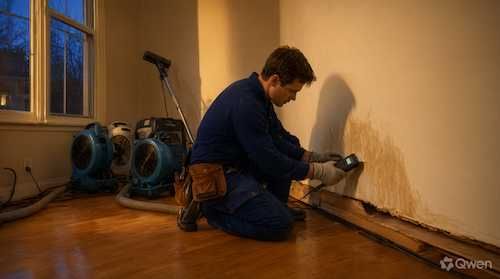
Two things make water damage different in this metro. The first is that the air is humid almost all year, so nothing dries on its own and any wet material is a mold incubator within days. The second is that a large share of the housing was built after 1980 and sits on a slab, with the air handler in the attic and the water heater in a closet — so the leaks that matter are the ones that run quietly in a space nobody is watching. Storm rain matters too, and it arrives with wind, which pushes water sideways into places a roof was never designed to shed from.
Wind-driven rain gets in sideways
The failure pattern in a tropical system is not a hole in the roof. It is water driven horizontally into window frames, door thresholds, the joint between a wall and a soffit, and any penetration that relies on gravity rather than on flashing. Once it is inside a wall, it travels along the sheathing or the top plate and appears as a wet ceiling somewhere else. Ask how the building is being checked after a storm event — the interior of the wall cavities at the windward elevations, the window heads and the sliding door thresholds — rather than only the roof and the ceilings that are obviously stained.
The mold window is short
In this climate, wet drywall and carpet are not a 'wait and see' problem. Warm, humid air keeps surfaces at the conditions microbial growth needs, and the practical window is days rather than weeks. That is why dry-down should start the same day the water is found and why dehumidification, not just air movement, is part of the answer — moving humid air around a wet room does very little. Ask what dehumidification capacity is being brought, how the space will be closed and controlled while it dries, and how dryness will be verified with readings.
Slab leaks and the wet spot that has no source
A house on a slab has no basement to reveal a plumbing leak, so the evidence is subtler: a warm area on the floor, the sound of running water when everything is off, a water bill that climbs, or a baseboard that stays damp. Flooring hides it until the damage is expensive. Meanwhile an irrigation line or a hose bib outside can wet a wall for weeks without being noticed. Ask how the source will be isolated — meter test, section isolation, or an acoustic or thermal check — and what will be opened to confirm it rather than assumed.
Evidence decides the claim
Insurers here distinguish carefully between a sudden discharge, a storm opening, and long-term seepage, and the difference is usually documentation rather than fact. Photographs taken before anything is moved, a dated timeline, moisture readings and a written scope from the contractor all point the same way. The other useful detail is the age of the failure: a supply hose that burst is a different event from a shower pan that has been leaking since a 2010 renovation. Ask the contractor to report conditions and scope without characterizing fault, and to photograph the source as well as the damage.
Homes that are empty for weeks
This metro has a large number of properties that sit empty for long stretches, whether as second homes, seasonal rentals or short-term lets. Those are the losses that run longest: a supply line or a condensate pan can release water for days before anyone is in the building, and by then the damage has spread beyond the room where it started. The controls are simple and usually skipped. Ask whether a leak detector with an automatic shut-off is fitted, whether the water can be isolated when the property is empty, and who checks it between guests.
What to pin down before work starts
Where this page stops
No prices are quoted and no loss is assessed here. Insurance coverage depends on the individual policy and its exclusions, and flood, storm and seepage are treated differently. Mold and structural questions require inspection.
Orlando metro context
The 2024 ACS 5-year estimates describe about 2.79 million residents in 1,022,315 households and 1,145,360 housing units, with 63.1% owner-occupied and 58.5% single-family detached. Only 23.8% of units predate 1980, which is why so much of the response here involves modern slab-on-grade construction with attic mechanical space rather than basements, cellars or crawlspaces. No climate station is reported for this metro in the site dataset, so no temperature or precipitation normals appear on this page.
Orlando housing indicators
| Indicator | Value | Source |
|---|---|---|
| Housing units built before 1980 | 23.8% | U.S. Census Bureau |
| Single-family detached share | 58.5% | U.S. Census Bureau |
| Owner-occupied share | 63.1% | U.S. Census Bureau |
| Metro households | 1,022,315 | U.S. Census Bureau |
| Housing units | 1,145,360 | U.S. Census Bureau |
| Metro population | 2,793,746 | U.S. Census Bureau |
No climate normals are shown because no station record is held for this metro in the site dataset. Storm risk here depends on the track of an individual system, not on a metro-wide average, so local drainage and elevation matter more than any published figure.
Frequently Asked Questions
How fast can mold develop after a leak here?
Days, not weeks, because the air is warm and humid and stays that way. That is why dry-down starts immediately rather than waiting for an adjuster or a contractor's first available slot.
The roof did not leak during the storm — where did the water come from?
Usually sideways: window heads, door thresholds, wall-to-soffit joints and any penetration that relies on gravity. Water entering a wall travels along the sheathing and shows up as a stain well away from the entry point.
Why is a dehumidifier necessary?
Air movement alone does not dry a room when the air being moved is already humid. Dehumidification is what lowers the moisture content of the material, and the space usually has to be closed and controlled while it happens.
How do I find a slab leak?
Start with the meter: shut everything off and see whether it still moves. Then isolate sections. A warm spot on the floor or a persistent damp baseboard can indicate a hot or cold line, and confirmation means opening the floor rather than guessing.
Is water from an irrigation break covered?
It depends on the policy and on how long it ran. Long-term seepage is commonly excluded while a sudden discharge may be covered, so the timeline of when it started matters as much as the damage.
Should I throw out wet carpet immediately?
If the water is clean and the carpet can be dried quickly, it may be salvageable. If the water came from outside, from a drain, or has been standing, porous material is usually removed. The classification drives the decision.
Sources and review date
- American Community Survey 2024 5-year estimates (CBSA tables) — U.S. Census Bureau, 2024 ACS 5-year estimates.
Reviewed on 2026-11-18.