
Jacksonville, FL · metro guide
Water Damage Restoration in Jacksonville: Storm Rain, Condensate, and Stucco
Storms bring the water in from outside. The humidity decides how much damage it does after.
Metro snapshot
Jacksonville in numbers
Sources named below each block
- Population
- 1.7M
- Households
- 663K
- Housing units
- 732K
- People / household
- 2.54
- population ÷ households
Owner-occupied homes 67%
The rest are rented. Owners are the ones who commission most exterior work.
Single-family detached 64%
Detached houses carry their own roof, gutters and exterior walls.
Built before 1980 32%
Older housing stock shapes what fails first: gutters, flashing, pipe material.
Season
The year in Jacksonville
- Precipitation
- 53.4 in
- Snowfall
- 0 in
Average temperature by month, °F — the shape of the year is what decides when exterior work gets done.
Precipitation by month, inches.
| Month | Average temperature (°F) | Precipitation (in) | Snowfall (in) |
|---|---|---|---|
| January | 54.2°F | 3.28 in | 0.0 in |
| February | 57.5°F | 2.86 in | 0.0 in |
| March | 62.4°F | 3.29 in | 0.0 in |
| April | 68.1°F | 2.93 in | 0.0 in |
| May | 74.9°F | 3.42 in | 0.0 in |
| June | 80.3°F | 7.60 in | 0.0 in |
| July | 82.5°F | 6.77 in | 0.0 in |
| August | 82.1°F | 6.88 in | 0.0 in |
| September | 78.8°F | 7.56 in | 0.0 in |
| October | 71.2°F | 4.03 in | 0.0 in |
| November | 62.3°F | 2.00 in | 0.0 in |
| December | 56.7°F | 2.78 in | 0.0 in |
NOAA 1991–2020 climate normals, station JACKSONVILLE, FL US (USW00013889). Station observations, not a metro-wide average — a metro that spans a mountain range can differ by more than this record shows.
Population, households and housing shares: U.S. Census Bureau, American Community Survey 2024 5-year estimates, metropolitan statistical area.
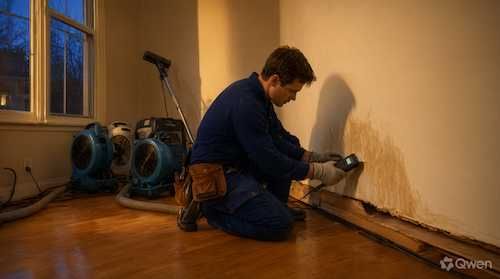
Water damage in Jacksonville arrives in two shapes. The dramatic one is a tropical system or a severe summer storm driving rain past the roof covering and into wall assemblies, often through a penetration that had been fine for years. The ordinary one is the air handler in the attic overflowing its condensate pan in the middle of a hot, humid afternoon. Both end up in the same place: a ceiling, a wall cavity or a floor covering that stays wet in air that will not dry it, and in this climate the interval between wet and moldy is measured in days.
Wind-driven rain and the details it finds
Rain driven at an angle does not respect shingles. It gets past vent boots, chimney flashing, the joint where a porch roof meets the wall, window heads and door thresholds, and it can be pushed uphill into a wall by pressure. Water then travels along framing, so the stain on the ceiling is frequently several feet from the opening. Ask how the entry point was identified, whether the flashing or threshold repair is included in the scope, and whether the repair will hold up in the next storm rather than merely closing the stain.
The condensate line runs for months
Cooling equipment here produces condensate almost continuously through the warm season, and where the air handler sits in the attic the drain is passing above finished rooms. Dust, algae and insect debris block the line, the pan fills, and the ceiling below tells you about it. Ask whether the pan has a float switch, where the secondary drain discharges, and when the line was last cleared. If a stain appears during the cooling season rather than during a storm, this is the first thing to check.
Stucco and window openings
A great deal of housing in this metro is finished in stucco, and stucco is only as good as the details behind it: the weep screed at the base, the flashing at windows and doors, and the sealant at penetrations. When water gets behind it, the cavity stays wet and the damage is invisible until the interior shows it. Ask whether the contractor will look behind the finish at the source, whether the repair addresses the drainage plane, and how the patch will be integrated so it does not become the next entry point.
The clock runs faster here
In a humid climate, materials that stay wet become a mold problem in days rather than weeks, and the air itself does not dry them. That makes dehumidification the critical equipment and extraction timing the critical decision. Ask what readings were taken, at which materials and locations, what dry standard applies, and who rechecks before the rebuild. Porous materials that cannot be dried quickly are usually removed, and that is often the right answer rather than a slow attempt to save them.
Where the water goes outside
Sandy soil drains quickly, which helps, but a flat lot during an intense storm still ponds, and a blocked swale or a downspout discharging beside the wall sends water to the slab edge. Ask where water stands after a storm and for how long, whether the grade falls away from the building, and whether the downspouts can be extended. In low-lying areas the honest answer may be that occasional flooding is a site condition, in which case the priority shifts to protecting the building rather than correcting the lot.
Questions to ask on the first visit
Where this page stops
This page does not assess a specific loss and publishes no prices. Sewage, mold and active intrusion require on-site assessment, and coverage questions belong to your insurer and the policy documents.
Jacksonville metro context
ACS 2024 5-year estimates report about 1.68 million residents in 663,101 households and 732,419 housing units, with 66.5% owner-occupied and 63.7% single-family detached. About 31.6% of units predate 1980, so much of the stock is slab-on-grade with stucco finishes and attic mechanical equipment. A climate station is not reported for this metro in the site dataset, so no precipitation or temperature figures are published on this page.
Jacksonville housing and ownership indicators
| Indicator | Value | Source |
|---|---|---|
| Housing units built before 1980 | 31.6% | U.S. Census Bureau |
| Single-family detached share | 63.7% | U.S. Census Bureau |
| Owner-occupied share | 66.5% | U.S. Census Bureau |
| Metro households | 663,101 | U.S. Census Bureau |
| Housing units | 732,419 | U.S. Census Bureau |
| Metro population | 1,683,960 | U.S. Census Bureau |
No climate normals are shown because no station record is held for this metro in the site dataset. Flood exposure varies considerably between inland lots and properties near the river or the coast.
Frequently Asked Questions
Why does water come through the ceiling during a storm if the roof looks fine?
Because wind-driven rain gets past a penetration or a flashing detail rather than through the field of the shingles. Vent boots, chimney flashing, wall and porch junctions and window heads are the usual entry points, and the stain often appears well away from them.
How quickly can mold grow here?
The window is generally measured in days for materials that remain wet, and the humid air slows drying. That is why extraction should start as soon as the source is controlled and why materials that cannot be dried are removed rather than kept.
What is behind stucco when it leaks?
A cavity that stays wet and hides the damage until the interior shows it. The durable repair addresses the drainage plane and the flashing at openings, not just the surface finish that cracked.
Should I run the air conditioner to dry the house?
Comfort cooling is not a drying strategy, though it removes some moisture. Proper drying uses dehumidification sized for the space, with readings taken to confirm progress. Ask for the drying plan rather than relying on the HVAC system.
Is a ceiling stain in summer always a roof problem?
No. Where the air handler is in the attic, a blocked condensate line is a frequent cause and it produces exactly the same stain. The timing of when the stain appears is the most useful clue you have.
What should I photograph first?
The water line on walls and contents, the visible source, damaged flooring and furniture, and any readings taken. Documentation made before cleanup is what insurers rely on, and it cannot be recreated afterwards.
Sources and review date
- American Community Survey 2024 5-year estimates (CBSA tables) — U.S. Census Bureau, 2024 ACS 5-year estimates.
Reviewed on 2026-11-18.