
Orlando, FL · metro guide
Roofing in Orlando: Shingle Age, Wind Rating and Insurers
The roof here is usually younger than the house — and its age, not its appearance, is what decides whether the property can be insured.
Metro snapshot
Orlando in numbers
Sources named below each block
- Population
- 2.8M
- Households
- 1.0M
- Housing units
- 1.1M
- People / household
- 2.73
- population ÷ households
Owner-occupied homes 63%
The rest are rented. Owners are the ones who commission most exterior work.
Single-family detached 59%
Detached houses carry their own roof, gutters and exterior walls.
Built before 1980 24%
Older housing stock shapes what fails first: gutters, flashing, pipe material.
Season
The year in Orlando
- Precipitation
- 51.5 in
- Snowfall
- 0 in
Average temperature by month, °F — the shape of the year is what decides when exterior work gets done.
Precipitation by month, inches.
| Month | Average temperature (°F) | Precipitation (in) | Snowfall (in) |
|---|---|---|---|
| January | 60.6°F | 2.48 in | 0.0 in |
| February | 63.6°F | 2.04 in | 0.0 in |
| March | 67.3°F | 3.03 in | 0.0 in |
| April | 72.2°F | 2.58 in | 0.0 in |
| May | 77.3°F | 4.02 in | 0.0 in |
| June | 81.2°F | 8.05 in | 0.0 in |
| July | 82.6°F | 7.46 in | 0.0 in |
| August | 82.6°F | 7.69 in | 0.0 in |
| September | 81.0°F | 6.37 in | 0.0 in |
| October | 75.5°F | 3.46 in | 0.0 in |
| November | 68.2°F | 1.79 in | 0.0 in |
| December | 63.3°F | 2.48 in | 0.0 in |
NOAA 1991–2020 climate normals, station ORLANDO INTL AP, FL US (USW00012815). Station observations, not a metro-wide average — a metro that spans a mountain range can differ by more than this record shows.
Population, households and housing shares: U.S. Census Bureau, American Community Survey 2024 5-year estimates, metropolitan statistical area.
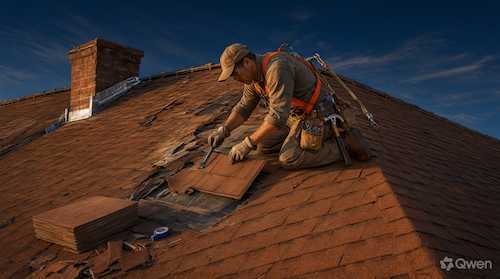
This is one of the youngest housing stocks in the dataset: only 23.8% of units predate 1980, and much of the metro was built in the subdivision booms of the 1990s and 2000s. That has a direct consequence for roofing — the roof is frequently a replacement cycle decision rather than an original roof, and the metro's asphalt shingle roofs are reaching their service limit in waves, subdivision by subdivision. Because the state's insurance market now looks closely at roof age and condition, a roof that still looks acceptable from the street can be the reason a policy is declined or a premium rises.
Roof age drives the insurance conversation
Insurers in Florida commonly ask for the age of the roof and may require an inspection before writing or renewing a policy, and older shingle roofs can become a condition of coverage rather than a maintenance item. That means a homeowner who was planning to wait a few years may find the decision made for them by a letter. The practical step is to establish the age from documentation rather than memory — a permit record, the closing file, or an invoice — and to get the condition documented before a renewal is refused. Ask what evidence of age and condition the contractor will provide, and whether they will meet an inspector on site.
Wind-rated assemblies and the details that fail
The building code here has required wind-rated assemblies for years, and the difference between two quotes for the same house is almost always in those details: the nailing pattern, the attachment of the deck, the secondary water barrier, the edge metal, and whether the roof-to-wall connection is verified while the roof is open. On a roof replacement, the perimeter and the ridge are where wind damage begins. Ask what wind rating the system achieves, what the nailing pattern is, whether a secondary water barrier is included, and whether the roof-to-wall connections will be inspected and documented while the deck is exposed.
Heat, moisture and attic ventilation
A shingle roof in this climate is cooked from above by the sun and from below by a hot attic, and both shorten its life. Ventilation matters more here than in a mild climate, and so does the moisture side: an attic that cannot dry out grows problems that the roof has to be opened to fix. Ask how intake and exhaust ventilation are balanced, whether any exhaust fans are dumping warm moist air into the attic, and whether the deck will be checked for soft spots and moisture while the roof is open.
Subdivisions, associations and matching
Much of this metro is governed by an association, and roofing is one of the areas where the rules bite: approved shingle colors, sometimes a limited list of products, and requirements about visible uniformity. There is also the practical matter of matching a roof to the neighboring houses on a street built in one phase — a small change in color is very visible. Ask whether the product and color are on the approved list, whether the association requires notice before work begins, and what the plan is for any visible difference from the neighboring roofs.
Porch roofs and low-slope sections
A large share of the houses here have a rear porch or a lanai under a low-slope roof, and those sections are frequently the first place water gets in. They are built with a different system from the main roof, terminated differently at the wall, and they often drain to a scupper or a downspout that nobody inspects. Because the main roof is what gets replaced, these sections are sometimes left in place past their life. Ask whether the low-slope areas are included in the scope, what system is specified for them, and how the transition to the main roof is being flashed.
What to pin down in the estimate
Where this page stops
No prices are quoted and no roof is assessed here. Insurance requirements, code wind ratings and association rules vary and change, so the applicable conditions should be confirmed with the insurer, the local authority and the association.
Orlando metro context
The 2024 ACS 5-year estimates describe about 2.79 million residents in 1,022,315 households and 1,145,360 housing units, with 63.1% owner-occupied and 58.5% single-family detached. Only 23.8% of units predate 1980 — the youngest stock in this dataset — which is why roofing here is dominated by replacement cycles on 1990s and 2000s subdivision houses. No climate station is reported for this metro in the site dataset, so no temperature or precipitation normals appear on this page.
Orlando housing indicators
| Indicator | Value | Source |
|---|---|---|
| Housing units built before 1980 | 23.8% | U.S. Census Bureau |
| Single-family detached share | 58.5% | U.S. Census Bureau |
| Owner-occupied share | 63.1% | U.S. Census Bureau |
| Metro households | 1,022,315 | U.S. Census Bureau |
| Housing units | 1,145,360 | U.S. Census Bureau |
| Metro population | 2,793,746 | U.S. Census Bureau |
No climate normals are shown because no station record is held for this metro in the site dataset. A young stock does not mean young roofs: the shingle covering on a 1990s subdivision is now the item under discussion.
Frequently Asked Questions
Does my roof's age affect my insurance?
In Florida it commonly does. Insurers ask for the age and may require an inspection, and an older shingle roof can become a condition of coverage. Establish the age from documentation rather than memory.
What is a secondary water barrier?
A membrane under the shingles that keeps water out if the covering is damaged or lifted. In a wind-driven rain climate it is one of the details that separates a basic replacement from a properly specified one.
Why do quotes for the same roof differ so much?
Usually because of what is behind the shingle: the underlayment, the edge metal, the nailing pattern, whether the deck is inspected, and whether the roof-to-wall connections are checked. Compare the details, not the total.
Can I replace only the damaged slope?
Sometimes, but matching an aged shingle exactly is difficult and the association may object to a visible difference. On a roof already at the end of its life, a partial repair is usually money spent twice.
How long does a shingle roof last here?
The sun and attic heat both shorten its life, and ventilation quality affects it. What matters practically is that the roof's age is documented, because that is what the insurer and the next buyer will ask about.
Does the association have to approve the shingle color?
Often yes, and some associations limit the products as well. Confirm the approved list before ordering, since a rejected color after delivery is an expensive correction.
Sources and review date
- American Community Survey 2024 5-year estimates (CBSA tables) — U.S. Census Bureau, 2024 ACS 5-year estimates.
Reviewed on 2026-11-18.