
Phoenix, AZ · metro guide
Water Damage Restoration in Phoenix: Where the Water Comes From
Phoenix losses rarely start with rain. Most begin with a supply line, a water heater, or an air conditioner drain running all summer.
Metro snapshot
Phoenix in numbers
Sources named below each block
- Population
- 5.0M
- Households
- 1.9M
- Housing units
- 2.1M
- People / household
- 2.66
- population ÷ households
Owner-occupied homes 67%
The rest are rented. Owners are the ones who commission most exterior work.
Single-family detached 65%
Detached houses carry their own roof, gutters and exterior walls.
Built before 1980 27%
Older housing stock shapes what fails first: gutters, flashing, pipe material.
Season
The year in Phoenix
- Precipitation
- 7.2 in
- Snowfall
- —
Average temperature by month, °F — the shape of the year is what decides when exterior work gets done.
Precipitation by month, inches.
| Month | Average temperature (°F) | Precipitation (in) | Snowfall (in) |
|---|---|---|---|
| January | 56.8°F | 0.87 in | — |
| February | 59.9°F | 0.87 in | — |
| March | 66.3°F | 0.83 in | — |
| April | 73.2°F | 0.22 in | — |
| May | 82.0°F | 0.13 in | — |
| June | 91.4°F | 0.02 in | — |
| July | 95.5°F | 0.91 in | — |
| August | 94.4°F | 0.93 in | — |
| September | 89.2°F | 0.57 in | — |
| October | 77.4°F | 0.56 in | — |
| November | 65.1°F | 0.57 in | — |
| December | 55.8°F | 0.74 in | — |
NOAA 1991–2020 climate normals, station PHOENIX SKY HARBOR INTL AP, AZ US (USW00023183). Station observations, not a metro-wide average — a metro that spans a mountain range can differ by more than this record shows.
Population, households and housing shares: U.S. Census Bureau, American Community Survey 2024 5-year estimates, metropolitan statistical area.
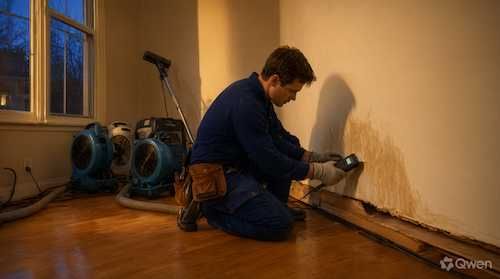
Phoenix gets about 7.2 inches of rain a year, so storm flooding is not the usual cause of a water damage call. The usual causes are indoors and slow: a supply line under a slab, a water heater in a garage, or an air conditioner condensate line that runs every day from May through September. July at Sky Harbor averages 95.5°F, which means cooling equipment is working hard exactly when a drain problem is most likely to appear.
Source first
A scope should identify whether the water came from a supply line, a drain, an appliance, cooling equipment, irrigation, or a monsoon storm, and whether it is still entering. Ask how the source was confirmed and what repair is needed before reconstruction begins. If the source is not controlled, drying equipment is treating a symptom.
Condensate is a water source
An air handler produces gallons of condensate a day in this climate. Ask whether the assessment looked at the drain line, the pan, the float switch, and the path the water took. A ceiling stain that appears in July is often a drain problem rather than a roof problem, and the fix belongs to HVAC work as much as restoration.
Drying in a dry climate
Low outdoor humidity helps evaporation, but it also hides moisture in wall cavities and under tile. Ask for moisture readings with locations and dates, equipment placement, and the dry standard used to close the job. Rapid surface drying is not the same as a dry assembly, and the record should show which was achieved.
Documentation and insurance
Photograph and date the affected areas before work starts, and keep an inventory of damaged items. Ask how the contractor documents the loss and whether they will share readings and photos with the insurer. Coverage depends on the policy, the cause, exclusions, and the deductible; this guide cannot determine coverage.
Questions worth asking before work begins
Where this page stops
This guide does not assess an active loss remotely and does not publish local prices. If water is still entering or there is an electrical safety concern, contact the appropriate emergency service. Coverage and remediation requirements depend on the property, the policy, and the responsible local authority.
Phoenix metro context
The 2024 ACS 5-year estimates put the metro at about 5.0 million residents and 1.9 million households. About 66.6% of occupied homes are owner-occupied, and about 65.3% of housing units are single-family detached. About 27.3% of housing units were built before 1980, so the stock is relatively new, but cooling systems run for months without a break. NOAA's Sky Harbor station records January averaging 56.8°F, July 95.5°F, and about 7.2 inches of precipitation a year.
Phoenix reference station and housing indicators
| Indicator | Value | Source |
|---|---|---|
| January mean temperature | 56.8°F | NOAA NCEI |
| July mean temperature | 95.5°F | NOAA NCEI |
| Annual precipitation | 7.2 in. | NOAA NCEI |
| Metro population | 5,028,754 | U.S. Census Bureau |
| Owner-occupied share | 66.6% | U.S. Census Bureau |
| Housing units built before 1980 | 27.3% | U.S. Census Bureau |
Station normals are historical averages for one location, not a forecast. Census values describe the metro area, not an individual property.
Frequently Asked Questions
What should I do first after discovering water damage?
Stop the source if it is safe to do so, keep people away from electrical hazards, and document the affected area with dated photos. Then arrange an assessment of the source and the wet materials.
Can an air conditioner cause water damage?
Yes. A blocked or disconnected condensate line, a failed pan, or a missing float switch can send water into ceilings and walls, especially during long cooling seasons. Ask the assessment to include the drain and the pan.
How is drying verified?
Drying is normally checked with moisture readings taken at documented locations and compared over time, along with visual inspection. Ask for the readings and the dry standard used to close the job.
Does homeowners insurance cover monsoon damage?
Coverage depends on the policy, the cause, exclusions, the deductible, and the insurer's review. Keep dated documentation and ask the insurer about the specific policy.
What is the difference between mitigation and reconstruction?
Mitigation covers extraction, removal of unsalvageable material, drying, and cleaning. Reconstruction restores the structure and finishes. Ask which parts are included and which are separate.
What is the population of the Phoenix metro area?
The U.S. Census Bureau's 2024 ACS 5-year estimates report about 5.0 million residents in the metro area. The figure describes regional scale, not the number of homes or providers.
Sources and review date
- American Community Survey 2024 5-year estimates (CBSA tables) — U.S. Census Bureau, 2024 ACS 5-year estimates.
- 1991–2020 station normals — PHOENIX SKY HARBOR INTL AP, AZ US (USW00023183) — NOAA National Centers for Environmental Information, 1991–2020 climate normals.
Reviewed on 2026-11-17.