
Phoenix, AZ · metro guide
Roofing in Phoenix: Heat, Monsoon, and What to Compare
Phoenix roofs are cooked for months and tested in weeks. The proposal should explain how the assembly handles heat, UV, and sudden monsoon rain.
Metro snapshot
Phoenix in numbers
Sources named below each block
- Population
- 5.0M
- Households
- 1.9M
- Housing units
- 2.1M
- People / household
- 2.66
- population ÷ households
Owner-occupied homes 67%
The rest are rented. Owners are the ones who commission most exterior work.
Single-family detached 65%
Detached houses carry their own roof, gutters and exterior walls.
Built before 1980 27%
Older housing stock shapes what fails first: gutters, flashing, pipe material.
Season
The year in Phoenix
- Precipitation
- 7.2 in
- Snowfall
- —
Average temperature by month, °F — the shape of the year is what decides when exterior work gets done.
Precipitation by month, inches.
| Month | Average temperature (°F) | Precipitation (in) | Snowfall (in) |
|---|---|---|---|
| January | 56.8°F | 0.87 in | — |
| February | 59.9°F | 0.87 in | — |
| March | 66.3°F | 0.83 in | — |
| April | 73.2°F | 0.22 in | — |
| May | 82.0°F | 0.13 in | — |
| June | 91.4°F | 0.02 in | — |
| July | 95.5°F | 0.91 in | — |
| August | 94.4°F | 0.93 in | — |
| September | 89.2°F | 0.57 in | — |
| October | 77.4°F | 0.56 in | — |
| November | 65.1°F | 0.57 in | — |
| December | 55.8°F | 0.74 in | — |
NOAA 1991–2020 climate normals, station PHOENIX SKY HARBOR INTL AP, AZ US (USW00023183). Station observations, not a metro-wide average — a metro that spans a mountain range can differ by more than this record shows.
Population, households and housing shares: U.S. Census Bureau, American Community Survey 2024 5-year estimates, metropolitan statistical area.
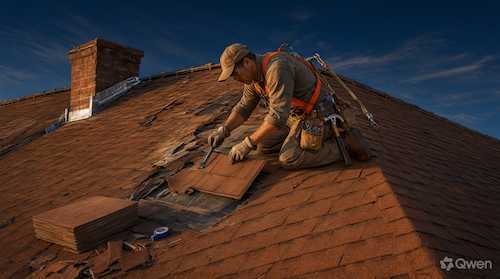
Phoenix is not a gentle climate for a roof. July at Sky Harbor averages 95.5°F, the sun is relentless, and the 7.2 inches of annual precipitation often arrives in short, violent storms. A roof can look intact through June and leak in August, because heat and UV degrade materials long before water finds the gap.
Tile, foam, and coating systems are not interchangeable
Concrete and clay tile roofs depend on the underlayment beneath the tile; the tile sheds sun and rain but does not waterproof the deck on its own. Foam roofs and reflective coatings are common on flat and low-slope homes, and they age differently. Ask what system is on the roof now, what is removed or recoated, and what warranty applies to each layer rather than only to the visible surface.
Heat, ventilation, and attic temperature
In a metro where summer heat is sustained, attic ventilation and insulation affect both roof life and cooling bills. Ask whether the proposal includes ventilation improvements and how the roof assembly is expected to perform under prolonged heat. Reflective coatings and proper ventilation are not cosmetic upgrades; they change how the roof behaves.
Monsoon rain finds the details
When rain arrives in a short burst, drainage and flashing matter more than the field of the roof. Ask how water leaves each roof plane, what happens at parapets and scuppers, and how penetrations are sealed. Ponding on a flat roof is a warning sign, not a temporary inconvenience.
How to compare two Phoenix roof proposals
Compare the assembly, removal or recoating scope, underlayment, flashing, drainage, ventilation, disposal, permit handling, and warranty terms. Ask how deck repair is handled if soft spots or delamination are found after removal, and whether that work is priced per sheet or as an allowance. On tile roofs, ask how many replacement tiles are included.
Questions to ask before approving work
Where this page ends
This page does not inspect a roof or publish local prices. Roof condition, permit requirements, and any homeowner-association rules must be confirmed at the property and with the responsible authority.
Phoenix metro context
The 2024 ACS 5-year estimates put the metro at about 5.0 million residents and 1.9 million households. About 66.6% of occupied homes are owner-occupied, and about 65.3% of housing units are single-family detached, so most roof decisions sit with the owner. Only about 27.3% of housing units were built before 1980 — a younger stock than older metros, which means many roofs have already been replaced at least once. NOAA's Sky Harbor station records July averaging 95.5°F and about 7.2 inches of precipitation a year.
Phoenix reference station and housing indicators
| Indicator | Value | Source |
|---|---|---|
| January mean temperature | 56.8°F | NOAA NCEI |
| July mean temperature | 95.5°F | NOAA NCEI |
| Annual mean temperature | 75.6°F | NOAA NCEI |
| Annual precipitation | 7.2 in. | NOAA NCEI |
| Metro population | 5,028,754 | U.S. Census Bureau |
| Housing units built before 1980 | 27.3% | U.S. Census Bureau |
| Single-family detached share | 65.3% | U.S. Census Bureau |
Station normals are historical averages for one location, not a forecast. Census values describe the metro area, not an individual property.
Frequently Asked Questions
How long does a roof last in Phoenix?
There is no metro-wide lifespan. Tile underlayment, foam and coating systems, ventilation, sun exposure, and past repairs all affect service life. Ask for the inspection findings and compare the condition of each layer rather than relying on an age rule of thumb.
Why does my roof leak during monsoon season?
Short, intense rain exposes flashing, underlayment, and drainage defects that stay hidden in dry weather. The source should be traced at the roof, not inferred from a ceiling stain alone.
What is the difference between tile roofing and foam roofing?
Tile is a pitched-roof covering that relies on underlayment for waterproofing; foam is a sprayed system used on many flat and low-slope roofs and is often protected with a coating. They have different maintenance, recoating, and repair requirements.
Can a foam roof be recoated instead of replaced?
Sometimes, depending on the foam's condition and moisture content. Ask what inspection or moisture test supports recoating, what warranty applies, and what happens if the foam has failed underneath.
Does attic ventilation matter in Phoenix?
Yes. Sustained heat and poor ventilation can shorten roof life and raise cooling demand. Ask whether the proposal includes ventilation or insulation improvements and how they are expected to affect the assembly.
What is the population of the Phoenix metro area?
The U.S. Census Bureau's 2024 ACS 5-year estimates report about 5.0 million residents in the metro area. The figure describes regional scale, not the number of homes or providers.
Sources and review date
- American Community Survey 2024 5-year estimates (CBSA tables) — U.S. Census Bureau, 2024 ACS 5-year estimates.
- 1991–2020 station normals — PHOENIX SKY HARBOR INTL AP, AZ US (USW00023183) — NOAA National Centers for Environmental Information, 1991–2020 climate normals.
Reviewed on 2026-11-17.