
Pittsburgh, PA · metro guide
Electrical in Pittsburgh: Brick Rowhouses, Hillside Houses, and Old Services
Nearly three quarters of the housing predates 1980, and a lot of it predates 1940.
Metro snapshot
Pittsburgh in numbers
Sources named below each block
- Population
- 2.4M
- Households
- 1.1M
- Housing units
- 1.2M
- People / household
- 2.30
- population ÷ households
Owner-occupied homes 71%
The rest are rented. Owners are the ones who commission most exterior work.
Single-family detached 68%
Detached houses carry their own roof, gutters and exterior walls.
Built before 1980 73%
Older housing stock shapes what fails first: gutters, flashing, pipe material.
Season
The year in Pittsburgh
- Precipitation
- 39.6 in
- Snowfall
- 44.1 in
Average temperature by month, °F — the shape of the year is what decides when exterior work gets done.
Precipitation by month, inches.
Snowfall by month, inches.
| Month | Average temperature (°F) | Precipitation (in) | Snowfall (in) |
|---|---|---|---|
| January | 28.8°F | 2.96 in | 13.3 in |
| February | 31.4°F | 2.62 in | 11.7 in |
| March | 39.7°F | 3.15 in | 7.6 in |
| April | 51.5°F | 3.32 in | 1.0 in |
| May | 61.2°F | 3.83 in | 0.0 in |
| June | 69.4°F | 4.12 in | 0.0 in |
| July | 73.2°F | 4.26 in | 0.0 in |
| August | 71.8°F | 3.52 in | 0.0 in |
| September | 64.9°F | 3.30 in | 0.0 in |
| October | 53.4°F | 2.83 in | 0.4 in |
| November | 42.6°F | 2.86 in | 2.4 in |
| December | 33.7°F | 2.84 in | 7.7 in |
NOAA 1991–2020 climate normals, station PITTSBURGH INTL AP, PA US (USW00094823). Station observations, not a metro-wide average — a metro that spans a mountain range can differ by more than this record shows.
Population, households and housing shares: U.S. Census Bureau, American Community Survey 2024 5-year estimates, metropolitan statistical area.
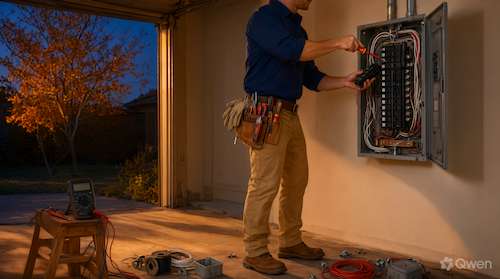
Pittsburgh has the oldest housing stock of any metro on this site: 73.1% of units were built before 1980, and the city's neighborhoods contain a great deal of brick rowhouse and frame construction from the first three decades of the twentieth century. Those houses were wired for lighting and a radio, upgraded for a refrigerator, and are now being asked to carry central air, a heat pump, an induction range and a car charger. The electrical question in Pittsburgh is therefore usually about how much of the original system is still in place and what it will take to bring it forward.
Knob-and-tube behind brick and plaster
Knob-and-tube wiring is still present in parts of the older neighborhoods, frequently spliced into newer circuits during renovations in the 1960s, 1980s or later. It has no equipment ground, which affects receptacles, anything with a metal case, and how an insurer reads the file. Two things are worth asking: which circuits are still on the old wiring, and what treatment is proposed — replacement, protection at the receptacle, or a documented decision to leave it. In a brick rowhouse the answer is complicated by the walls themselves, since new cable has to be routed through accessible cavities or surface conduit.
Shared walls and shared services
Only 68.0% of metro units are single-family detached, and the attached rowhouse stock brings its own issues: party walls, meters that may sit in a shared basement or an alley, and common-area circuits that were tapped off one household's service decades ago. Work in one unit can involve the neighbor's wall or the common entry. Ask which panel serves which unit, whether anything is in common space, and what consent or access is needed before work begins.
Houses built into a slope
Pittsburgh's hills produce houses with multiple levels and sometimes an integral garage or a basement that opens at grade on one side. That layout affects where the service enters, where the panel can live, and how much cable has to travel between floors. Ask where the service enters the building, where the panel is, whether any of it is in a space that floods, and how new circuits will reach the upper floors without opening finished walls unnecessarily.
Capacity and the winter load
January averages 28.8°F at the airport station, so heating is the dominant seasonal load, whether from a furnace, a boiler or electric resistance. Adding a heat pump with auxiliary heat to a house that already has a dryer and an electric range can push a 100-amp service to its practical limit. Ask for a load calculation that assumes the coldest week, and ask whether the panel has physical space for the breakers even if it is adequate on paper.
Permits, inspection and old work
Electrical work is licensed and inspected, and a house that has been renovated several times over a century may contain work from several eras, some of it undocumented. Ask who pulls the permit, what the inspection covers, and how the contract handles a finding outside the original scope. In this housing stock that is the normal condition rather than an edge case, and a contractor who plans for it prices more honestly than one who does not.
What to settle before approving work
Where this page stops
No specific property is assessed here and no prices are published. Electrical hazards, service capacity and code compliance require on-site evaluation by a licensed electrician, and permit requirements belong to the local authority.
Pittsburgh metro context
The 2024 ACS 5-year estimates count about 2.44 million residents in 1,061,705 households across 1,174,149 housing units. Owner occupancy is 70.7%, about 68.0% of units are single-family detached, and 73.1% were built before 1980 — the oldest stock on this site, which is why original wiring and service capacity dominate the local conversation. NOAA's station at Pittsburgh International records January at 28.8°F, July at 73.2°F, 39.6 inches of precipitation and 44.1 inches of snow.
Pittsburgh reference station and housing indicators
| Indicator | Value | Source |
|---|---|---|
| January mean temperature | 28.8°F | NOAA NCEI |
| July mean temperature | 73.2°F | NOAA NCEI |
| Annual snowfall | 44.1 in. | NOAA NCEI |
| Housing units built before 1980 | 73.1% | U.S. Census Bureau |
| Single-family detached share | 68.0% | U.S. Census Bureau |
| Owner-occupied share | 70.7% | U.S. Census Bureau |
Station normals are 30-year averages for one location, not a forecast. A load calculation uses a colder design condition than the January mean and must be done for the specific house.
Frequently Asked Questions
Does knob-and-tube wiring have to be replaced?
Not always and not immediately. What decides it is the condition of the wiring, whether circuits are appropriately protected, and how the insurer views it. Ask which circuits are involved and what options exist before agreeing to a whole-house rewiring.
How do you rewire a brick rowhouse?
Carefully, and usually by finding the routes that already exist: cavities, chases and basements. Some surface conduit is often unavoidable, and the plaster repair is a separate scope. Ask how the runs will be routed and who closes the walls afterwards.
Is a 100-amp service enough for a heat pump?
Often it can be, sometimes with load management, but only a calculation that includes auxiliary heat and the other large loads at the same time will answer it. Ask for the calculation rather than a rule of thumb.
What is different about electrical work in an attached house?
Shared walls, shared basements and meters in common space. Work may need a neighbor's consent or access, and tracing which panel serves which unit is part of the job rather than an afterthought.
Do I need a permit to replace a panel?
In most jurisdictions, yes, and a service change certainly requires one. Confirm with the local building department for the address, and ask the electrician whether permit handling and the inspection visit are included.
Why is my panel in a basement that sometimes floods?
Because that is where services historically entered the building. Equipment in a space with a water history is a genuine concern, so ask whether the panel can be relocated or protected, and address the water source rather than only the equipment.
Sources and review date
- American Community Survey 2024 5-year estimates (CBSA tables) — U.S. Census Bureau, 2024 ACS 5-year estimates.
- 1991–2020 station normals — PITTSBURGH INTL AP, PA US (USW00094823) — NOAA National Centers for Environmental Information, 1991–2020 climate normals.
Reviewed on 2026-11-18.