
Providence, RI-MA · metro guide
Gutter Cleaning in Providence: Triple-Deckers, Sea Salt and Ice
Old, dense and coastal, with rear porches that the downspouts drain onto.
Metro snapshot
Providence in numbers
Sources named below each block
- Population
- 1.7M
- Households
- 675K
- Housing units
- 731K
- People / household
- 2.49
- population ÷ households
Owner-occupied homes 63%
The rest are rented. Owners are the ones who commission most exterior work.
Single-family detached 55%
Detached houses carry their own roof, gutters and exterior walls.
Built before 1980 70%
Older housing stock shapes what fails first: gutters, flashing, pipe material.
Season
The year in Providence
- Precipitation
- 47.5 in
- Snowfall
- 36.6 in
Average temperature by month, °F — the shape of the year is what decides when exterior work gets done.
Precipitation by month, inches.
Snowfall by month, inches.
| Month | Average temperature (°F) | Precipitation (in) | Snowfall (in) |
|---|---|---|---|
| January | 30.2°F | 3.96 in | 10.3 in |
| February | 32.0°F | 3.44 in | 10.5 in |
| March | 38.9°F | 4.90 in | 6.4 in |
| April | 49.3°F | 4.29 in | 0.6 in |
| May | 59.1°F | 3.37 in | 0.0 in |
| June | 68.2°F | 3.81 in | 0.0 in |
| July | 74.4°F | 2.91 in | 0.0 in |
| August | 73.0°F | 3.59 in | 0.0 in |
| September | 65.6°F | 4.17 in | 0.0 in |
| October | 54.4°F | 4.18 in | 0.2 in |
| November | 44.5°F | 4.27 in | 1.0 in |
| December | 35.5°F | 4.65 in | 7.6 in |
NOAA 1991–2020 climate normals, station PROVIDENCE T F GREEN AP, RI US (USW00014765). Station observations, not a metro-wide average — a metro that spans a mountain range can differ by more than this record shows.
Population, households and housing shares: U.S. Census Bureau, American Community Survey 2024 5-year estimates, metropolitan statistical area.
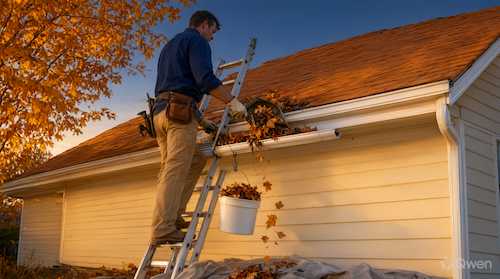
Providence has 70.0% of its housing built before 1980 and only 54.7% detached, so the stock is old and much of it is triple-deckers and two-family houses with rear porches. Those porches matter for drainage: the rear run often discharges onto a porch roof or directly onto the deck below, and the water then finds the porch structure. Bay air adds salt, and winters add ice.
Rear porches and where the run discharges
On a triple-decker the rear downspout frequently ends over a porch roof or the deck itself, so a blocked run wets the porch structure rather than the ground. Ask where the rear run discharges and whether the porch takes water it was not designed for.
Sea salt and road salt
Bay air deposits salt continuously and winter adds it from the roads, and both hold moisture against metal runs, hangers and fasteners. Ask whether the run's condition is assessed.
Ice at the eave and in the outlet
A blocked run freezes and the outlet plugs, and meltwater backs up under the roof edge. The clean that prevents it has to happen before the freeze. Ask when the autumn visit is scheduled.
Shared access and who authorizes
In a multi-family building the roofline may be reached through a unit, over a porch roof or from a shared stair, and the person booking the work may not control any of them. Ask how access is arranged.
Old runs and narrow profiles
With seven in ten units predating 1980, four-inch and half-round runs are common, and rear additions have usually added roof area. Ask what profile is fitted.
What to pin down in the estimate
Where this page stops
No prices are quoted and no property is assessed here. Porch structure, rot and ice-dam causes are findings that need inspection, and shared-building access belongs to the owners involved.
Providence metro context
The 2024 ACS 5-year estimates describe about 1.68 million residents in 675,395 households and 730,957 housing units, with 63.2% owner-occupied and 54.7% single-family detached. About 70.0% of units predate 1980. No climate station is reported for this metro in the site dataset, so no temperature or precipitation normals appear on this page.
Providence housing indicators
| Indicator | Value | Source |
|---|---|---|
| Housing units built before 1980 | 70.0% | U.S. Census Bureau |
| Single-family detached share | 54.7% | U.S. Census Bureau |
| Owner-occupied share | 63.2% | U.S. Census Bureau |
| Metro households | 675,395 | U.S. Census Bureau |
| Housing units | 730,957 | U.S. Census Bureau |
| Metro population | 1,684,071 | U.S. Census Bureau |
Station normals are historical averages for one location, not a forecast. What a gutter has to carry depends on roof area, pitch, the debris the surrounding trees drop and whether downspouts discharge where the water can leave.
Frequently Asked Questions
Why does my porch roof leak when the gutter is blocked?
The rear run often discharges over the porch, so a blockage sends the water onto the porch structure rather than to the ground.
Does salt air damage gutters?
It holds moisture against metal and fasteners, so coastal runs corrode faster than inland ones.
When should gutters be cleared here?
Late autumn, before the first sustained freeze, and again in spring.
Can you clean one unit in a triple-decker?
Yes, but access is external and may cross shared space. Confirm who authorizes it.
Is a four-inch run common?
Yes on the older stock, and it fills faster than a modern run.
Do I need to be home?
Exterior work can be done with agreed access. Nothing inside the house is involved.
Sources and review date
- American Community Survey 2024 5-year estimates (CBSA tables) — U.S. Census Bureau, 2024 ACS 5-year estimates.
Reviewed on 2026-11-18.