
Salt Lake City, UT · metro guide
Plumbing in Salt Lake City: Hard Water, Irrigation Blowouts, and Freeze Risk
Half the plumbing problems in this valley start with the sprinkler system or the water softener.
Metro snapshot
Salt Lake City in numbers
Sources named below each block
- Population
- 1.3M
- Households
- 450K
- Housing units
- 475K
- People / household
- 2.83
- population ÷ households
Owner-occupied homes 67%
The rest are rented. Owners are the ones who commission most exterior work.
Single-family detached 61%
Detached houses carry their own roof, gutters and exterior walls.
Built before 1980 42%
Older housing stock shapes what fails first: gutters, flashing, pipe material.
Season
The year in Salt Lake City
- Precipitation
- 15.5 in
- Snowfall
- 51.9 in
Average temperature by month, °F — the shape of the year is what decides when exterior work gets done.
Precipitation by month, inches.
Snowfall by month, inches.
| Month | Average temperature (°F) | Precipitation (in) | Snowfall (in) |
|---|---|---|---|
| January | 31.4°F | 1.43 in | 12.7 in |
| February | 36.6°F | 1.30 in | 10.7 in |
| March | 45.8°F | 1.75 in | 5.9 in |
| April | 51.8°F | 2.16 in | 2.9 in |
| May | 61.5°F | 1.82 in | 0.1 in |
| June | 71.6°F | 0.95 in | 0.0 in |
| July | 81.1°F | 0.49 in | 0.0 in |
| August | 79.1°F | 0.58 in | 0.0 in |
| September | 68.4°F | 1.06 in | 0.0 in |
| October | 54.6°F | 1.26 in | 0.5 in |
| November | 41.7°F | 1.32 in | 7.0 in |
| December | 32.2°F | 1.40 in | 12.1 in |
NOAA 1991–2020 climate normals, station SALT LAKE CITY INTL AP, UT US (USW00024127). Station observations, not a metro-wide average — a metro that spans a mountain range can differ by more than this record shows.
Population, households and housing shares: U.S. Census Bureau, American Community Survey 2024 5-year estimates, metropolitan statistical area.
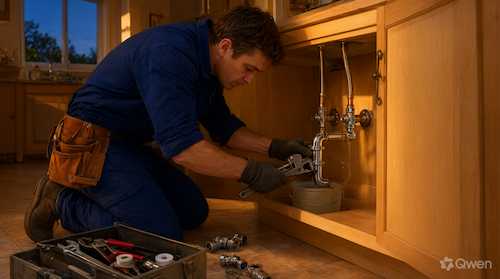
Two local habits shape plumbing along the Wasatch Front more than anything else. The first is irrigation: almost every detached house has an in-ground sprinkler system, which means an outdoor plumbing network with its own backflow assembly, valves and a seasonal procedure that has to be done correctly before the first hard freeze. The second is water hardness, which is high enough that a softener is normal equipment rather than a luxury. Between them, a large share of the calls a plumber gets here involve a broken line discovered at spring start-up or a water heater that has been quietly scaling up for a decade.
The sprinkler system is plumbing that lives underground
An irrigation system holds water in lateral lines, a manifold and a backflow device, and it fails at the points where water is left standing. A blowout that misses a zone, a valve that does not close fully, or a backflow assembly that was never drained will produce a split in the first hard freeze, and the break surfaces at start-up in spring when the water goes back on. Ask who performs the winterization, whether all zones are blown out including the drip circuits, and whether the backflow assembly is drained separately. Also ask about the start-up visit — turning the system on gradually and walking the zones is how a break gets found before it runs for a week.
Backflow testing is a scheduled obligation
An irrigation system connected to the potable supply requires a backflow prevention assembly, and many jurisdictions require it to be tested annually by a certified tester with results filed with the water authority. That is a compliance item rather than a repair one, and it is easy to overlook until a renewal notice arrives. Ask whether the assembly is on the property, when it was last tested, and whether the plumber performing other work is certified to test it. If the device has been removed or bypassed by a previous owner, that is worth correcting before anything else.
Scale is the cost of hard water
Hard water leaves mineral deposit on fixtures, in the water heater, in the dishwasher and on glassware, and the expensive version of that is a heater that has to push heat through an inch of scale. Where a softener is installed, ask whether it is sized for the household, whether the outdoor taps are bypassed so softened water is not used for irrigation, and who maintains it. Salt-based softeners also need the drain line and the brine tank checked, and a softener that has stopped regenerating is worse than none because it may pass hard water while looking functional.
Freeze risk in a climate that does not expect it
Winters in this valley are cold enough to matter, and the damage usually happens in the places that were never designed for it: an unheated crawl space with an unprotected supply line, a hose bib, a line in an exterior wall of a house built before insulation standards changed, and the irrigation system described above. A single hard night is enough. Ask what is protected with insulation or heat tape, where the main shutoff is, and whether the shutoff actually turns. In older houses, a gate valve that has not been operated in twenty years can fail at the moment it is needed.
Pressure and the components downstream
Municipal pressure and the elevation of the property both affect what arrives at the fixtures, and high pressure accelerates wear on valves, hose bibs and irrigation components. A pressure-reducing valve at the service is standard on newer construction and can fail or be missing on older homes. Ask whether the pressure has been measured and what it reads. It is a five-minute check that prevents a whole category of leaks, and it belongs in the same visit as any other work.
Questions for a plumbing estimate
Where this page stops
This page does not diagnose a system and publishes no prices. Gas work, sewer work and water heater installation require a licensed plumber and, depending on the address, a permit and inspection. Water quality questions belong to the local water authority.
Salt Lake City metro context
ACS 2024 5-year estimates report about 1.28 million residents in 450,170 households and 474,627 housing units, with 67.0% owner-occupied and 60.9% single-family detached — a high ownership rate and a large detached share, which is why so many households own both a softener and an irrigation system. About 42.3% of units predate 1980. A climate station is not reported for this metro in the site dataset, so no temperature figures are published here.
Salt Lake City housing and ownership indicators
| Indicator | Value | Source |
|---|---|---|
| Single-family detached share | 60.9% | U.S. Census Bureau |
| Owner-occupied share | 67.0% | U.S. Census Bureau |
| Housing units built before 1980 | 42.3% | U.S. Census Bureau |
| Metro households | 450,170 | U.S. Census Bureau |
| Housing units | 474,627 | U.S. Census Bureau |
| Metro population | 1,275,870 | U.S. Census Bureau |
No climate normals are shown because no station record is held for this metro in the site dataset. Freeze risk and water chemistry vary with location and with the source serving the address.
Frequently Asked Questions
Why do sprinkler lines break every spring?
Usually because water was left in a lateral, a valve or the backflow assembly through a hard freeze. A proper blowout covers every zone including drip circuits and drains the backflow device separately. Start-up in spring should be gradual, with each zone walked while it runs.
Do I need annual backflow testing?
Many jurisdictions require it for irrigation assemblies, with results filed by a certified tester. Requirements and intervals vary, so confirm with the local water authority for the address and keep the documentation.
Is a water softener necessary here?
It is a maintenance decision rather than a requirement, but hard water shortens the life of water heaters and appliances. If you have one, confirm it is regenerating and sized correctly, and keep the outdoor irrigation on unsoftened water.
How do I protect pipes from a hard freeze?
Insulate or heat-tape the vulnerable runs, close and drain hose bibs, disconnect hoses, and know where the main shutoff is. Crawl spaces and exterior walls in older houses are the usual weak points, and a single cold night is enough to split a line.
How often should a water heater be flushed?
Annually is the usual recommendation in hard-water areas, and it is the cheapest way to extend tank life. Tankless units need descaling instead, on a schedule that depends on the water and the manufacturer's instructions.
What does high water pressure do to a house?
It accelerates wear on valves, fixtures, hose bibs and irrigation components, and it makes every small leak worse. A pressure-reducing valve set correctly at the service protects everything downstream, and measuring the pressure is quick.
Sources and review date
- American Community Survey 2024 5-year estimates (CBSA tables) — U.S. Census Bureau, 2024 ACS 5-year estimates.
Reviewed on 2026-11-18.