
Salt Lake City, UT · metro guide
Roofing in Salt Lake City: Snow Load, Bench Winds, and Summer Hail
One roof has to survive lake-effect snow, canyon wind and a hail season — and it gets checked from the ground once a year.
Metro snapshot
Salt Lake City in numbers
Sources named below each block
- Population
- 1.3M
- Households
- 450K
- Housing units
- 475K
- People / household
- 2.83
- population ÷ households
Owner-occupied homes 67%
The rest are rented. Owners are the ones who commission most exterior work.
Single-family detached 61%
Detached houses carry their own roof, gutters and exterior walls.
Built before 1980 42%
Older housing stock shapes what fails first: gutters, flashing, pipe material.
Season
The year in Salt Lake City
- Precipitation
- 15.5 in
- Snowfall
- 51.9 in
Average temperature by month, °F — the shape of the year is what decides when exterior work gets done.
Precipitation by month, inches.
Snowfall by month, inches.
| Month | Average temperature (°F) | Precipitation (in) | Snowfall (in) |
|---|---|---|---|
| January | 31.4°F | 1.43 in | 12.7 in |
| February | 36.6°F | 1.30 in | 10.7 in |
| March | 45.8°F | 1.75 in | 5.9 in |
| April | 51.8°F | 2.16 in | 2.9 in |
| May | 61.5°F | 1.82 in | 0.1 in |
| June | 71.6°F | 0.95 in | 0.0 in |
| July | 81.1°F | 0.49 in | 0.0 in |
| August | 79.1°F | 0.58 in | 0.0 in |
| September | 68.4°F | 1.06 in | 0.0 in |
| October | 54.6°F | 1.26 in | 0.5 in |
| November | 41.7°F | 1.32 in | 7.0 in |
| December | 32.2°F | 1.40 in | 12.1 in |
NOAA 1991–2020 climate normals, station SALT LAKE CITY INTL AP, UT US (USW00024127). Station observations, not a metro-wide average — a metro that spans a mountain range can differ by more than this record shows.
Population, households and housing shares: U.S. Census Bureau, American Community Survey 2024 5-year estimates, metropolitan statistical area.
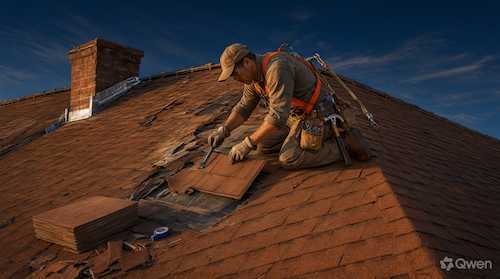
A roof along the Wasatch Front is asked to do three different jobs in the same year. In winter it carries snow that can arrive in heavy lake-effect bands and sits on the deck through repeated freeze-thaw cycles at the eave. In spring it takes wind coming down the canyons. In summer it absorbs intense ultraviolet at altitude and, in some years, hail. Because 42.3% of the housing here predates 1980, a good share of the roofs being replaced now sit on houses built when attic ventilation was an afterthought and the deck was whatever was on the truck.
Snow load is a design input, not a surprise
Roof structures here are engineered for a ground snow load that is considerably higher than in most of the country, and the requirement to keep that capacity intact is why a layover of a second layer is worth questioning. Additional shingle weight, hidden deck damage and blocked ventilation all reduce the margin the original design had. Ask how many layers are present, whether a full tear-off is proposed, what the deck condition is likely to be, and what is priced if it turns out to be soft. The eave is where snow sits longest, so that is where deck problems usually appear first.
Ice at the eave, and the membrane under it
Repeated melt and refreeze at the cold eave is normal here, and the defense is a waterproof membrane under the shingles that extends up from the edge. How far it runs, and whether it also covers valleys and penetrations, is the detail that separates a roof built for this climate from one built for a milder one. Ask for the distance in feet rather than a general assurance, and ask whether the membrane is installed under the manufacturer's specification or as a local habit.
Wind on the benches and in the canyons
Houses higher on the east bench and near canyon mouths see wind that lifts and creases shingles from the edges inward, and the failure starts at the rake and the ridge rather than in the middle of the field. That makes the fastening pattern and the edge detailing the important part of the specification. Ask what the wind rating of the shingle is, what the nailing pattern will be, whether starter strip and ridge cap are being replaced as part of the job, and whether the existing roof has already lost shingles in past events.
Hail leaves evidence on the soft metals
Summer storms bruise shingle mats and knock granules loose, and the marks are often easier to read on vents, gutter aprons and flashing than on the field of the roof. If an insurance claim is involved, ask how the damage is documented, per slope and per item, and whether the contractor will meet the adjuster on site. A roofer who will not put findings in writing for an adjuster is a roofer who will leave you to argue the scope alone.
Ventilation and the summer attic
An under-ventilated attic runs hot in summer, which shortens shingle life from below, and it traps moisture in winter, which can show up as frost on the underside of the deck. Intake at the soffit and exhaust at the ridge have to be balanced, and blown insulation must not cover the intake path. Ask what the ventilation calculation is, whether baffles will be installed, and whether a bath fan discharging into the attic will be corrected while the roof is open — the last one is common in older houses and easy to fix at that moment.
Questions to ask before signing
Where this page stops
This page does not inspect roofs and publishes no prices. Deck condition, structural capacity and storm damage require on-site assessment, and insurance questions belong to the carrier and the policy.
Salt Lake City metro context
ACS 2024 5-year estimates put the metro at about 1.28 million residents in 450,170 households and 474,627 housing units, with 67.0% owner-occupied and 60.9% single-family detached; 42.3% of units were built before 1980. That older share is where original ventilation and first-generation decking are most likely to be found. A climate station is not reported for this metro in the site dataset, so no snow or temperature normals are published on this page.
Salt Lake City housing and ownership indicators
| Indicator | Value | Source |
|---|---|---|
| Housing units built before 1980 | 42.3% | U.S. Census Bureau |
| Single-family detached share | 60.9% | U.S. Census Bureau |
| Owner-occupied share | 67.0% | U.S. Census Bureau |
| Housing units | 474,627 | U.S. Census Bureau |
| Metro households | 450,170 | U.S. Census Bureau |
| Metro population | 1,275,870 | U.S. Census Bureau |
No NOAA climate normals are shown for this metro because no station record is held in the site dataset. Snow accumulation and wind exposure vary substantially between the valley floor, the benches and the canyon mouths.
Frequently Asked Questions
Is a second layer of shingles acceptable here?
It may be permitted depending on how many layers exist, but it hides the deck and adds weight to a structure designed around a specific snow load. Ask for the layer count in writing and for what a tear-off would cost by comparison, rather than accepting a layover as the default.
How do I stop ice forming at the roof edge?
Keep the deck cold: seal air leaks at the ceiling plane, insulate properly, and make sure the soffit intake and ridge exhaust work. The membrane under the shingles is the backstop for the water that does get in. Heat cable and raking treat symptoms.
My shingles lifted at the ridge. Why?
Wind exposure, usually at the rake and ridge first, which is where edge detailing and fastening matter most. Houses on the benches and near canyon mouths see more of this. If shingles have already been lost, the fastening pattern and edge components deserve scrutiny before the next installation.
Does attic ventilation really affect shingle life?
Yes. A hot, poorly vented attic shortens the life of the covering from underneath, and in winter it holds moisture that can damage the deck. Balancing intake and exhaust is part of a roof job, not an optional extra.
How is hail damage assessed?
By inspecting slopes and the soft metals — vents, flashing, gutter aprons — and documenting findings item by item. Insurers generally expect an inspection rather than a phone estimate, and the documentation is what determines the approved scope.
Should the bath fan vent through the roof?
What matters is that it terminates outside on a short, insulated run. A fan discharging into the attic adds moisture to the deck and undermines every other moisture measure, and the roof replacement is the easiest moment to correct it.
Sources and review date
- American Community Survey 2024 5-year estimates (CBSA tables) — U.S. Census Bureau, 2024 ACS 5-year estimates.
Reviewed on 2026-11-18.